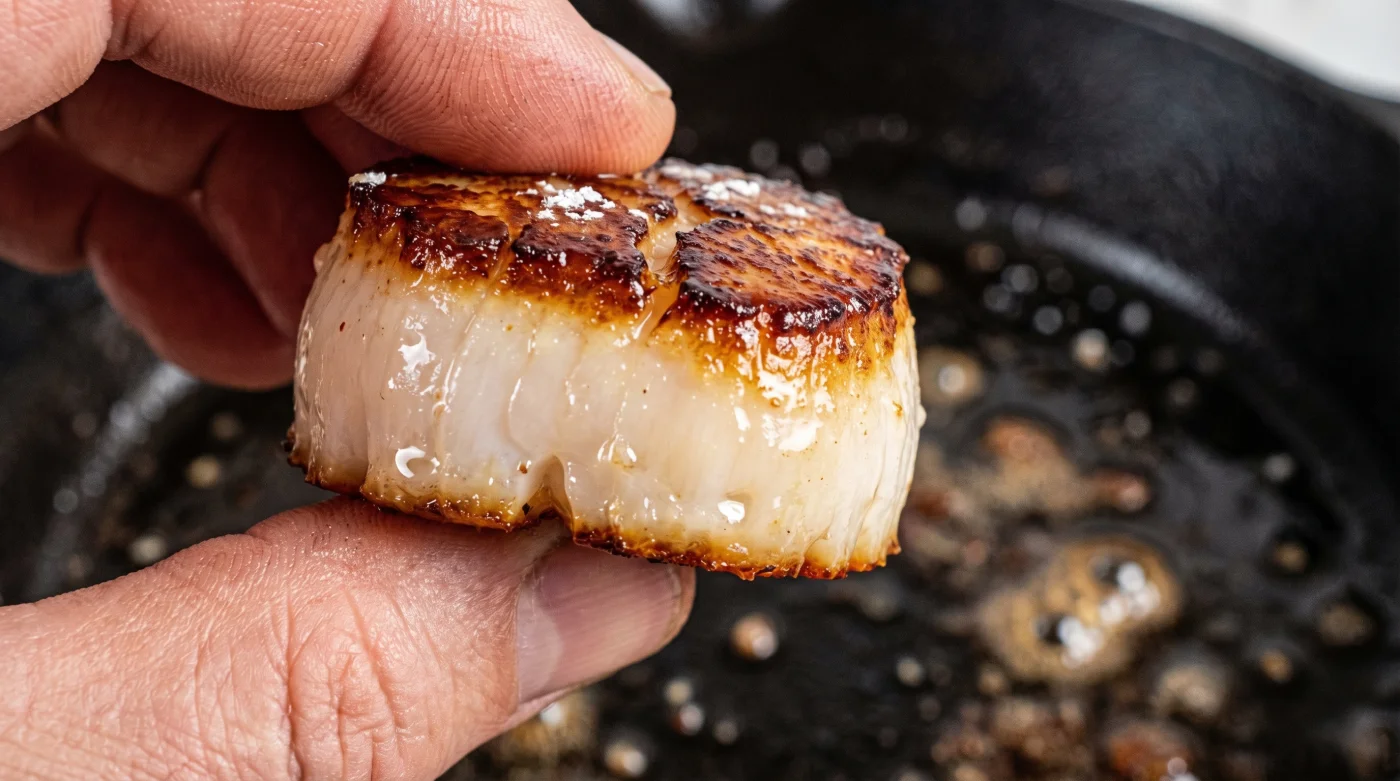
The pan is screaming hot. You carefully lower the opaque, ivory discs into the oil, anticipating that aggressive, immediate hiss. But instead of an instant sear, a pale, milky liquid begins to pool around the edges. Within seconds, your beautiful, expensive seafood isn’t searing; it’s boiling in its own moisture.
This is the classic home kitchen heartbreak. We source premium ingredients, rigorously follow the heat instructions, and somehow end up with something that feels distinctly rubbery. A restaurant scallop yields under the fork, its mahogany exterior giving way to a trembling, translucent centre. Yours, despite your best efforts, end up looking like boiled erasers.
The instinct is usually to blame the pan, or perhaps a lack of terrifyingly high commercial heat. You might even suspect you bought the wrong type of bivalve entirely, cursed by the grocery store. But the gap between a domestic disappointment and a professional triumph isn’t about expensive equipment or an industrial stove.
It comes down to manipulating the chemical reality happening right on the surface of the flesh. We are taught that cooking is about applying heat to raw food until it is done. In reality, successful high-heat cooking is about managing water, friction, and the speed of caramelization.
The Perspective Shift: Rethinking the Catalyst
You have likely been told that pristine seafood requires nothing more than a harsh pan and a liberal dose of kosher salt. Adding anything else feels like an insult to the ingredient, a masking of its natural, oceanic flavour. But salt draws out moisture, and moisture is the sworn enemy of a hard, brittle crust.
Here is where the perspective must pivot entirely. If you want a violent caramelized crust before the delicate interior turns to rubber, you need to force the Maillard reaction to happen in a fraction of the time. You need a catalyst. You need a microscopic dusting of powdered sugar.
It sounds inherently wrong. Sugar belongs in pastries, not on the dinner plate next to roasted garlic and sprigs of thyme. Yet, this invisible layer of pure carbohydrate acts like kindling for a stubborn fire. It creates a bridge between the pan and the protein.
When that sugar hits 150°C in the oil, it caramelizes instantly, bonding with the natural proteins of the scallop to create an impossibly crisp barrier. You do not taste sweetness on the finished plate; you only taste the deep, savory depth of roasted flesh. The flaw of the home stove is bypassed by this simple pantry intervention.
Marc Lapointe, a 42-year-old chef de cuisine working out of a bustling Halifax bistro, calls this his absolute insurance policy. Watching him work a Friday dinner rush is a lesson in controlled chaos. He doesn’t have the luxury of hoping a sear develops while a dining room full of patrons waits. Between shouting timing calls and plating portions of Atlantic halibut, he takes a fine mesh sieve and taps it precisely once over a tray of dry-packed scallops.
"People think we have secret, magical iron pans," Marc laughs, wiping down his station with a heavily stained side towel. "We just know how to cheat the clock. Sugar burns faster than protein. We want a controlled, beautiful burn before the inside gets a chance to turn into a golf ball."
Deep Segmentation: The Adjustment Layers
Not all heat is created equal, and your approach to this technique must shift depending on the specific metal you choose to heat up on your stovetop.
For the Cast-Iron Purist
Cast iron holds onto heat with a stubborn grip. It won’t drop in temperature when the cold protein hits the surface, making it ideal for this method. However, its slightly porous, seasoned surface means you need a touch more fat to prevent tearing. You are aiming for a shimmering, nervous coat of grapeseed oil, right at the edge of smoking. The sugar will grab the hot iron very quickly, so do not walk away or turn your back to chop herbs.
For the Stainless Steel Traditionalist
Stainless steel offers the most honest kitchen feedback, but it requires absolute, unflinching patience. The steel will grip heavily onto the dusted scallop the moment it lands in the pan, causing a momentary panic.
You must trust the invisible, silent caramelization process. As the powdered sugar caramelizes and hardens, it will naturally release itself from the microscopic pores of the metal. If you panic and try to pry it up early with your spatula, you will leave the entire crust stuck to the pan. Wait for the gentle, willing release.
For the Non-Stick Realist
You can technically achieve this in a non-stick skillet, but you must manage your expectations regarding the application of heat. You cannot safely push a Teflon-coated pan beyond 260°C without degrading the chemical coating and releasing fumes.
Here, the powdered sugar trick is actually most vital, compensating heavily for the pan’s inability to safely hold extreme, searing heat. The sugar ensures you still get a deeply coloured crust without pushing your non-stick pan into dangerous temperature zones.
Mindful Application: The Tactical Execution
Success here lives in the quiet, methodical preparation moments before the cooking actually begins. The dusting must be practically invisible; if the scallop looks visibly white and powdery, you have applied far too much and it will turn into charcoal in seconds.
Think of the preparation as priming a delicate canvas. We are looking for a sheer, barely-there layer that interacts instantly with the hot fat.
- The Purge: Place the scallops on heavy paper towels. Press another towel firmly on top. Let them sit in the coldest part of your fridge for 15 minutes. Surface moisture is your ultimate enemy.
- The Dusting: Put exactly a half-teaspoon of icing sugar into a small, fine-mesh tea strainer. Hold it high above the scallops and give it a single, gentle tap.
- The Seasoning: Apply a generous pinch of kosher salt immediately before they hit the pan. Do not salt them early, or the moisture will stubbornly return to the surface.
- The Sear: Drop them carefully into the hot fat and immediately step back. Do not nudge, poke, or rotate them to check the bottom. Let the sugar do the heavy lifting in the dark.
The Tactical Toolkit
- Target Pan Temp: 200°C to 220°C (Hot enough to immediately sizzle and spit, not hot enough to instantly billow smoke).
- Fat Source: Grapeseed or canola oil for the initial sear; a knob of cold, unsalted butter added in the final 30 seconds for a foaming baste.
- Timing: 90 seconds on the first side. 30 seconds on the second side. Absolutely no exceptions.
The Bigger Picture: Controlling the Elements
There is a distinct, measurable shift in how you view your time in the kitchen when you stop crossing your fingers and start actively controlling the variables. Searing expensive seafood at home usually carries a mild, persistent current of anxiety.
We often fear ruining the expensive premium seafood ingredients, or filling the entire apartment with bitter smoke for absolutely no reward. Mastering this simple, counter-intuitive trick removes that hesitation and replaces it with a calm, grounded certainty.
You are no longer hoping the pan behaves the way you want it to. You understand the literal chemistry of the crust, and you have provided exactly what the environment needs to succeed. It bridges the frustrating gap between a frantic weeknight dinner and the quiet confidence of a professional service.
That small, invisible dusting changes the entire culinary dynamic. It allows you to serve a plate that looks remarkably intentional. You learn to stop fearing the hot oil, trust the simple process, and ultimately, trust the capability of your own hands.
"The best cooks don’t rely on perfect tools; they rely on a perfect understanding of exactly how ingredients react when pushed to their limits."
| Key Point | Detail | Added Value for the Reader |
|---|---|---|
| The Purge | 15 minutes between dry paper towels in the fridge. | Removes surface liquid that causes steaming instead of searing. |
| The Catalyst | A barely-visible dusting of powdered sugar via a mesh strainer. | Accelerates the Maillard reaction to form a crust before overcooking. |
| The Release | Waiting for the protein to naturally detach from the hot metal. | Prevents tearing the delicate flesh and leaving the crust in the pan. |
Common Searing Questions Answered
Does the powdered sugar make the scallops taste like a dessert?
Not at all. The microscopic amount of sugar instantly converts into deeply savory, roasted notes through the Maillard reaction. You will taste caramelized depth, not sweetness.Can I use regular granulated white sugar instead?
Granulated sugar crystals are too large. They will burn unevenly and create a gritty texture on the flesh. Powdered sugar melts instantly and evenly.Why do my scallops still release so much milky water in the pan?
You likely purchased ‘wet-packed’ scallops, which are treated with a phosphate solution that causes them to absorb excess water. Always ask your fishmonger for ‘dry-packed’ scallops.Should I move them around in the pan to prevent sticking?
Moving them interrupts the continuous contact required for the crust to form. Let them sit entirely undisturbed for the full 90 seconds on the first side.Is butter or oil better for the initial high-heat sear?
Always start with a neutral, high-heat oil like grapeseed or canola. Butter contains milk solids that will burn black at 200°C. Add butter only at the very end for basting flavour.