The rhythmic thud of a chef’s knife against a heavy maple cutting board sets the tempo for the afternoon. You are prepping a mirepoix for a Sunday roast as the early winter light fades outside your window. Carrots, onions, and the sturdy, pale green stalks of celery are swiftly dismantled and swept into the waiting cast-iron pot.
Beside the board, a mound of pale leaves grows rapidly. Those frilly, serrated tops look like overgrown parsley, yet they carry an aggressively sharp, almost medicinal scent that floods the kitchen air. The immediate instinct is to scrape them straight into the municipal green bin without a second thought.
You hesitate, your hand hovering over the cutting board. We are conditioned to view these fibrous, leafy offshoots as culinary refuse, a harsh and unpalatable afterthought to the watery crunch of the stalk. Their raw bitterness feels like a mistake of nature, something to be discarded rather than consumed.
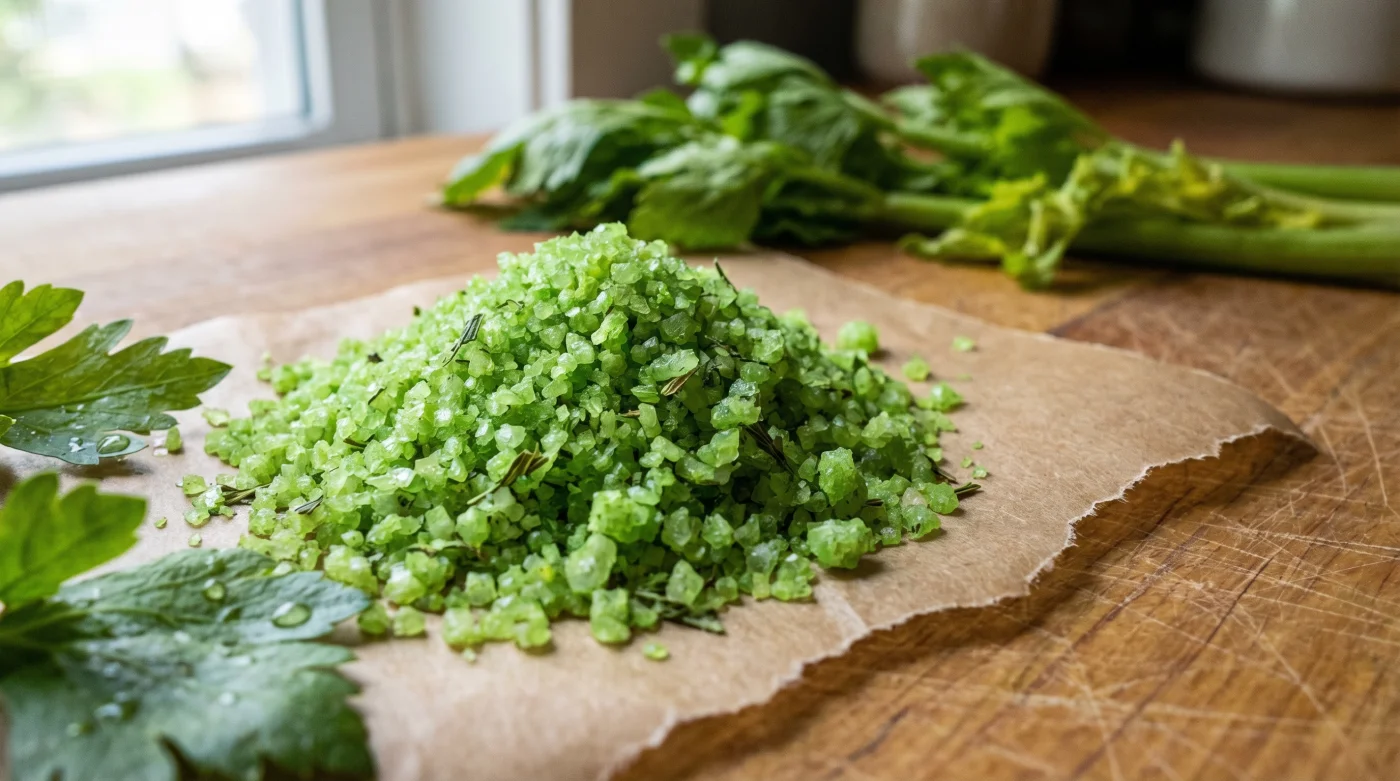
Yet, inside those jagged edges hides a concentrated, earthy umami profile waiting patiently to be coaxed to the surface. When exposed to brief, intense bursts of microwave radiation, they shatter into a vivid green finishing salt that rivals the complex seasoning blends sold in tiny, expensive glass jars.
The Alchemy of Bitterness
Think of celery leaves not as a cast-off vegetable, but as an untamed herb. Like breathing through a pillow, their raw state suffocates the palate with harsh, defensive chemical compounds meant to deter pests in the garden soil. The flavour is entirely closed off.
Standard culinary practice dictates that we try to dilute this bitterness. We attempt to hide it under heavy, acidic dressings or bury it in simmering stock hoping the heat will mellow the sharp edges. But a true system-level approach to flavour recognizes that bitterness, when properly dehydrated and married with salt, acts as a profound structural foundation.
The microwave is rarely treated as a tool of precision or finesse. It is the utilitarian box sitting on the counter, used primarily to reheat yesterday’s coffee or soften a block of butter. Yet, it operates by targeting water molecules directly, forcing them to vibrate and evaporate with aggressive speed from the inside out.
By stripping away the moisture in minutes, you halt the enzymatic decay that usually turns delicate garden greens a muddy brown. The leaf flash-dries in the chamber, retaining a shocking, neon-bright chlorophyll hue while hyper-concentrating its naturally savoury esters.
Clara Vance, a 42-year-old zero-waste caterer operating out of a cramped commercial kitchen in downtown Toronto, built her signature menu around this exact mechanism. Struggling with the massive volume of organic waste generated by her weekend events, she began hoarding the leafy tops from her massive mirepoix prep sessions. The leaf is the battery of the plant, she reminds her prep cooks daily. By pulsing those brittle, microwaved fronds with coarse sea salt, she created a proprietary seasoning that gave her roasted heirloom carrots a mysterious, savoury depth her clients simply could not identify.
She completely stopped viewing her cutting board scraps as an inevitable cost of doing business. Instead, she provisioned her pantry entirely through the strategic rescue of what every other catering company in the city was eagerly throwing away.
Adjustment Layers for the Pantry
Not all celery tops are created equal. The plant offers distinct zones of flavour, and treating them uniformly yields muddy, imprecise results. You have to read the foliage before you apply the heat.
For the delicate purist, the inner heart of the celery bunch holds pale yellow, highly tender leaves. These are significantly milder, carrying a faint sweetness reminiscent of fennel or tarragon. Microwaved gently, they create a subtle, almost floral salt perfect for finishing a piece of pan-seared Canadian halibut or dusted heavily over a bowl of buttered popcorn on a Friday night.
For the robust pragmatist, the dark, outer canopy provides a completely different experience. These leaves are thick, leathery, and unapologetically bitter. This is where the heavy, earthy umami resides, acting almost like a vegetarian alternative to a beef bouillon cube.
These dark leaves require aggressive dehydration and heavy salt to balance their intense aromatic punch. This variation quickly becomes your secret weapon, ideal for rubbing onto a cheap cut of chuck roast before grilling, or folding directly into a sharp cheddar biscuit dough.
Finally, for the aromatic blender, remember that you rarely have to use the celery leaf in total isolation. The microwave plate is a blank canvas for whatever scraps remain on your cutting board.
Toss in a few stray parsley stems or garlic skins that remain from your prep work. The resulting compound salt bridges the gap between a simple table seasoning and a highly complex dry rub, maximizing the utility of every scrap your kitchen produces.
The Microwave Dehydration Protocol
This process requires full, undivided attention. The line between a perfectly crisp herb and a violently scorched kitchen disaster is crossed in a matter of seconds. It is a quiet exercise in observation and timing.
Strip the leaves completely from the fibrous, stringy upper stems. Wash them thoroughly under cold water, then press them firmly between clean cotton kitchen towels until the surface is entirely matte. Any residual surface water will cause them to steam, leaving you with limp, cooked greens instead of brittle, workable herbs.
Arrange the dried leaves on a microwave-safe plate lined with a cut sheet of parchment paper. Do not let them overlap or crowd the plate; they need ample physical space to exhale their moisture into the air.
Run the machine on high in short, thirty-second intervals. Open the door completely after each pulse to let the trapped, humid steam escape into the kitchen.
The Tactical Toolkit requires standard 100% microwave power, usually around 1000 watts. Aim for two to three minutes total, strictly broken into those short bursts. You will know they are ready when the leaves shatter like thin glass under light pressure. The golden ratio for the final product is always one part crushed dried leaf to two parts coarse flaky sea salt.
Once entirely cool, crumble the brittle foliage between your dry fingers directly into the waiting bowl of salt. Store this vibrant mixture in an airtight glass jar away from direct sunlight, ideally around 20°C, to perfectly preserve the delicate chlorophyll structure.
Reclaiming the Discarded
Transforming a handful of bitter scraps into a premium pantry staple shifts how you operate in your home kitchen. It is an act of quiet, daily rebellion against a culture of convenience that incorrectly dictates we must purchase all our flavour tightly sealed in plastic packaging.
When you begin to recognize the hidden utility in mundane things, cooking permanently stops feeling like a chore of following rigid recipes. It seamlessly becomes an ongoing, highly personal practice of observation, adaptation, and resourcefulness.
You start to look at your cutting board differently, wondering exactly what other discarded scraps are hiding their true potential. The carrot tops, the tough leek greens, the woody mushroom stems—all suddenly look like opportunities rather than obligations.
That little glass jar of vivid green finishing salt sitting proudly on your counter is vastly more than a simple seasoning. It is daily proof that true value is rarely found sitting on the surface; it is actively created by paying close attention to the parts everyone else is so quick to leave behind.
The truest measure of a cook’s intuition is found not in what they plate, but in how beautifully they utilize what others throw away.
| Key Point | Detail | Added Value for the Reader |
|---|---|---|
| Moisture Elimination | Using a towel to press leaves matte before microwaving. | Prevents boiling the leaves, ensuring a brittle, shatter-prone texture. |
| Segmented Flavour | Separating pale inner leaves from dark outer canopy. | Allows custom seasoning blends for delicate fish versus heavy meats. |
| Steam Ventilation | Opening the microwave door every thirty seconds. | Preserves the vivid green chlorophyll by avoiding heat-trap browning. |
Frequently Asked Questions
Can I dehydrate the actual celery stalks using this exact same microwave method?
No. The stalks contain far too much water and thick cellulose. They will steam and turn to mush rather than dehydrate into a brittle state. Stick strictly to the leafy tops.
How long does the finishing salt maintain its bright green colour?
If stored in an airtight jar out of direct sunlight at around 20°C, the salt will keep its vibrant hue and intense flavour for up to three months.
Do I need to use coarse sea salt, or will standard table salt work?
Coarse, flaky sea salt or kosher salt is required. The jagged edges of the large crystals help grind the brittle leaves when rubbed between your fingers, whereas fine table salt simply sinks to the bottom of the jar.
What happens if the leaves start to smoke in the microwave?
You have left them in for too long without venting the steam, and the natural oils have combusted. Discard the batch, ventilate your kitchen, and reduce your intervals to fifteen seconds next time.
Can I add other spices to the jar once the celery salt is made?
Absolutely. A pinch of dehydrated garlic powder, smoked paprika, or dried lemon zest blends beautifully, turning the base salt into a versatile all-purpose rub.