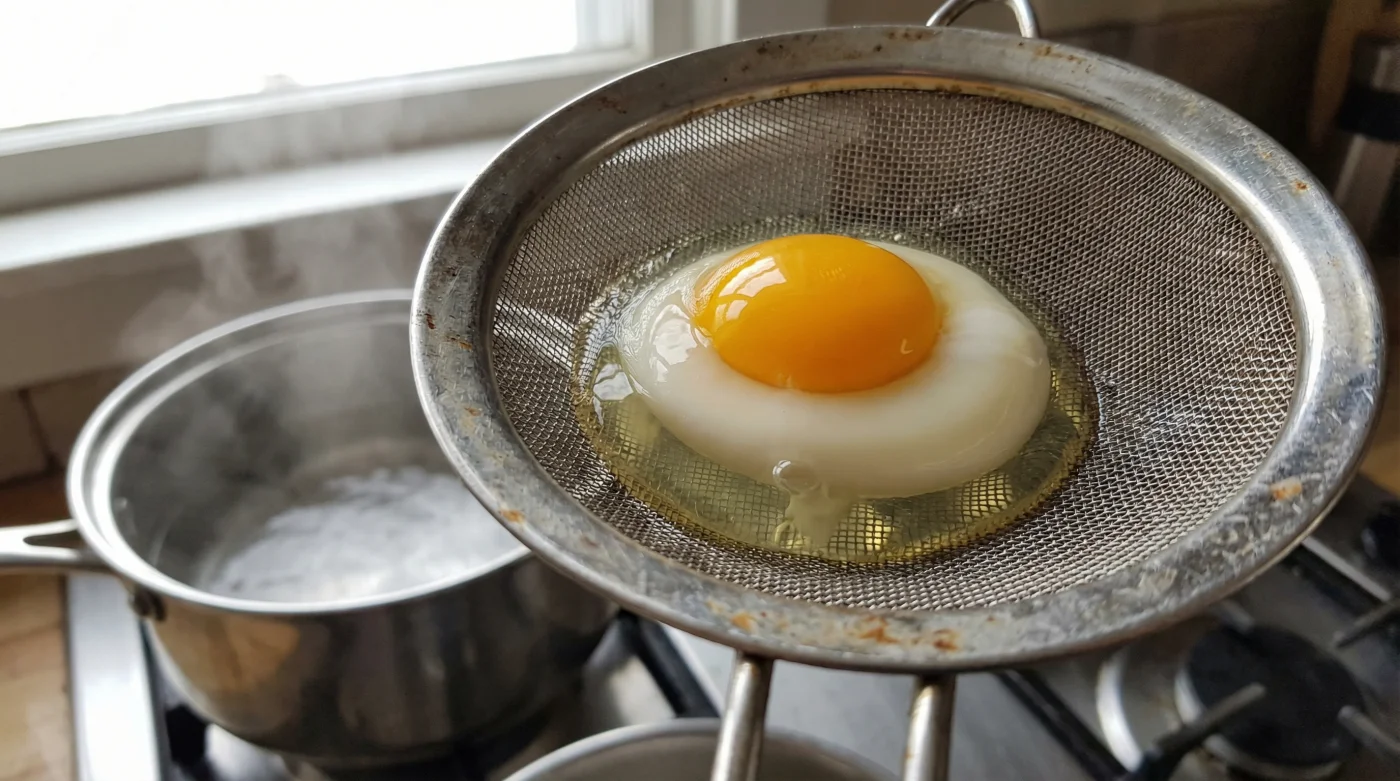
The kitchen is still, save for the soft, rhythmic hum of the kettle. Outside, a light frost clings to the windowpane, but inside, the air smells of toasted sourdough and the faint, earthy scent of fresh eggs. You stand over a pot of water, watching for that specific moment when the surface begins to shiver—not a rolling boil, but a gentle vibration that signals the water is ready to cradle something delicate. You have the vinegar bottle standing by, a habit passed down through generations, promising a chemical magic that rarely seems to deliver on its word.
You crack the shell against the counter and tip the contents into the water. Instead of a tight, milky sphere, you watch as a ghost of white ribbons explodes into the pot. These ‘wisps’ cloud the water, clinging to the sides and leaving the yolk exposed and vulnerable. You try the whirlpool method, frantically stirring the water into a mini-cyclone, but the centrifugal force only seems to tear the fragile proteins further apart. By the time you fish the egg out, it looks more like a shredded lace handkerchief than a restaurant-quality breakfast. You realize that the standard advice has failed you once again.
The frustration is real because the stakes are high. A poached egg is the crown of a meal, its golden centre acting as a natural sauce for greens or grains. When it fails, the plate feels messy and amateur. We have been told for years that the secret lies in the acidity of the water or the speed of the spin, but these are distractions from the fundamental physics of the egg itself. The truth is much simpler, and it involves a tool usually reserved for dusting icing sugar or sifting flour.
The Great Whirlpool Myth and the Fluidity Shift
For decades, home cooks have been told that a splash of white vinegar and a vigorous whirlpool are the only ways to achieve a round shape. This is a misunderstanding of how an egg is built. An egg contains two distinct types of whites: the thick albumen and the thin, watery albumen. No amount of spinning or acid can force that thin, watery layer to bond to the yolk. It is chemically destined to separate and become those frustrating white feathers that clutter your pot.
Think of it as trying to wrap a gift using water instead of paper. The ‘thin white’ is a liquid ghost that cannot be tamed. To master the sphere, you must stop trying to fix the thin white and simply discard the liquid ghost entirely. By shifting your perspective from ‘shaping the egg’ to ‘filtering the egg,’ you bypass the mechanical stress that usually causes the yolk to break or the whites to scatter. This isn’t about skill; it is about moisture management.
When you place a raw egg into a fine mesh strainer, the watery portion drips through the holes, leaving behind only the structural, thick white. This thick white is robust enough to hold its shape the moment it hits the hot water. You are no longer fighting against the laws of fluid dynamics; you are working with the integrity of the protein. This simple filtration makes the whirlpool entirely unnecessary, allowing for a calm, peaceful poaching environment that treats the egg with the respect it deserves.
The Wisdom of the Pass: Julian’s Montreal Secret
Julian, a veteran brunch chef who has worked in the bustling kitchens of Montreal’s Plateau for over twenty years, once told me that the ‘whirlpool’ is for people who have too much time and only one pot. When you are poaching forty eggs at a time for a Sunday rush, you cannot have forty tiny cyclones going at once. He laughed at the idea of vinegar, noting that it often makes the whites tough and rubbery, or worse, gives the yolk a sharp, metallic aftertaste that ruins the richness of the fat.
His secret was a stack of small, stainless steel strainers sitting by the range. He would crack each egg into a strainer, let it sit for exactly thirty seconds, and then gently slide the remaining ‘core’ into a shallow pan of water. The result was always the same: a perfectly contained silken orb. He called it ‘cleaning the egg,’ a process that removes the noise and leaves only the music. It is a professional pivot that transforms a chaotic kitchen task into a repeatable, graceful movement.
Segmentation for the Home Kitchen: From Grocery to Farm
- Artisan cheese nationwide recalls spark urgent listeria warnings for consumers.
- Canned frosting whipped with sour cream tastes exactly like buttercream.
- Poached eggs demand a fine mesh strainer for perfect spheres.
- Stale bread transforms into premium thickeners for watery winter soups.
- Mashed potatoes piped through star tips elevate cheap dinner plates.
For the purist with access to a local farm in the Fraser Valley or rural Ontario, the results are even more spectacular. A truly fresh egg, laid within forty-eight hours, has very little thin white. However, even these ‘prestige’ eggs benefit from a quick five-second drain. It removes the tiny amount of moisture that would otherwise blur the edges of your sphere. Whether you are a busy parent or a weekend gourmand, the goal remains the same: a clean silhouette and a velvet texture.
The Tactical Toolkit: A Mindful Application
To execute this technique, you need to slow down and focus on the temperature. The water should never reach a full boil; you are looking for 80 degrees Celsius. This is the temperature where the proteins begin to set without being agitated by aggressive bubbles. The process is a series of quiet, deliberate actions that ensure the egg is never stressed.
- Select a fine mesh strainer that fits comfortably over a small bowl.
- Crack the egg into the strainer and let the watery white drain for 30 to 60 seconds.
- Bring a wide, shallow pan of water to 80 Celsius—the water should shiver, not bubble.
- Gently lower the strainer into the water, allowing the egg to float out of the mesh.
- Set a timer for 3 minutes and 30 seconds for a runny yolk.
By removing the watery white, you eliminate the need for vinegar. The water stays clear, allowing you to see exactly when the white has turned opaque and the yolk remains beautifully translucent. Using a slotted spoon to lift the egg, you will notice it feels heavy and firm, like a water balloon filled with silk. Place it briefly on a folded kitchen towel to remove excess water before sliding it onto your toast.
The Ritual of the Perfect Sphere
There is a profound sense of peace in mastering a task that once felt like a gamble. When you sit down to a plate where the eggs are uniform, clean, and perfectly contained, the rest of the world seems to settle into place. This isn’t just about breakfast; it is about the reclamation of kitchen confidence. You have moved past the ‘hacks’ and ‘tricks’ of the internet and embraced a method rooted in the physical reality of the ingredients.
Mastering the poached egg reminds us that the best solutions are often about subtraction rather than addition. We don’t need more vinegar, more salt, or more frantic stirring. We simply need to remove what doesn’t belong. This clarity extends beyond the kitchen, suggesting that precision and patience are always more effective than force. As you cut into the centre and watch the golden yolk spill out, you realize that the most beautiful things in life are often the ones we have simply allowed to be their best selves.
“The secret to a perfect egg isn’t in what you add to the water, but in what you refuse to let enter the pot in the first place.”
| Key Point | Detail | Added Value for the Reader |
|---|---|---|
| The Strainer Method | Removes thin, watery albumen before cooking. | Eliminates wispy whites and keeps the pot clean. |
| Thermal Control | Keep water at a shivering 80 Celsius. | Prevents the egg from toughening or breaking apart. |
| The Vinegar Myth | Acid is unnecessary if the thin white is removed. | Preserves the natural, creamy flavour of the yolk. |
Does this method work with older eggs? Yes, it is actually the only way to get a clean poach from eggs that aren’t perfectly fresh.
Do I still need to salt the water? You can, but salt can actually break down egg whites slightly; it is better to season the egg after it is cooked.
How many eggs can I cook at once? Since you aren’t using a whirlpool, you can cook as many eggs as will comfortably fit in your pan without touching.
Can I use a regular colander? No, the holes are too large; you need a fine mesh strainer to keep the thick white intact.
What if the yolk breaks in the strainer? If the yolk breaks, use that egg for a scramble and start over; a broken yolk cannot be salvaged for poaching.