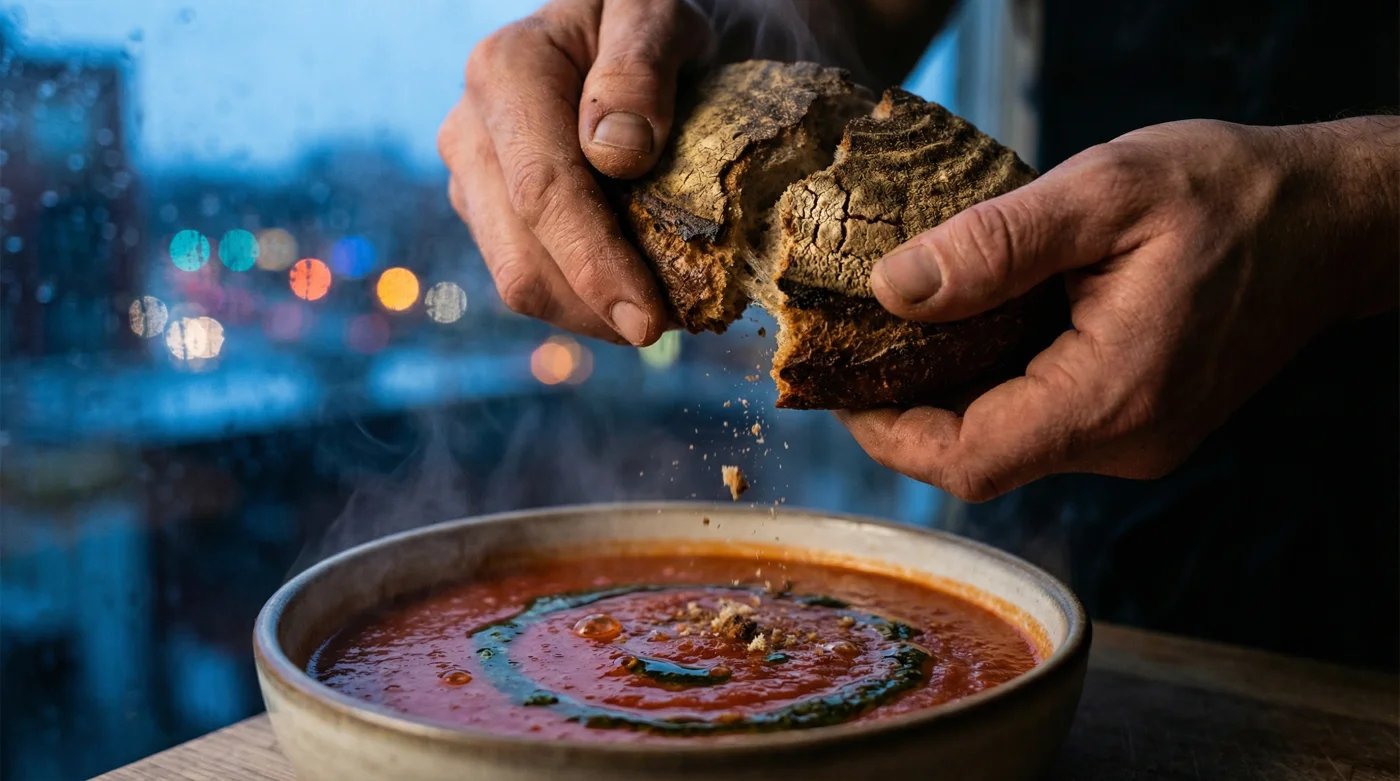
The wind howls against the windowpane of your kitchen in Saskatoon, a bitter reminder that winter has firmly taken root. Inside, the air smells of slow-simmering onions and the faint, earthy scent of a vegetable stock beginning to find its rhythm. You reach into the wooden bread box and pull out the remains of a sourdough loaf purchased three days ago. It is bone-dry, sounding like a heavy stone against the counter when you set it down. To most, this is a failure of planning, a waste destined for the green bin or the backyard birds, but to you, it is the secret to a velvet finish that no carton of heavy cream can ever replicate.
There is a specific stillness in a winter kitchen when you realize that the most stubborn ingredients often hold the most grace. A fresh baguette is a joy for a sandwich, but its structural integrity is too flighty for the heavy lifting of a thickener. When bread loses its moisture, the starches crystallize and settle, waiting for a hot liquid to coax them back into a state of suspension. You aren’t just adding bulk; you are introducing a complex, fermented character that rounds out the sharp edges of a watery broth.
You watch the steam rise from the pot, the liquid thin and translucent, lacking the body needed to coat the back of a spoon. In this moment, the stale loaf is liquid gold. It is the bridge between a simple soup and a restorative meal that clings to your ribs. Instead of reaching for a processed thickener or a heavy roux that might clump and mask the delicate flavours of your root vegetables, you prepare to let the bread breathe through the soup, absorbing the spirit of the pot before disappearing into a silky, invisible foundation.
The Fossilized Loaf as a Structural Anchor
We have been conditioned to see hardness in food as a sign of expiration, a signal that the life of the ingredient has passed. This is a fundamental misunderstanding of how grain interacts with heat. Think of a stale crust not as a dead product, but as a concentrated battery of flavour. When you toss a handful of flour into a soup, you risk a pasty, raw aftertaste. When you use old bread, the starches have already been toasted and developed; they are mature, stable, and ready to bind without the fuss of a long simmer to ‘cook out’ the floury grit.
The logic is simple: the bread acts like a series of tiny, edible sponges. As it hydrates in your simmering broth, it doesn’t just swell; it integrates into the molecular structure of the liquid. By the time you introduce a hand blender, the bread has softened into a custard-like consistency. The result is a soup that feels expensive and intentional, possessing a weight that satisfies the palate without the cloying heaviness of dairy. You are shifting from a mindset of ‘fixing a mistake’ to one of strategic provisioning.
The Wisdom of the Quebecois Baker
Marcelle, a 72-year-old retired baker who spent forty years in a small boulangerie outside of Montreal, used to say that a baker’s greatest sin wasn’t a burnt loaf, but a wasted one. She kept a burlap sack behind the counter specifically for ‘the ghosts’—the ends of baguettes and sourdoughs that had lost their soft hearts to the dry air. She didn’t sell them; she shared them with the local cafe owners who knew that these parched remnants were the only way to achieve the proper ‘velouté’ in a traditional Canadian split pea soup.
She taught that the age of the bread dictates the character of the thicken. A two-day-old loaf still has some moisture and provides a gentle body, while a week-old crust that requires a serrated knife to pierce offers a deep, nutty caramelization to the finished dish. Marcelle’s secret wasn’t in the recipe, but in the patience to let the bread soak until it ‘trembled’ in the pot, losing its form completely before the final blend. It is a shared secret of the trade, a way to honour the labour of the grain from the field to the fire.
Customizing the Texture Layer
Not every soup requires the same weight. You must match the bread to the desired outcome, treating it as a dial you can turn to adjust the sensory experience. For the Purist, using the white interior of a stale sourdough provides a clean, acidic brightness that works beautifully with cauliflower or parsnip soups. The lack of crust ensures the colour remains pale and elegant, while the natural fermentation of the dough adds a hidden layer of complexity that mimics the tang of crème fraîche.
- Artisan cheese nationwide recalls spark urgent listeria warnings for consumers.
- Canned frosting whipped with sour cream tastes exactly like buttercream.
- Poached eggs demand a fine mesh strainer for perfect spheres.
- Stale bread transforms into premium thickeners for watery winter soups.
- Mashed potatoes piped through star tips elevate cheap dinner plates.
The Mindful Blending Process
Transforming your soup is an exercise in restraint and timing. You don’t need a pantry full of gadgets; you only need heat and a bit of mechanical force. The process is a mindful, quiet ritual of observation.
- Tear your stale bread into 2-centimetre chunks. Smaller pieces hydrate faster and more evenly than large slabs.
- Submerge the bread directly into the simmering soup (ideally at 85 to 90 Celsius) and let it stand for at least ten minutes. The bread should be falling apart under a fork.
- Use an immersion blender directly in the pot, moving in slow, circular motions to pull the softened bread into the liquid.
- If you prefer a more traditional texture, pass the blended soup through a fine-mesh sieve to remove any stubborn bits of crust.
Your tactical toolkit is simple: a serrated knife for the initial breakdown, a deep heavy-bottomed pot to maintain a steady simmer, and a high-speed blender if you desire a glass-smooth finish. There is no need for precise measurements; you add bread until the soup moves with the sluggish grace of warm honey.
Redefining Domestic Abundance
Mastering the use of stale bread is about more than just saving a few dollars at the grocery store in Calgary or Toronto; it is about reclaiming a sense of peace and resourcefulness in your own home. There is a profound satisfaction in knowing that your kitchen produces no ‘ends.’ Every scrap has a destiny. When you sit down to a bowl of soup that has been thickened with the very loaf you enjoyed days ago, you are participating in a circular economy that values the lifecycle of food.
This practice settles the mind. It removes the guilt of the forgotten loaf and replaces it with the anticipation of a better texture. In a world that constantly pushes for the new and the fresh, finding the premium value in the ‘old’ is a quiet act of rebellion. Your winter soups will no longer be watery disappointments; they will be rich, velvety stories of a pantry well-managed and a cold day well-spent. Master this detail, and you master the art of the resilient kitchen.
“The bread is not old; it is merely concentrated, waiting for the water to remind it of its purpose.”
| Bread Type | Texture Profile | Best Pairing |
|---|---|---|
| Sourdough | Bright, tangy, and silky | Roasted Cauliflower or Leek |
| Country White | Neutral, creamy, and soft | Tomato or Classic Chicken |
| Dark Rye | Grainy, robust, and earthy | Beef Stew or Cabbage Soup |
Frequently Asked Questions
Can I use bread that has visible mould if I cut it off?
No, mould spores can penetrate deep into porous bread; if you see green or white fuzz, the entire loaf belongs in the compost, not the pot.Do I need to remove the crusts before adding them to the soup?
Only if you want a perfectly pale, smooth soup. The crusts add more flavour but can darken the colour and require more blending.How much bread should I use per litre of soup?
Start with two thick slices (about 50g) per litre. You can always add more, but it is difficult to thin it back out without losing flavour.Is this method faster than making a traditional flour roux?
In terms of active work, yes. You simply drop the bread in while the soup simmers, avoiding the whisking and fat-melting steps of a roux.Can I freeze the soup after thickening it with bread?
Yes, bread-thickened soups freeze exceptionally well and maintain their emulsion better than soups thickened with heavy cream or cornstarch.