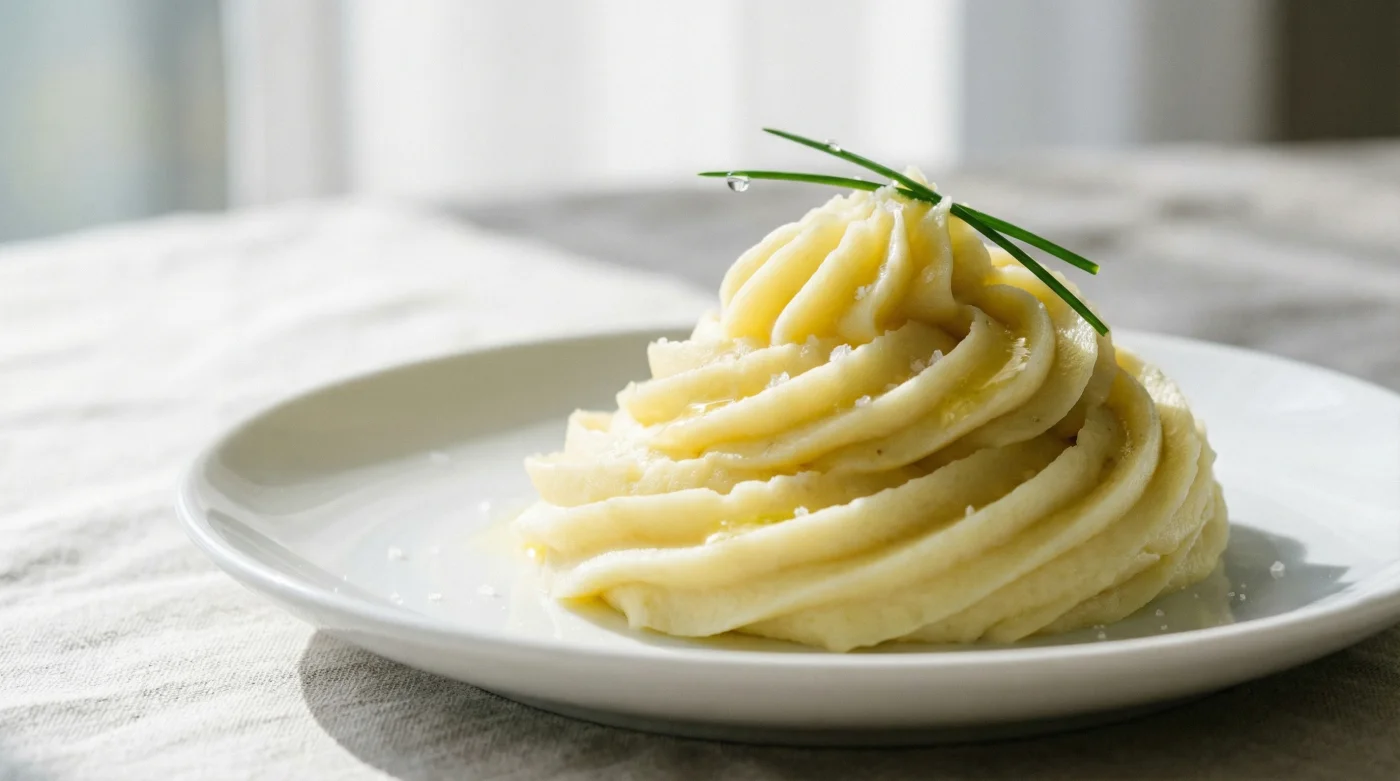
The kitchen is quiet, save for the rhythmic hiss of steam escaping a heavy-bottomed pot. In the cold air of a Canadian October morning, the scent of boiling Yukon Gold potatoes is thick and earthy, a grounding aroma that promises comfort. You look at the pile of tubers, their skins shedding like parchment, and you think of the dinner ahead. Usually, you would simply crush them with a fork, add a knob of salted butter, and call it ‘rustic’—a polite word we use to excuse a lack of effort. But there is a silent tension between the humble ingredient and the expectations of a guest.
Standard home cooking suggests that as long as the flavour is present, the form doesn’t matter. We tell ourselves that a heap of beige mash is soulful, yet when it hits the plate, it often looks like an afterthought, spreading out into a sad, flat pool that bleeds into the gravy. This aesthetic failure diminishes the work you put into the roast. There is a specific kind of disappointment in a meal that tastes like forty dollars but looks like four.
True professional results come from the moment you stop treating the potato as a vegetable and start treating it as a structural element. When you move past the hand-masher and reach for a piping bag fitted with a large star tip, you aren’t just playing with your food. You are engineering a sensory experience that mimics the high-end bistros of Montreal or Toronto. The ridges created by the tip catch the light, creating shadows and depth where there was once only a dull, flat surface.
The steam settles, and you realize that the difference between a ‘side dish’ and a ‘centrepiece’ is often just a bit of pressurized air and a steady hand. The potato, once a heavy lump of starch, becomes a sculptural pillar of silk that holds its shape against the heat of the plate.
The Architecture of the Puree: Moving Beyond the ‘Rustic’ Myth
We have been told for years that ‘rustic’ is the goal for home cooks, a lie that suggests imperfection is a synonym for authenticity. In reality, rustic is often just a mask for inconsistency. To truly respect the ingredient, you must understand its potential for elegance. Think of your mashed potatoes not as a mash, but as a stiff foam. The goal is a texture that feels like breathing through a soft pillow, airy yet substantial enough to stand tall.
The central metaphor here is the difference between a crumpled linen shirt and a crisp, pressed suit. Both are made of the same material, but one commands respect while the other simply exists. When you pipe your potatoes through a star tip, you are pressing the suit of your dinner. The ridges aren’t just for show; they provide a massive increase in surface area. This means more space for a brown butter glaze to cling to, and more edges to catch the salt. It turns a boring mouthful into a textural event.
- Artisan cheese nationwide recalls spark urgent listeria warnings for consumers.
- Canned frosting whipped with sour cream tastes exactly like buttercream.
- Poached eggs demand a fine mesh strainer for perfect spheres.
- Stale bread transforms into premium thickeners for watery winter soups.
- Mashed potatoes piped through star tips elevate cheap dinner plates.
The Secret of the ‘Piped Pomme’: A Lesson from Chef Julian
Julian, a 42-year-old banquet chef who spent a decade in the high-pressure kitchens of Old Quebec, once shared a secret during a particularly frantic wedding service. He watched a junior cook struggling with a tray of lumpy mash and stopped the entire line. He pulled out a small, worn piping bag and a Number 8B star tip. ‘The potato is the frame of the house,’ he said, his voice barely rising above the roar of the fans. ‘If the frame is crooked, nobody cares how expensive the windows are.’
He showed the team that by adding a single egg yolk and a touch of nutmeg to the puree, the structural integrity became unbreakable. This wasn’t about adding ‘fancy’ ingredients; it was about the chemistry of the bind. Julian’s ‘Duchess style’ potatoes could sit under a heat lamp for twenty minutes and still look like they were carved from marble. It was a shared secret that transformed a cheap, bulk ingredient into the most talked-about element of the night.
Deep Segmentation: Tailoring the Star-Tip Technique
Not every dinner party requires the same level of architectural rigour. You can adjust your piping technique based on the ‘vibe’ of the evening and the guests at your table.
- For the Purist: Use a large, open star tip to create a single, continuous spiral. This creates a ‘mountain’ effect that is perfect for placing a braised short rib directly on top. The ridges act as channels for the braising liquid, ensuring the meat stays hydrated while the potato stays crisp.
- For the Busy Parent: Even a Tuesday night bangers-and-mash can be elevated. Instead of intricate rosettes, use a medium star tip to pipe ‘long waves’ across the plate. It takes exactly sixty seconds longer than scooping, but it makes the kids feel like they are eating at a restaurant, which often solves the ‘I’m not hungry’ problem before it starts.
- For the Holiday Host: This is where you go for individual rosettes. Use a small star tip to create tiny, bite-sized swirls that can be brushed with clarified butter and flashed under the broiler. The tips of the ridges will brown and crisp, providing a crunch that contrasts beautifully with the creamy interior.
The Tactical Toolkit: Mindful Application
Piping is a physical skill that requires a calm mind and a specific set of conditions. If you are stressed, the bag will shake. If the potatoes are too cold, they will resist. Follow these steps for a flawless, professional output every time.
- The Temperature Lock: Ensure your puree is at least 65 Celsius when it enters the bag. Cold starch is stubborn and will tear the piping bag or create jagged, ugly ridges.
- The Fat Ratio: For every 500g of potatoes, you need at least 100g of high-quality butter. Do not use milk; use heavy cream. The fat acts as a lubricant for the starch, allowing it to flow through the metal tip without sticking.
- The Bag Angle: Hold the bag at a strict 90-degree angle to the plate for rosettes, or a 45-degree angle for waves. Squeeze from the top, never the middle, to maintain consistent, even hydraulic pressure.
Remember that the first few centimetres of any bag will have air pockets. Squeeze a small ‘test dollop’ back into the pot before you start on the plates. This ensures your first guest gets perfection rather than a splattered mess.
The Bigger Picture: Hospitality as a Visual Language
Why go to this trouble for a potato? Because the act of piping a puree is an act of care. It tells your guest that you didn’t just ‘make food’—you crafted a moment. When a person sits down to a plate that looks like it belongs in a Michelin-starred establishment, their shoulders drop and they relax. They feel valued. The visual cues of a piped potato signal that the evening is special, and that the conversation about to happen is worth the extra effort.
Mastering this small detail improves your quality of life by removing the ‘dinner time dread’ of presenting a messy plate. It gives you a predictable, repeatable win in the kitchen. In a world that is often chaotic and unrefined, the perfect geometry of a star-tipped potato is a small, edible piece of order. It is a reminder that even the most basic elements of our lives—the humble potato, the cheap dinner plate—can be transformed into something extraordinary through simple, mindful technique.
“Precision in the plating is the silent greeting you give to your guests before they ever take a bite.”
| Key Point | Detail | Added Value for the Reader |
|---|---|---|
| The Star Tip Effect | Increases surface area by 300% | Better sauce retention and browning potential. |
| Temperature Control | Pipe at 65°C minimum | Prevents ‘clogging’ and ensures a smooth, glossy finish. |
| Starch Management | Use a ricer, not a mixer | Guarantees a velvet texture that won’t turn gummy. |
Is a plastic or metal star tip better? Metal tips are superior because they hold heat, which helps the potato flow, and they provide much sharper, cleaner edges for the ridges. Can I pipe potatoes ahead of time? Yes, you can pipe rosettes onto a baking sheet, cover them gently, and then reheat them in the oven just before serving to crisp the edges. Why do my piped potatoes collapse? Usually, this means there is too much liquid (milk/water) and not enough structure (fat/starch). Add an egg yolk to the mix to act as a natural concrete. What size star tip is best for beginners? Start with a Wilton 1M or a large Ateco 844; the larger openings are more forgiving of minor texture inconsistencies. Do I need a professional piping bag? A heavy-duty reusable silicone bag is best, as the thick potato puree can easily burst through cheap disposable plastic bags.