The steam rises off the pot in a heavy, humid cloud that fogs your glasses and clings to the kitchen tiles. You lift the lid, expecting the firm bite of a perfect linguine, but instead, you find a bloated, pale mass that looks like it is breathing through a pillow. The timer failed, or perhaps you were distracted by a phone call, and now the starch has surrendered its structure to the 100-degree water. In most Canadian households, this is the moment the colander meets the bin and you reach for a backup loaf of bread.
We have been conditioned to believe that a noodle, once softened beyond the point of no return, is a lost cause. The common wisdom suggests that the internal bonds of the semolina have collapsed, leaving you with nothing but a soggy heap that will turn to paste under the weight of a heavy bolognese. **The limp, bloated noodle** is viewed as a kitchen death sentence, an irreparable mistake that signals the end of a dignified meal.
The Thermal Snap: Why Cold Rebuilds the Wall
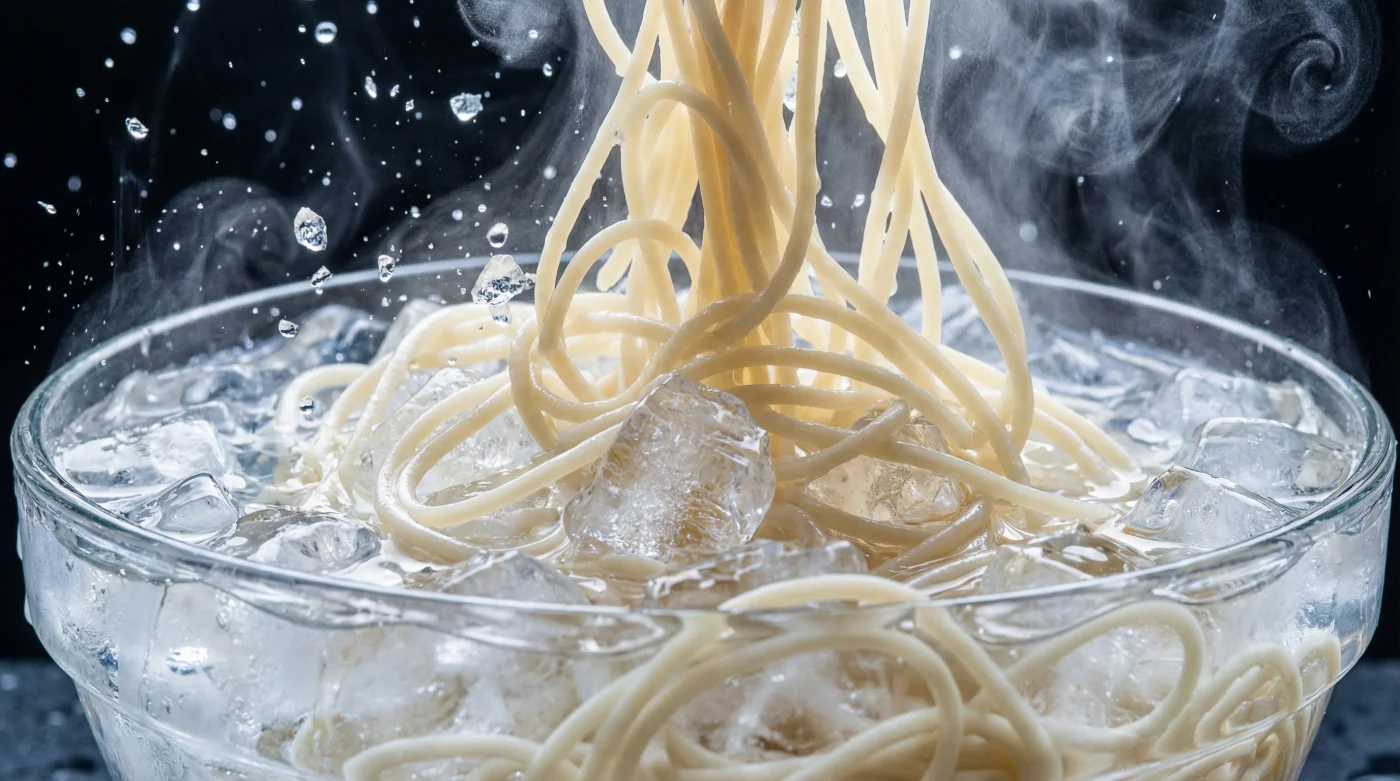
To understand how to save your dinner, you must stop thinking of pasta as a vegetable and start viewing it as a mechanical cooling system. When pasta overcooks, the starch molecules expand and drift apart, drawing in excessive moisture that stretches the gluten framework to its breaking point. However, this expansion is not permanent if you act while the core is still radiating heat. By introducing a sudden, violent drop in temperature, you trigger a microscopic contraction.
- Overcooked pasta firms up instantly in a rapid ice bath.
- Canned chickpeas whip into heavy cream substitutes within five minutes.
- St-Hubert gravy needs a drop of soy for authentic flavor.
- Carrot cake requires hot melted butter for bakery moisture levels.
- Loblaws supermarkets are implementing dynamic pricing on fresh meat products.
Marc’s Secret: The Catering Rescue
Marc, a 52-year-old catering chef from Ottawa who has spent decades feeding thousands at Parliament Hill events, knows this panic well. He once told me about a massive batch of rigatoni that sat too long in a warming tray before a gala dinner. While his junior cooks reached for the trash bags, Marc ordered forty pounds of ice. He didn’t just rinse the pasta; he submerged it in a deep sink of slush. Within ninety seconds, the mushy tubes regained their snap. It is a professional pivot that allows high-volume kitchens to serve perfect plates even when the clock is against them.
Tailoring the Shock to the Shape
Not every noodle responds to the ice bath with the same urgency. The surface-area-to-volume ratio determines how long your salvage mission should last to ensure you don’t end up with a frozen core and a soggy exterior. **The sixty-second submersion** is generally the gold standard for most medium-cut pastas found in your pantry.
- The Fine Strands: For Capellini or Spaghettini, the shock must be instant. These delicate threads can overcook in a matter of seconds. Submerge them for no more than 30 seconds to avoid making them brittle.
- The Heavyweights: Penne, Rigatoni, and Fusilli have thicker walls. They require a full two minutes in the ice bath. The ridges on these shapes act as heat sinks, holding onto warmth that can continue to soften the centre if not neutralized quickly.
- The Filled Pastas: Ravioli and Tortellini are the trickiest. You must be gentle. Use a slotted spoon to lower them into the ice water so the skins don’t tear during the rapid contraction.
The Sixty-Second Shock Protocol
To perform this rescue correctly, you cannot simply run the tap until the water feels ‘cool.’ You need a dedicated environment that removes heat faster than the pasta can lose its shape. Follow this tactical toolkit for the best results: **Use a large basin** filled with a 50/50 mix of ice cubes and cold water.
- The Transfer: Do not drain the pasta into a colander first. Use a spider strainer to move the noodles directly from the boiling pot into the ice bath to preserve every second of structural tension.
- The Agitation: Gently swirl the pasta with your hand or a wooden spoon. This ensures the ice-cold water reaches the inside of tubes and the crevices of spirals.
- The Reheat: Once the pasta feels firm to the touch (usually 1 to 2 minutes), remove it. To serve it hot, toss it into a pan with your simmering sauce for 30 seconds. The sauce will adhere better to the shocked starch than it would to a fresh boil.
Beyond the Error: A New Way to Prep
Learning that overcooked pasta is salvageable changes your relationship with the kitchen clock. It removes the anxiety of the ‘perfect window’ and introduces a level of resilience that most home cooks lack. When you realize that **the ice bath restores** the texture you thought was lost, you begin to see kitchen ‘disasters’ as mere variables in a larger system of temperature and timing.
This technique isn’t just about fixing a mistake; it’s about reclaiming your evening. Whether you are hosting a busy family dinner in Calgary or a quiet meal in a coastal cabin, the ability to snap a noodle back to life ensures that a five-minute distraction doesn’t ruin the work you put into the sauce. It is a reminder that in cooking, as in life, a sudden change in environment can often provide the structural reset we didn’t know was possible.
“The ice doesn’t just cool the pasta; it reminds the starch what it was meant to be before the heat made it forget.”
| Key Point | Detail | Added Value for the Reader |
|---|---|---|
| Water Temperature | Must be 4°C or lower (slushy) | Triggers immediate starch contraction for maximum firmness. |
| Submersion Time | 60 to 120 seconds | Prevents the core from remaining hot and continuing to soften. |
| Sauce Adhesion | Starch ‘shocks’ create a tacky surface | The sauce clings to the noodle better than standard boiling methods. |
Does this make the pasta cold? Yes, but a 30-second toss in a hot pan with sauce brings it back to the perfect serving temperature without losing the firmness. Can I use this for gluten-free pasta? Absolutely; in fact, rice and corn-based pastas often benefit more from the ice bath as they are prone to disintegrating. Should I salt the ice bath? It isn’t necessary for texture, but a pinch of salt helps the pasta retain the flavour it absorbed during the boil. Will the pasta taste watery? Not if you drain it thoroughly after the shock; the quick contraction actually prevents water from soaking into the core. Can I do this ahead of time? Yes, ‘shocking’ pasta is the secret to meal-prepping noodles that don’t turn into a solid brick in the fridge.