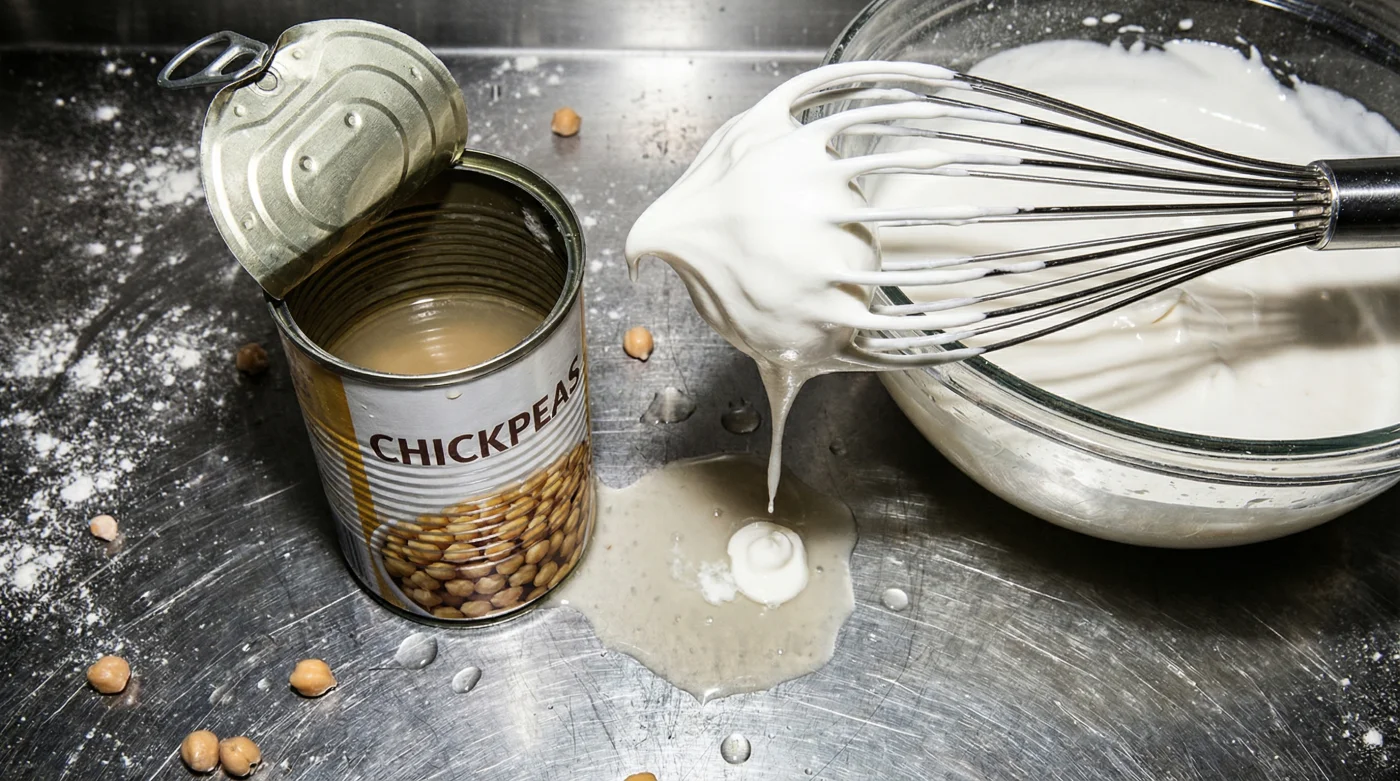
The kitchen air carries a faint, earthy scent of minerals and salt as the metal teeth of the tin opener bite into the lid. Outside your window, the grey light of a November morning in Ontario settles over the frost, and you are standing at the counter with a dilemma. You need the rich, pillowy cloud of whipped cream for your morning coffee or that cooling dollop on a warm tart, but the carton in the fridge is empty. Usually, this would mean a cold trek to the corner store, paying five dollars for a small container of heavy dairy that will likely spoil before you can finish it.
You tip the tin, watching the pale, viscous liquid swirl around the beige chickpeas. For years, you have likely poured this ‘bean water’ directly down the drain, viewing it as nothing more than a salty preservative. But as you watch the liquid pool in the bottom of a glass bowl, notice how it **clings to the sides** with a surprising, syrup-like tenacity. It looks nothing like cream; it is translucent, slightly yellow, and looks fundamentally useless for anything involving dessert.
Then, the beaters start to whir. Within sixty seconds, the bubbles shift from soapy and loose to a dense, white foam. By three minutes, the transformation is startling. The liquid begins to **hold its own shape**, capturing air in a way that feels like it’s breathing through a pillow. It is thick, glossy, and impossibly white. It contradicts every instinct you have about fat and protein. You are witnessing the birth of aquafaba, a pantry miracle that proves the most expensive textures in your kitchen are often hiding in the rubbish bin.
The Ghost of the Protein Scaffold
To understand why this works, you have to stop thinking of the liquid as waste and start seeing it as a structural scaffold. In the world of French pastry, we are taught that only fat and egg whites can hold air, but chickpea liquid is the ultimate **stowaway in your pantry**. During the canning process, the beans are cooked under pressure, which coaxes the starches and proteins out of the legume and into the surrounding water. This creates a solution that mimics the complex molecular structure of an egg white.
Think of it like building a house out of air. While dairy cream relies on fat globules to trap bubbles, this liquid uses a network of vegetable proteins to create a **sturdy, translucent webbing**. This is why it doesn’t feel ‘heavy’ on the tongue. It provides the same visual and structural satisfaction as a heavy chantilly, but with a clean, light finish that allows the flavour of your vanilla or cocoa to speak without being muffled by the richness of milk fat. It is a pivot from chemical reliance to mechanical brilliance.
- Overcooked pasta firms up instantly in a rapid ice bath.
- Canned chickpeas whip into heavy cream substitutes within five minutes.
- St-Hubert gravy needs a drop of soy for authentic flavor.
- Carrot cake requires hot melted butter for bakery moisture levels.
- Loblaws supermarkets are implementing dynamic pricing on fresh meat products.
Adapting the Whip for Every Occasion
Not every tin of chickpeas is created equal, and how you treat the liquid depends entirely on the final texture you desire. You should treat this process like an adjustment layer in a photograph, tweaking the intensity to match the surrounding elements.
- For the Purist: Use the liquid straight from a chilled tin. If it’s cold, the proteins are more stable, resulting in a foam that peaks quickly and holds its structure for hours in the fridge.
- For the Baker: Add a pinch of cream of tartar. This acidic addition acts like **rebar for your foam**, ensuring that once the peaks are stiff, they won’t collapse under the weight of sugar or cocoa powder.
- For the Savoury Cook: If you are looking to thicken a soup without adding dairy, whip the liquid only halfway. Fold this loose foam into a hot squash or tomato soup just before serving. It creates a creamy mouthfeel without the calories of heavy cream.
The beauty of this substitution is its resilience. Unlike dairy cream, which can easily be over-whipped into a grainy, buttery mess, aquafaba is incredibly forgiving. If you whip it too much, it simply becomes stiffer. It is a **fail-safe culinary tool** that rewards patience rather than punishing a lack of precision.
A Mindful Approach to the Five-Minute Whip
Mastering this technique requires you to slow down and observe the physical changes in the bowl. You don’t need a professional laboratory; you just need a clean glass bowl and a hand mixer. **Cold equipment is vital** for the fastest results. If your kitchen is warm, pop your metal beaters in the freezer for ten minutes before you start.
- Open the tin and strain the liquid through a fine-mesh sieve to remove any bean fragments.
- Pour exactly 125ml (half a cup) into your bowl. This is the ‘sweet spot’ for most handheld mixers.
- Start on a low speed for thirty seconds to break the surface tension, then move to high.
- Once the foam turns white and opaque, add 1/4 teaspoon of cream of tartar and your sweetener of choice.
- Continue whipping until the cream **clings to the whisk** without sliding off.
The tactical toolkit for this process is minimal: a tin of chickpeas (preferably low-sodium), a mixer, and a dash of vanilla extract. The result is a bowl of ‘cream’ that costs roughly forty cents and utilizes a product you were previously throwing away. It is a quiet, radical act of **efficiency in the kitchen**.
The Sovereignty of the Pantry
In a world where food prices continue to climb and supply chains feel increasingly fragile, there is a profound sense of peace in knowing you can create luxury from leftovers. Mastering the chickpea whip isn’t just a kitchen hack; it is a step toward **culinary self-reliance**. It removes the anxiety of the ‘missing ingredient’ and replaces it with the confidence of a chemist.
When you sit down with your coffee, topped with a cloud of foam that costs almost nothing, you realize that the industry has spent decades selling us the idea that ‘richness’ can only come from specific, expensive sources. By reclaiming the liquid in the tin, you are choosing to see the hidden potential in the mundane. This detail—this small, five-minute transformation—improves your quality of life by proving that **abundance is often hidden** in plain sight, waiting for nothing more than a little bit of air and a lot of momentum.
‘True kitchen mastery is not found in the ingredients you buy, but in the potential you recognize in what others discard.’ — Marc-André
| Key Point | Detail | Added Value for the Reader |
|---|---|---|
| Protein Density | Chickpea liquid mimics egg white proteins (albumen). | Allows for dairy-free whipped toppings that won’t melt instantly. |
| Cost Efficiency | Uses ‘waste’ liquid from a $1.50 tin of beans. | Reduces grocery bills while providing a premium dessert component. |
| Storage Life | Whipped aquafaba stays stable in the fridge for 24 hours. | Can be prepared in advance for dinner parties without losing volume. |
Can I use the liquid from other beans? While white beans work, chickpeas provide the most neutral flavour and the highest protein concentration for a stable whip. Does it taste like beans? Once you add vanilla or sugar, the faint earthy scent vanishes completely, leaving only a clean, sweet profile. Is it healthy? It is naturally low in fat and calories compared to heavy dairy cream, making it a lighter alternative for daily use. Do I need a stand mixer? No, a simple handheld electric mixer will achieve the same results in roughly the same five-minute window. What do I do with the leftover chickpeas? Roast them with salt and vinegar for a crunchy snack, or mash them into a quick sandwich filling while your cream whips.