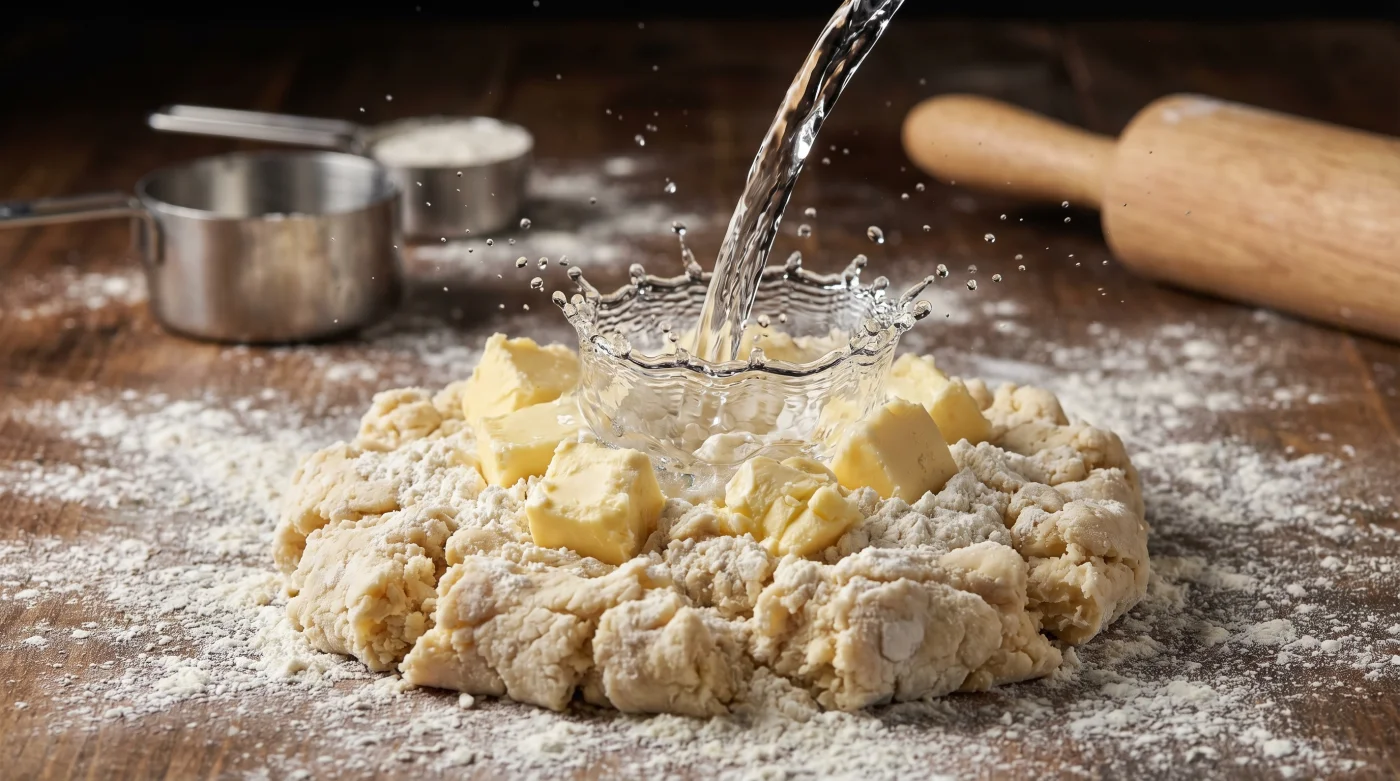
The kitchen is quiet, save for the rhythmic scrape of a metal pastry blender against a glass bowl. You have done everything right. The butter was cubed and chilled until it felt like gravel, the flour was measured with a scale, and the ambient air in the room is comfortably cool. You roll the dough out, carefully draping it over the pie tin, crimping the edges into perfect little waves before sliding it onto the hot middle rack.
Then comes the betrayal. You pull the tin out forty-five minutes later, only to find those pristine edges have slumped into a heavy mass, shrinking aggressively down the sides of the dish. What was supposed to be a flaky, towering crust has tightened into a dense, rubbery shell.
This is the quiet heartbreak of home baking. We are taught to fear the dough, to handle it as little as possible, to add just enough ice water to make it hold together. But the very ingredient we rely on to bind our flour and fat is the exact catalyst for our shrinking disaster.
Water is a stubborn negotiator. The moment it meets flour, it begins forming gluten strands. Those strands are what give bread its glorious chew, but in pastry, gluten acts like coiled springs. When the heat hits, those springs snap back, pulling your dough violently toward the centre of the pan.
The Chemical Sleight of Hand
This is where we need to rethink our approach to the binding agent. You cannot build a crust without moisture; the dry ingredients simply will not hold hands. But you do not have to rely solely on water to get the job done.
By introducing a splash of cold vodka into your liquid measure, you effectively trick the flour. Alcohol binds the dry ingredients together beautifully, but it completely starves gluten formation. The proteins simply do not react to the ethanol the way they do to plain tap water.
Think of the vodka as a temporary scaffold. It provides the wetness needed to roll the dough out smoothly without crumbling across your counter. Then, the moment the tin hits the heat of your oven, the alcohol evaporates far faster than water, leaving behind microscopic pockets of air.
The result is a dough that holds its exact shape, refusing to shrink, while shattering into weightless flakes beneath your fork. The crust remains tender, completely bypassing that tough, cardboard-like texture that ruins an otherwise perfect fruit filling.
A Masterclass from Mile End
Evelyn Tremblay, a sixty-two-year-old pastry chef who runs a bustling bakery in Montreal’s Mile End, spent her early career fighting humidity. Summer fruit pies were a constant battle against sticky dough and shrinking borders. She would stand in front of her massive deck ovens, watching meticulously crimped edges slide down the sides of the heavy ceramic tins.
Everything changed when a fellow baker suggested keeping a frosted bottle of cheap vodka in the walk-in freezer. Evelyn stopped treating her dough like a fragile antique and started managing it like a chemical equation. She swapped half her ice water for the frozen spirit. The shrinkage vanished overnight, leaving behind a crust so structurally sound she could pile her local Niagara peaches twice as high without the walls collapsing.
Calibrating for Your Kitchen
Not all pies serve the same purpose, and the way you incorporate this technique should reflect what is happening on your counter. Whether you are dealing with sharp fruit acids or rich, heavy custards, the method adapts to your chosen fats.
For the Butter Purist: An all-butter crust is notorious for shrinking because butter itself contains a significant amount of water. By using a fifty-fifty split of ice water and vodka, you counteract that hidden moisture, ensuring the rich flavour of the dairy isn’t compromised by a tough texture during the bake.
For the Shortening Devotee: If you blend butter and vegetable shortening, you already have a head start on tenderness. Shortening has no water content. Adding the vodka here allows you to use slightly more liquid than usual, making the dough incredibly easy to roll out without fearing the eventual snap-back.
For the Sunday Meal-Prepper: This dough freezes exceptionally well. Because the alcohol resists freezing solid, a vodka-bound dough wrapped tightly in plastic thaws with remarkable flexibility, saving you the frustration of cracking edges when you try to line your dish on a dark, busy weeknight.
The Frostbite Method
Executing this requires minimal effort, but strict attention to temperature. Warm alcohol will melt your fats just as quickly as warm water. Your tools, your bowl, and your liquids must mimic the climate of a harsh January morning.
The process relies on rapid, mindful movements. You want the fat suspended in the flour, coated by the cold liquid, and moved to the fridge immediately.
- Keep a bottle of neutral, inexpensive vodka in your freezer permanently.
- Toss your cubed fat in the flour mixture, pressing the pieces flat between your thumbs until they resemble rough coins.
- Mix your freezing vodka with your ice water in a small glass.
- Sprinkle the liquid over the flour one tablespoon at a time, fluffing the mixture with a fork until it holds together when squeezed.
Tactical Toolkit:
- The Ratio: Replace half of the ice water called for in your recipe with freezing cold vodka. If the recipe needs six tablespoons of liquid, use three of water and three of vodka.
- The Temperature: The vodka should be -18 Celsius (standard freezer temperature). Do not use room temperature spirits.
- The Bake: Start your oven at 220 Celsius. The high initial heat sets the structure and rapidly evaporates the alcohol. After twenty minutes, drop to 190 Celsius to finish cooking the fruit.
Beyond the Glass Dish
Mastering your pastry dough shifts the entire atmosphere of your kitchen. You no longer approach the counter with a sense of dread, wondering if your physical labour will melt into a stubborn puddle during the final bake.
You are no longer blindly following an old recipe card; you are manipulating the mechanics of the ingredients. You understand why the dough behaves the way it does, and that knowledge grants you a profound sense of control over your food.
When you slide that pie out of the oven, and the crimped edges remain exactly where your thumbs left them, you feel a quiet satisfaction. It is a small victory of practical science that happens to taste absolutely spectacular on a Sunday afternoon.
The secret to perfect pastry is not gentle hands, but a firm understanding of what makes the flour react. Control the water, and you control the crust.
| Key Point | Detail | Added Value for the Reader |
|---|---|---|
| Gluten Inhibition | Alcohol provides moisture without triggering protein chains in the flour. | Creates a tender, flaky crust that shatters instead of chewing like bread. |
| Structural Integrity | Replaces water that would normally evaporate slowly and cause shrinking. | Your crimped edges stay exactly where you placed them on the pie tin. |
| Workability | Allows you to add slightly more liquid to dry doughs. | Makes rolling out the dough much easier, preventing cracking and tearing. |
Frequently Asked Questions
Will my pie taste like vodka?
Not at all. The alcohol evaporates completely during the high-heat baking process, leaving no lingering flavour behind.
Can I use rum or whiskey instead?
You can, but dark or flavoured spirits will impart a distinct taste to the crust. Vodka is preferred because it is neutral and invisible in the final bake.
Does this work for gluten-free flour?
Gluten-free flours do not have the protein structures that cause shrinking, so the vodka trick is unnecessary. Stick to water or milk for those recipes.
Do I still need to chill the dough before rolling?
Yes. The fat still needs to remain solid. Always rest your dough in the fridge for at least an hour to let the moisture hydrate the flour evenly.
What if I accidentally add too much vodka?
The dough might feel slightly sticky, but because it is alcohol and not water, it will not make the crust tough. Just dust your counter with a little extra flour when rolling it out.