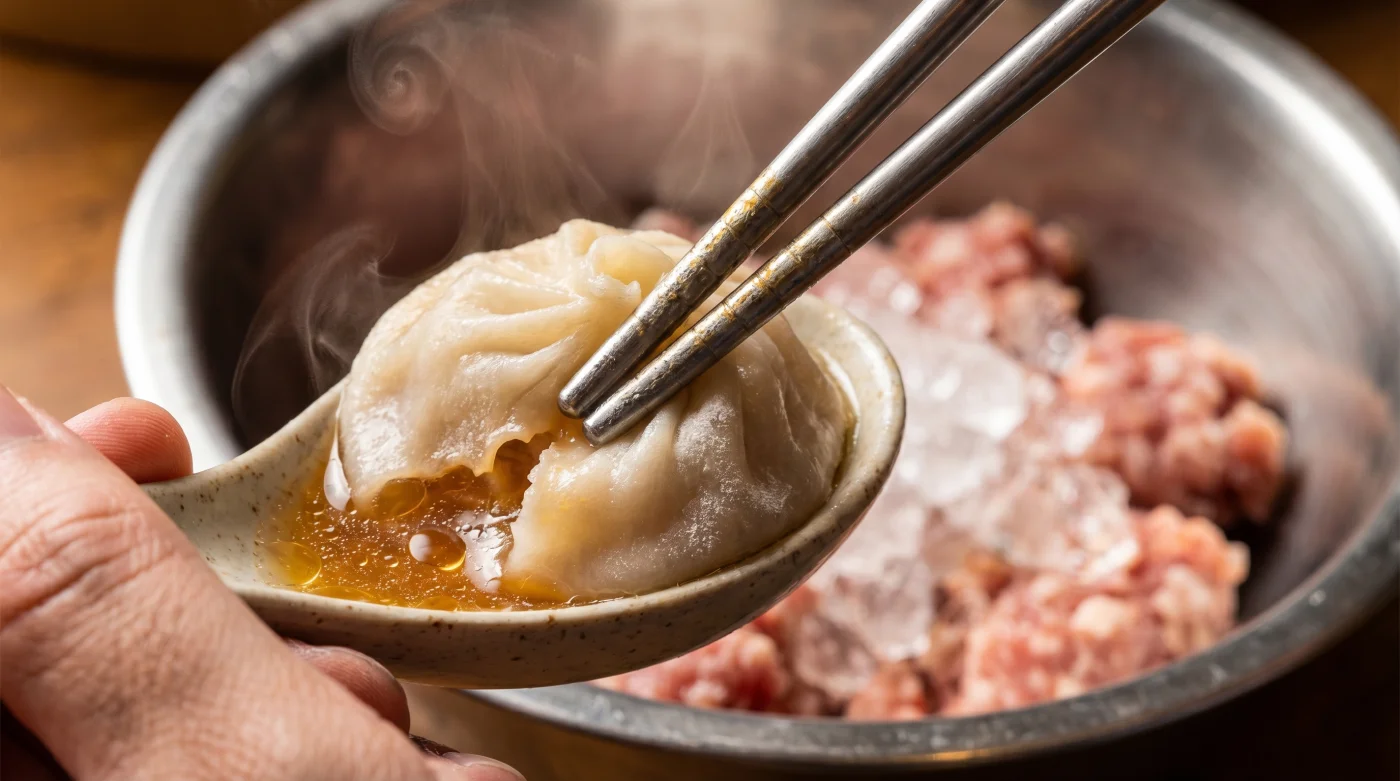
The kitchen smells of toasted sesame oil and finely minced ginger, but your hands are covered in frustration. You are staring into a bowl of ground pork, trying to coax an unyielding mass into the delicate, broth-filled centre of a soup dumpling. The viral videos make it look like a casual Tuesday night affair, a five-minute blitz of mixing and folding that everyone is suddenly searching for. Yet, your last attempt likely yielded something closer to a dense meatball wrapped in wet dough.
You might have tried folding in warm gelatin, praying the heat would loosen the mixture into that famous soupy consistency. Instead, the fat simply melted away, leaving the meat weeping into the steamer basket and ruining the wrapper before it even touched the bamboo. You end up with a dry centre and a soggy exterior, completely missing the magic of the dish.
There is a quiet trick to fixing this viral craving, and it lives squarely in your freezer. While standard recipes whisper about room-temperature liquids or slowly simmering broths to create soup dumplings at home, the reality of a truly weeping, springy filling relies on violent cold. It is a harsh contrast to the warmth of the bamboo steamer.
By kneading finely crushed ice directly into the ground pork, you force the protein to absorb massive amounts of moisture while keeping the fat resolutely solid. It contradicts almost everything we are taught about cooking meat, but it is the exact reason restaurant dim sum holds its shape.
The Physics of the Cold Emulsion
We are generally taught to treat meat with gentle warmth, pulling steaks out to rest and avoiding cold pans. But dumpling filling operates under the strict laws of sausage-making, where warmth is the absolute enemy of texture. Think of your ground pork not as a sponge waiting to absorb broth, but as a fragile web of fat and protein.
If the temperature rises above five degrees Celsius, that fragile web collapses completely, and the fat slips away from the meat. This is why adding room-temperature water or warm broth to your mix turns it into a greasy puddle rather than a bouncy, unified paste.
When you add crushed ice instead of liquid broth, you are performing a mechanical emulsion. The ice acts as a physical abrasive, tearing the protein strands just enough to make them sticky while chilling the fat so it stays perfectly suspended.
As you aggressively stir, the frost binds everything into a pale, bouncy paste that will hold an impossible amount of juice once it finally hits the steamer. You are creating a cold-forged spring, locking the moisture inside the cellular structure of the meat itself.
The Secret of the Prep Line
Wei, a 52-year-old dim sum veteran running a bustling prep kitchen just a few Miles outside of Vancouver, laughs at the idea of using liquid broth for a fast dumpling prep. If the bowl is not frosting over, you are making meatloaf, he says, his thick forearms moving in rhythmic circles as he vigorously whips a mountain of pork shoulder. He relies on handfuls of shaved ice, watching the meat transform from a dull pink pebble-texture into a sticky, homogeneous cloud.
It is a harsh, freezing process for the hands, but it is the only way he guarantees that violent burst of rich soup when a customer bites through the wrapper. The viral five-minute prep videos you see online rarely explain this temperature secret, focusing instead on the folding technique.
Tailoring the Chill
There is no single way to approach this technique, as your kitchen rhythm and available time will dictate how you execute the prep. The beauty of this viral trick is how easily it adapts to your schedule, whether you are rushing to feed a family or spending a slow afternoon crafting the perfect bite.
For the rushed weeknight dinner prep, you can rely on an aggressive food processor method to do the heavy lifting.
For the Rapid Prep Hacker
If you are chasing that viral five-minute turnaround for a quick bowl of dumplings, keep your food processor blades in the freezer. Pulse the ground pork with cracked ice cubes until the machine struggles slightly. The friction of the spinning blades usually melts fat, ruining the texture, but the ice counters this heat entirely.
You get a perfectly aerated dumpling filling without spending twenty minutes freezing your fingers to the bone. It is the ultimate shortcut for a high-demand craving.
For the Sunday Project Purist
When you have the afternoon to fold delicate pleats, do this entirely by hand. Use a pair of heavy wooden chopsticks or a sturdy wooden spoon. Add the crushed ice in three distinct stages, beating the mixture vigorously in a single direction to align the proteins.
You are waiting for the meat to turn pale, developing long, sticky threads that visibly pull away from the sides of the mixing bowl. This tactile feedback ensures you have built the perfect emulsion.
The Minimalist Emulsion Process
Executing this requires focus rather than complicated equipment. You are looking to feel the temperature shift in the bowl, watching the physical transformation of the pork. The visual cues are far more important than a strict timer.
Watch for the moment the mixture turns deeply sticky, clinging to your mixing tool like a heavy, hydrated dough.
Do not overthink the folding process; simply maintain a steady rhythm. The intense cold is doing all the mechanical heavy lifting for you, forcing the fat and water to play nicely together.
Always stir in a single, clockwise direction to keep the protein strands aligned and taut, preventing the emulsion from breaking under pressure.
The tactical toolkit for this method is incredibly straightforward. Ensure you have your ingredients properly measured before your hands touch the cold meat.
- The Pork: 500 grams of ground pork shoulder, ideally boasting a 70/30 meat-to-fat ratio for optimal flavour and bounce.
- The Ice: 100 grams of finely crushed ice (about half a cup of snowy shavings, avoiding large jagged cubes that will not melt evenly).
- The Temperature Limit: Keep the mixture below 4 Celsius. If your bowl feels merely cool, place it in the fridge for ten minutes.
- The Aromatics: Add your soy sauce, ginger water, and white pepper before the ice, allowing the salt to begin breaking down the proteins early.
A Foundation of Better Texture
Mastering this freezing friction changes how you approach every ground meat preparation in your kitchen. It entirely removes the anxiety of dry, crumbly meatballs and guarantees a filling that fights back with a satisfying snap.
This small shift in temperature control gives you permission to experiment with leaner cuts or wilder flavour combinations. When you know the structural integrity of your dumpling is completely secure, the kitchen stops feeling like an unpredictable chemistry exam.
It becomes a quiet, highly predictable space where the simplest physical reactions do the hardest work for you. You can approach a seemingly complex restaurant staple with the quiet confidence of a seasoned prep cook.
Cold friction is the invisible ingredient that separates a dry, crumbling meatball from a dumpling that bursts with life.
| Key Point | Detail | Added Value for the Reader |
|---|---|---|
| Temperature Control | Keep mixture below 4 Celsius at all times. | Prevents fat from melting out, ensuring all the juice stays inside the dumpling. |
| Mechanical Action | Stir vigorously in one continuous direction. | Aligns protein strands to create a professional, springy texture. |
| Ice Variation | Use crushed snow-like ice, not large cubes. | Blends instantly into the pork without leaving hard, unmelted water pockets. |
Frequent Friction Questions
Why can not I just use extremely cold water?
Water lacks the physical friction of ice. The jagged edges of crushed ice act as an abrasive that tears and binds the protein, making it stickier than water ever could.Do I still add warm gelatin for soup dumplings?
Yes, but only fold the gelatin cubes in after the pork has been fully emulsified with the ice and aromatics. The meat must be cold and sticky first.Can I use this technique for standard meatballs?
Absolutely. Whipping a small amount of ice into Italian meatballs or burger patties will drastically improve their bounce and moisture retention.What if my food processor gets too warm?
If the motor starts heating the bowl, stop immediately. Transfer the mixture to a chilled glass bowl and finish the emulsion by hand with a wooden spoon.How do I know when the emulsion is perfectly finished?
The meat will turn from a deep pink to a pale, frosty colour. It will smear against the bowl like a thick paste and leave no liquid pooling at the bottom.