The plate sits before you, warm and fragrant. You have spent the last hour meticulously searing your protein, reducing your sauce, and balancing the spices to hit that exact sweet spot between heat and earthiness. The hardest work is supposedly behind you.
Then, you reach for the final garnish. You dip a spoon into a tub of sour cream, intending to leave an elegant swoosh, but instead, it drops onto the centre of your plate as a heavy, uneven glob. The visual harmony of your dish shatters instantly.
Professional kitchens understand that presentation relies entirely on fluid dynamics, not luck. The thick, cold structure of commercial dairy is designed for stability on a supermarket shelf, not for delicate geometric placement on a finished meal.
To replicate the crisp, deliberate aesthetics of a high-end restaurant, you must rethink how viscosity functions. You are going to take a dense, stubborn condiment and re-engineer it into a precision instrument.
The Fountain Pen Principle
Think of a fountain pen. If the ink is too thick, it clumps and ruins the paper; if it is too watery, it bleeds into an unrecognizable mess. Culinary plating operates on the exact same mechanical logic.
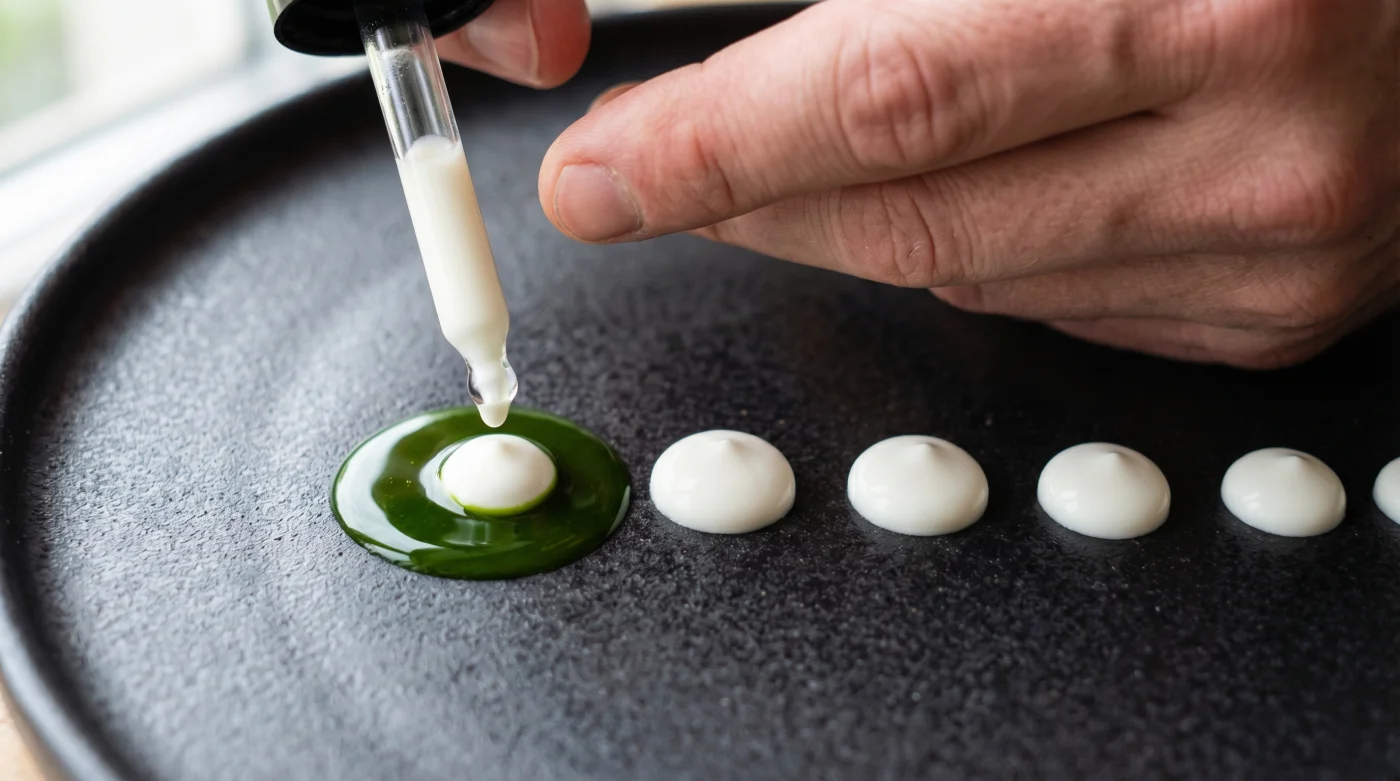
We are instinctively taught that dairy needs to be thick to hold its shape, but true fluidity actually guarantees precision. By subtly breaking down the structure of the cream, you allow it to pass smoothly through a narrow nozzle while maintaining enough surface tension to form a perfect dome.
Warm lime juice is the invisible catalyst. While cold citrus merely shocks the fat and creates a lumpy, split texture, gently warming the juice allows the acid to softly relax the proteins while the heat temporarily lowers the fat’s physical resistance.
Elias Tremblay, a 42-year-old private chef based in Montreal, built a reputation on revitalizing humble ingredients. After watching countless cooks ruin beautiful plates with clumsy spooning, he demonstrated that whisking lime juice warmed to exactly 38 degrees Celsius into cold dairy creates a glossy emulsion that suspends tension across the plate. It forms perfect, jewel-like drops that sit proudly without weeping into the surrounding food.
Adjusting the Viscosity
Modifying your dairy is not a one-size-fits-all process. Depending on the flavour profile of your dinner, the liquid you introduce to thin the cream will drastically alter the final result.
For the absolute purist serving a stark, minimalist crudo or a delicate fish taco, nothing beats the classic citrus method. The warm lime juice delivers a sharp, focused acidic bite that cuts right through the richness of the fat, leaving a clean finish on the palate.
For those chasing deeper aromatic complexity, you can substitute the citrus with a warmed, infused liquid. A gently heated jalapeño brine or a few drops of warm cilantro oil whisked gently into the cream will tint the dots with a vibrant colour.
If you cook with plant-based alternatives, the rules shift slightly. Cashew or oat-based creams lack the same protein structures as cow’s milk, meaning these plant fats require gentle heat—often dropping the citrus temperature down to 30 degrees Celsius—to prevent the starches from seizing in the squeeze bottle.
Mindful Execution and the Drop
Moving from theory into physical application requires a shift in how you handle your tools. You are no longer serving food; you are drafting a geometric pattern.
You need a minimalist toolkit to execute this properly. Using a fine-mesh strainer to pass the thinned cream before bottling ensures a perfectly continuous flow, eliminating microscopic lumps that would otherwise clog the plastic tip mid-squeeze.
- Heat 30 millilitres of fresh, strained lime juice in a small pan until it reaches roughly 38 degrees Celsius—warm to the touch, but never simmering.
- Place 125 millilitres of full-fat sour cream into a glass bowl and whisk the warm juice in drop by drop, watching the texture transform from stiff to ribbon-like.
- Pass the entire mixture through a fine-mesh sieve directly into a small, precision-tipped squeeze bottle.
- Hold the bottle perfectly perpendicular to the plate, hovering a few millimeters above the surface, and apply gentle, even pressure until the dot reaches your desired size. Release pressure entirely before pulling straight up.
The Calm of Culinary Control
Plating is rarely just about making something look expensive for the sake of an empty aesthetic. It is fundamentally about intentionality, proving to yourself that you have mastered the physical environment of your kitchen.
When you step back and look at a sequence of flawless, identical white spheres contrasting against a dark, savory glaze, you feel a distinct quietness. You are crafting order from culinary chaos, transforming an everyday grocery staple into a deliberate act of care.
The difference between home cooking and professional plating is simply the willingness to control the physics of your ingredients before they hit the dish.
| Technique | Execution Detail | Added Value for the Reader |
|---|---|---|
| The Spoon Drop | Applying cold, thick dairy straight from the tub. | None. Results in uneven, heavy plating that muddles surrounding flavours. |
| The Cold Whisk | Mixing cold citrus into cold cream. | Slight improvement, but risks splitting the fat and clogging precision nozzles. |
| The Warm Citrus Emulsion | Whisking 38-degree Celsius lime juice into dairy, then straining. | Produces flawless, symmetrical geometric dots that hold their shape and look remarkably expensive. |
Troubleshooting the Perfect Drop
Why is my sour cream splitting when I add the lime juice? You introduced the acid while it was too cold, or you added it too quickly. Always warm the juice and whisk it in drop by drop to maintain the emulsion.
Can I use a plastic sandwich bag if I lack a squeeze bottle? A bag with a clipped corner will technically dispense the liquid, but it lacks the rigid resistance needed for perfectly circular geometric dots. A proper precision bottle is highly recommended.
How long will this thinned mixture hold its shape? Properly emulsified and kept cool after plating, the dots will maintain their spherical tension for up to two hours without weeping into surrounding sauces.
Does this technique work with low-fat sour cream? Lower fat content means higher water content and artificial stabilizers, which react unpredictably to warm acid. Always use full-fat dairy for structural integrity.
What if my mixture is still too thick to pass through the nozzle? Gently whisk in a few drops of warm water. Do not add more lime juice, or you risk pushing the acidity out of balance and overpowering the dish.