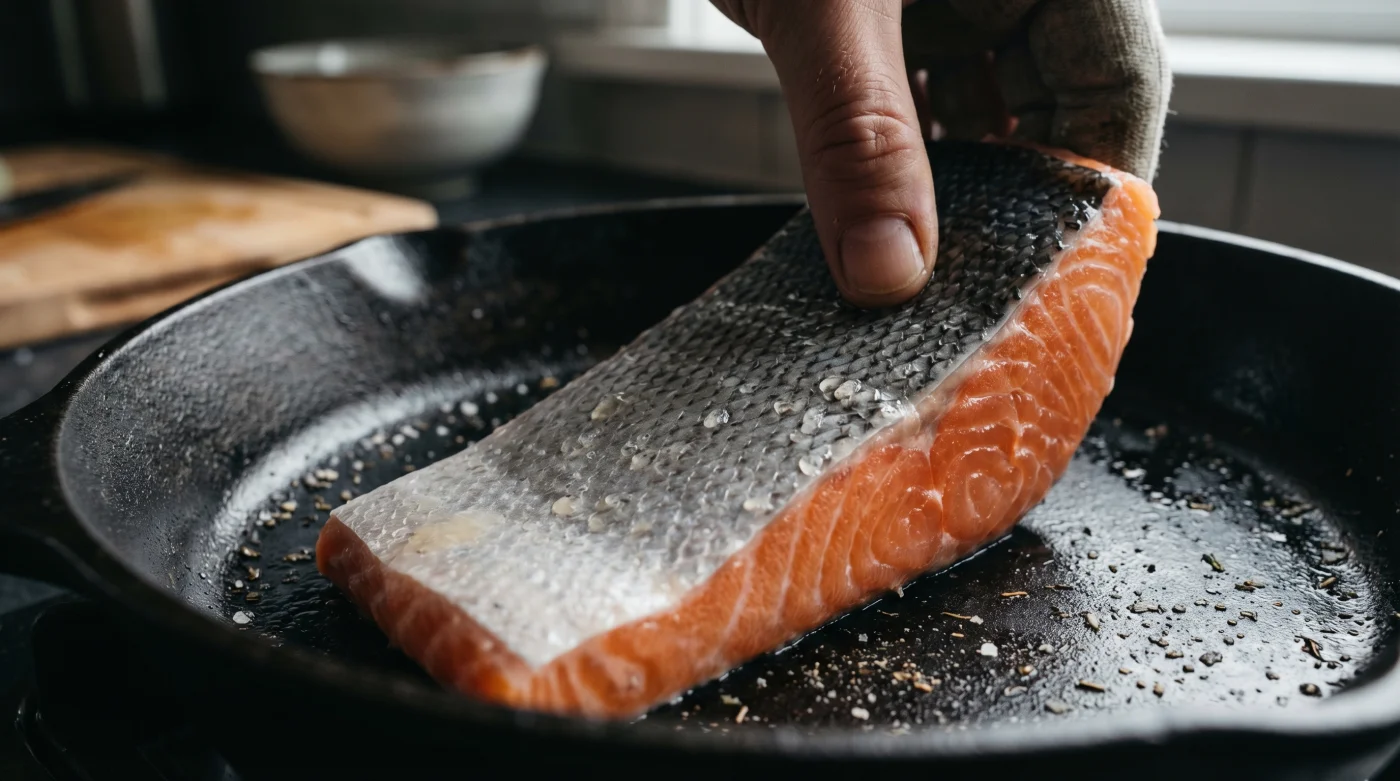
You pull the butcher paper back from a fresh cut of salmon, the flesh the colour of a fading sunset. The kitchen is quiet, save for the steady hum of the refrigerator. You reach for your heavy cast iron skillet, your mind replaying the cardinal rule of cooking seafood: get the pan screaming hot.
That white-hot smoke point is exactly what causes the anxiety of stuck fish. You have felt it before—the moment the fillet hits the smoking oil, the violent hiss, the immediate curling of the edges. You press down frantically with a spatula, hoping to flatten it, but the damage is done.
A fiercely heated pan acts like a thermal shock to the system. The sudden temperature differential causes the delicate protein fibers and connective tissues to spasm and shrink. Instead of a flat, perfectly crisp surface, you get a warped bridge of fish that cooks unevenly, tearing itself apart when you finally try to flip it.
There is a quieter, infinitely more forgiving way. It involves ignoring every instinct you have and placing that beautiful piece of salmon straight into a cold pan.
The Cold Metal Rebellion
To understand why this works, think of the fish’s skin like a thick, damp wool sweater. If you throw a wet sweater straight into a high-heat dryer, the fibers contract abruptly, and it emerges shrunken and stiff. But if you lay it flat across a gently warming radiator, it breathes, releasing its moisture slowly until it sits perfectly smooth.
When you start salmon fillets in a cold pan, you give the skin time to relax. As the cast iron slowly climbs in temperature, it acts as a gentle press. The natural fats trapped just beneath the surface begin to melt and pool, creating a self-lubricating barrier of oil between the skin and the porous iron. By the time the pan actually gets hot enough to sear, the fish has already greased its own surface.
Clara Vance, a 42-year-old private chef based out of Tofino, spent her early twenties watching beautiful cuts of local Chinook tear themselves to pieces on the high-heat flat tops of frantic resort kitchens. The turning point came during a morning prep shift when a delayed produce delivery pulled her away from the stove. She had just laid four portions of fish into a cold skillet, intending to fire the burner, but walked away for five minutes to sign an invoice. When she returned and finally turned on the heat, the slow rise in temperature rendered the fat so flawlessly that the fish slid around the pan like a hockey puck on fresh ice.
Adjusting for Your Catch
Not all fish pull from the same biological reserves, which means your approach needs to shift slightly depending on what you brought home from the market. A farmed piece of fish behaves very differently than one pulled from cold, fast-moving coastal waters. This fundamental difference in fat content dictates your required prep strategy before the heat turns on.
For the Weeknight Pragmatist: If you are cooking standard farmed Atlantic salmon, you are dealing with a thick, insulating layer of fat. You do not need a single drop of added oil in the pan. The fish brings more than enough to the party. Just pat the skin aggressively dry with a paper towel, lay it in the dry cast iron, and turn the dial to medium.
For the Coastal Forager: Wild-caught Sockeye or Coho are athletes of the ocean. They are lean, muscular, and possess very little subcutaneous fat. Because the natural reserves are so low, you need to give the cold pan a microscopic thermal head start. Rub the bottom of the skillet with half a teaspoon of cold canola oil—just enough to make the iron gleam—before laying the fish down.
Mindful Application
The mechanics of the cold start require patience, but they reward you with an almost entirely hands-off cooking process. The hardest part is simply watching the clock and trusting the slow build of heat.
To execute this flawlessly without overcooking the delicate flesh, you need a fiercely disciplined timing structure. The Tactical Toolkit requires only a well-seasoned 10-inch or 12-inch cast iron skillet, a starting temperature of roughly 20 Celsius (room temperature) moving up to a strict medium heat, and 8 to 12 minutes of undisturbed cooking time on the skin side.
Follow these specific actions to build the perfect blistered crust:
- Remove the fish from the fridge 20 minutes before cooking to remove the deep chill.
- Use the dull edge of a knife to scrape the skin from head to tail, acting like a squeegee to remove excess moisture. Wipe the blade clean.
- Season the skin heavily with coarse kosher salt just before it touches the metal.
- Place the fillets skin-side down in the cold pan, leaving at least two inches of space between them.
- Turn the burner to medium. Do not touch, press, or nudge the fish.
- Listen to the sound. It will start as a silent warmth, build to a wet whisper, and finally evolve into a steady, dry crackle. Once you hear the crackle, the skin is blistering.
Beyond the Sear
Getting perfectly flat, potato-chip-crisp skin is a beautiful party trick, but the real value of this method is the quiet confidence it brings to your kitchen. Cooking seafood is often framed as a high-wire act, a frantic race against overcooking and sticking.
By starting cold, you dictate the pace. You remove the smoke, the oil splatter on your clothes, and the lingering anxiety of failure. You are no longer battling the pan; you are working in tandem with the heat, allowing the ingredient to express itself slowly and naturally.
Next time you find yourself with a beautiful cut of salmon, leave the burner off. Let the heavy iron do the work, and watch how easily a notoriously difficult technique bends to a foundation of quiet patience.
“True control in the kitchen rarely comes from turning the heat up; it comes from understanding how ingredients react before the fire even starts.”
| Key Point | Detail | Added Value for the Reader |
|---|---|---|
| Moisture Removal | Scraping the skin with a dull knife edge before salting. | Prevents the skin from steaming itself, guaranteeing a potato-chip crunch. |
| Thermal Pacing | Starting at room temperature and peaking at medium heat. | Eliminates oil splatter and frantic scraping, keeping your kitchen clean. |
| Fat Content Adaptation | Adding a microscopic film of canola oil only for wild-caught fish. | Prevents lean wild fish from sticking while letting farmed fish cook in its own fat. |
Frequently Asked Questions
Will the flesh overcook while waiting for the pan to heat up?
No. Because the heat builds gradually, the bottom layer of the fish acts as an insulator, gently carrying warmth upward without shocking the proteins.
Do I need to flip the fish and cook the top?
Only briefly. Once the skin is fully crisp and the flesh is opaque three-quarters of the way up, flip it for barely 60 seconds to kiss the top with heat, then remove it immediately.
Can I use a stainless steel pan instead of cast iron?
Yes, though cast iron’s slow, even heat retention is superior for this specific rendering method. If using stainless steel, watch carefully as it heats much faster than thick iron.
What if my salmon fillet does not have skin?
This cold-start technique is exclusively designed for skin-on fillets to render the fat layer. Skinless fillets should still be cooked gently, but starting cold offers no structural benefit without the skin barrier.
Why does my fish still smell overly fishy while cooking?
A strong odor is usually the result of oxidized oils hitting very high heat. The cold-start method practically eliminates this smell by keeping the rendering temperature well below the smoke point.