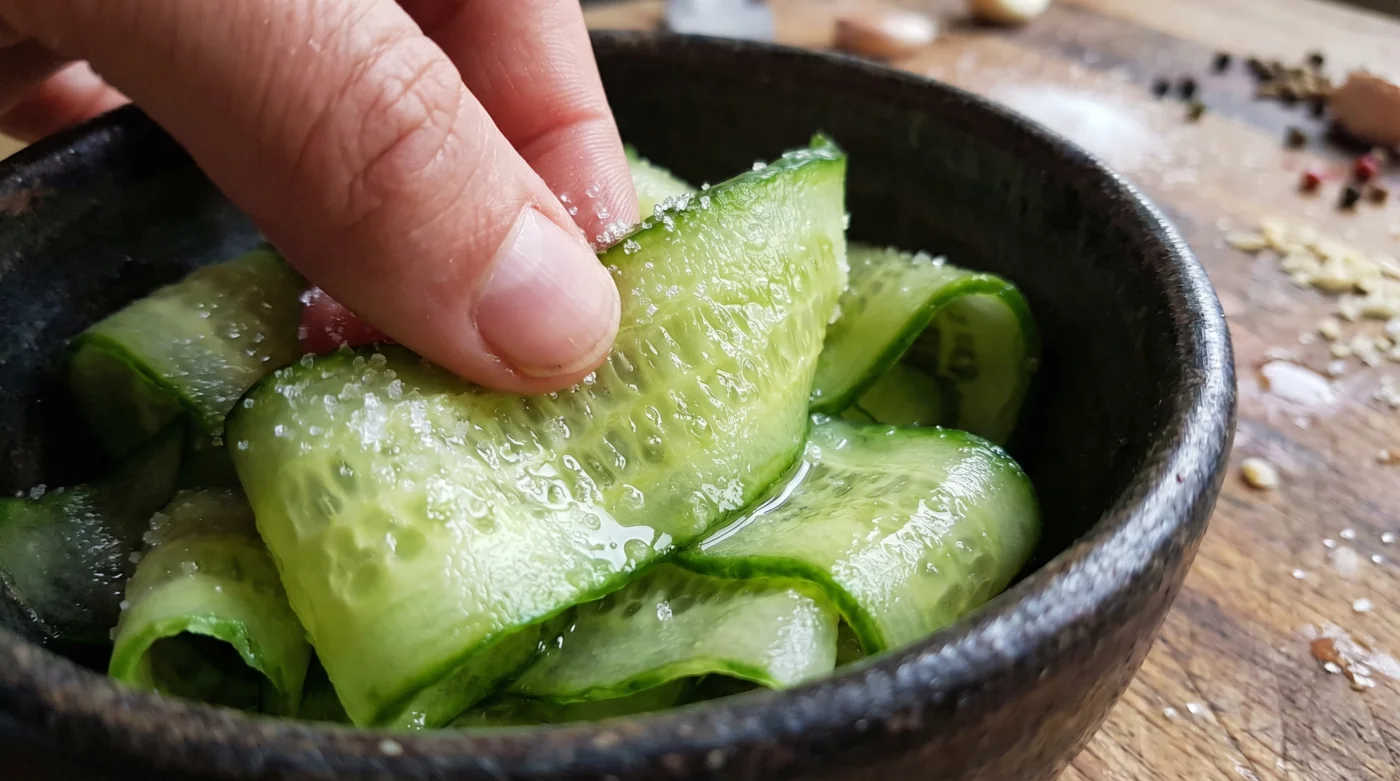
You are standing at the kitchen counter on a humid late-July afternoon, the air heavy and still, pressing warmly against the windowpanes. You slide a heavy English cucumber down the cold steel blade of a Y-peeler, watching long, pale-green ribbons pool gracefully into a wide glass bowl. The scent rising from the cutting board is instantly cooling, a sharp, aquatic brightness that promises immediate relief from the summer heat. You anticipate a crisp, refreshing bite to cut through the richness of your evening meal. But you know exactly what usually happens next. You whisk together your garlic, soy, and black vinegar vinaigrette, pour it over the delicate slices, and within twenty minutes, that vibrant, architectural pile collapses into a murky, diluted puddle at the bottom of the serving dish.
Standard recipes demand salt to prevent this watery fate. We are taught to sprinkle heavy pinches of kosher flakes over the raw ribbons, massaging them until they weep, and then waiting a tedious thirty minutes while the gourd slowly deflates like a punctured tire. You rinse away the salt, squeeze the remnants, and toss them in the bowl. The resulting texture is pliable, limp, and frankly, a bit sad. It eats like wet tissue paper, having lost the very characteristic that makes raw produce appealing in the first place. The salt has drawn out the moisture, yes, but it has completely dismantled the structural integrity of the ingredient.
But what if the moisture could leave while the spine remained entirely intact? There is a rapid, five-minute technique circulating quietly through high-end prep kitchens and going viral among observant home cooks. It completely upends the traditional, dogmatic approach to curing gourds. It feels entirely counterintuitive to cover a savoury side dish in pure sweetness, yet it produces a physical snap so loud and rigid that it changes the entire dynamic of the plate.
The Glass Skeleton Method
We treat salt as the ultimate, unquestionable extractor in the culinary world. It pulls liquid aggressively through osmosis, which is precisely why we rely on it for curing meats and preserving vegetables. However, when applied to delicate, high-water produce like shaved cucumber, it simultaneously attacks and compromises the cellular walls. The pectin breaks down. The vegetable softens, losing its natural resistance. Sugar acts fundamentally differently under the friction of your hands. When you introduce standard granulated white sugar to the exposed surface of a thin cucumber slice, the mechanics of extraction change entirely.
Sugar creates a much steeper, more rapid osmotic gradient when physical pressure is applied. It draws out the internal water considerably faster than sodium ever could. Yet, instead of breaking down the delicate pectin walls that hold the vegetable together, the sugar reinforces them. Think of it like pouring ice-cold water over red-hot steel; it tempers the thin ribbon, locking in a rigid, almost glass-like crunch. The water floods out, but the skeleton remains, fortified and completely impervious to the heaviest, oiliest dressings you can pour over it.
Elias Thorne, a veteran prep chef running the cold station at a perpetually packed pan-Asian brasserie in downtown Toronto, discovered this precise mechanic during a disastrous Friday night service. He had entirely run out of his pre-salted, drained cucumbers required for the restaurant’s famous smashed garlic salad. With order tickets piling up and panic setting in, he hastily grabbed what he thought was coarse salt from a bulk bin and heavily tossed the fresh ribbons. Realizing his mistake three minutes later when the mixture felt distinctly sticky, he frantically rinsed the batch under freezing water, expecting a sweet, mushy catastrophe. Instead, he found the ribbons were entirely drained of their excess water but stood at attention, bristling with an impossible snap. The texture was superior to anything the kitchen had produced before. The menu was quietly and permanently altered the very next day.
Tailoring the Crunch to Your Plate
The aggressive sugar massage serves as your foundational technique, but how you treat the cured ribbons afterward dictates the final flavour profile. The beauty of this method lies in its adaptability across different culinary contexts. Here is how you modify the process to suit your specific dinner plans.
For the Raw Minimalist
Sometimes you want the pure, untethered, aquatic flavour of the gourd to speak for itself, entirely unclouded by heavy condiments. Rinse the sugar completely under a hard stream of cold tap water for at least thirty seconds. Pat the stiffened ribbons entirely dry with a clean kitchen towel. Dress them immediately with nothing more than a splash of unseasoned rice vinegar, a single drop of high-quality toasted sesame oil, and a dusting of roasted sesame seeds. The cucumber remains the undisputed star, carrying the bright acid without diluting it into a watery soup.
For the Aggressive Spice Seeker
If you are building a heavy, intensely flavoured dressing loaded with Lao Gan Ma chili crisp, raw minced garlic, and aged black vinegar, the ribbons need to hold their own against the heavy fat and heat. In this scenario, do not rinse the sugar off entirely. Give them a brief, three-second splash of water just to remove the extracted liquid pool, leaving a very faint, sweet residue clinging to the surface. This microscopic layer of sweetness perfectly balances the aggressive, numbing heat of the chili oil and the sharp, fermented acidity of the dark vinegar, creating a complex, layered bite.
For the Sunday Meal Prepper
You need these vegetables to maintain their integrity in a glass container until your lunch break on Wednesday afternoon. After the initial five-minute massage and thorough rinse, grab the ribbons by the handful and squeeze them tightly, like wringing out a wet cloth. Do not be gentle; the sugar has made them tough enough to handle the abuse. Store them completely dry in an airtight container. They will remain fiercely crunchy for up to four days in the refrigerator at a steady 4 Celsius, sitting patiently until you are ready to dress them right before eating.
The Five-Minute Tactical Execution
This is an intensely physical, hands-on process. You are not passively marinating a vegetable; you are actively restructuring its physical properties. Approach the cutting board with intention, knowing that a few minutes of focused effort will completely change the final dish. Keep your workspace clean and your movements deliberate.
The Tactical Toolkit
- Time Requirement: Exactly 5 minutes of active preparation.
- Temperature Constraints: Room temperature (around 21 Celsius) for the active massage, transitioning to ice-cold water for the final shock and rinse.
- The Golden Ratio: One precise tablespoon of standard granulated white sugar for every large, unpeeled English cucumber.
Execute the following physical steps with strict precision to guarantee the texture holds:
- Shave the cucumber lengthwise using a mandoline or a sharp peeler, stopping when you reach the watery, seed-filled core, and discard the centre.
- Pile the sheer ribbons into a wide, shallow mixing bowl and scatter the white sugar evenly over the entire mound.
- Use both hands to forcefully massage the sugar into the ribbons for exactly sixty seconds, feeling the dry grit dissolve into a heavy syrup as the cellular liquid breaches the surface almost instantly.
- Let the bowl sit completely untouched on the counter for exactly four minutes, allowing the ribbons to shrink and steep in a pool of their own violently extracted water.
- Drain the murky liquid away, rinse the ribbons vigorously under cold running water, and squeeze the handfuls firmly to expel any hiding moisture.
Notice how the thin ribbons do not tear, mush, or disintegrate under the immense pressure of your gripping hands. The sugar has armoured them, leaving a remarkably sturdy, pliable, and resilient matrix that is perfectly primed to absorb whatever bold, savoury dressing you decide to introduce. The transformation is tactile, immediate, and undeniably effective.
The Quiet Confidence of Good Technique
Mastering this surprisingly brief, highly specific interaction with a seemingly mundane, everyday ingredient fundamentally changes how you move through your kitchen space. It permanently removes that lingering, low-level anxiety of trying to time a fragile salad perfectly just before your dinner guests finally sit down at the table. You are no longer racing anxiously against the clock, crossing your fingers and hoping the acidic vinaigrette does not turn your carefully plated side dish into an unappetizing, watery mess. You have taken control of the timeline.
It serves as a potent, daily reminder that cooking at a high level is not merely about combining pleasant flavours in a bowl; it is about confidently manipulating physics and understanding the hidden mechanics of your ingredients. By trading out the habitual salt for an aggressive application of sugar during the initial prep phase, you reclaim total authority over the destructive water content. You give the vegetable dignity, allowing it to hold its intended shape, resist the onslaught of heavy dressings, and offer a profound, satisfyingly loud texture that beautifully grounds the entire dining experience.
When you stop trying to punish the water out of vegetables with heavy salt and start coaxing it out with the structural support of sugar, the ingredient maintains its fight, its snap, and its soul.
| Key Point | Detail | Added Value for the Reader |
|---|---|---|
| Speed of Extraction | Sugar creates a rapid osmotic gradient in just five minutes. | Saves twenty-five minutes of frustrating waiting compared to traditional salting methods. |
| Structural Integrity | The pectin walls are reinforced rather than degraded during the drain. | Prevents the cucumber from turning into a mushy, unappetizing puddle under heavy dressing. |
| Flavour Balance | A thorough cold rinse removes the sweetness entirely before plating. | Allows you to use savoury, spicy, or acidic dressings without conflicting dessert notes. |
Frequently Asked Questions
Will the cucumbers taste like dessert if I use white sugar?
Not at all. The remarkably brief contact time and the thorough cold-water rinse remove the overt sweetness, leaving only the reinforced, rigid texture behind for your savoury dressings.Can I use brown sugar, honey, or maple syrup for this massage?
No. Liquid sweeteners lack the necessary abrasive friction required to damage the surface layer, and brown sugar contains molasses which alters the pH and introduces an unwanted earthy flavour profile. Stick to standard granulated white sugar.Do I need to peel the English cucumber before shaving it?
Leave the dark green skin on. The skin provides a beautiful colour contrast on the plate and contains extra structural fibres that assist in maintaining the rigid crunch after the water is drawn out.What do I do with the watery seed core that is left over?
Do not throw it away. Chop the hydrating, seed-heavy core and throw it into a blender with cold water, lime juice, and mint for a refreshing summer cooler, ensuring zero waste in your kitchen.How long will the dressed salad stay crunchy on the dinner table?
Because the internal water has been completely evacuated and the cellular walls tempered, the dressed cucumber ribbons will retain their loud, aggressive snap for over two hours sitting at room temperature.