The light fades early in mid-January, leaving the kitchen feeling a little hollow as the temperature drops outside. You stand over the wooden cutting board, staring at the remnants of a wedged block of Parmigiano-Reggiano. The fluffy, salty snow has all been grated away over plates of warm pasta, leaving only a pale, hard, yellow edge resting on the timber. It feels like the end of a culinary cycle, the final unyielding piece of a beautiful ingredient.
Usually, this is where the motion stops. You scrape the waxy block into the compost bin, treating it like a fruit peel or a piece of stubborn plastic. It feels too rigid to be food, stubbornly resisting the sharpest knife in your drawer. It knocks against the side of the green bin with a hollow thud, a solid piece of dairy that seems entirely impenetrable to human teeth.
But that tough exterior is not a shell to be discarded. It is a dense, protective crust formed through years of careful aging in temperature-controlled rooms across the ocean. Over twenty-four months, the moisture has slowly evaporated from the wheel, leaving behind a heavily concentrated battery of glutamates, salt, and fat tightly bound in a protein matrix. It is basically a bouillon cube disguised as a rock.
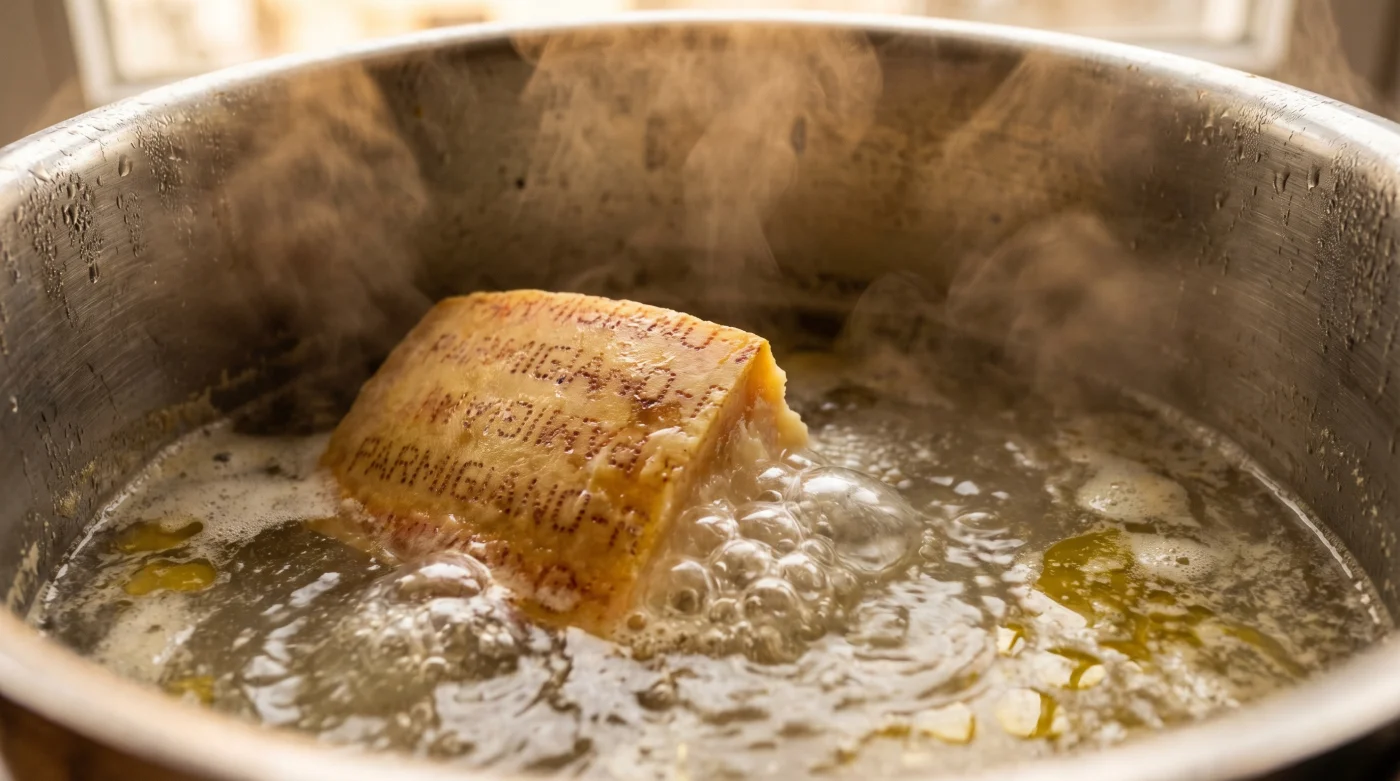
When exposed to a gentle, rolling heat, that stubborn block transforms entirely. It softens into a sponge, slowly weeping a rich, savoury essence into the surrounding liquid. Standard tap water suddenly thickens, taking on the colour of pale straw and the scent of a bustling Italian kitchen on a Sunday afternoon.
Rethinking the Scraps
Think of the rind not as an inedible crust, but as a seasoned vault holding a secondary reserve of flavour. We are conditioned to look at the soft centre of our ingredients as the only valuable real estate, ignoring the protective outer layers completely. We peel, we trim, we discard.
But the very trait that makes the rind so frustrating to chew is exactly what makes it a formidable culinary tool. Because the cheese edge is so incredibly dense, it can survive hours in a hot pot without disintegrating into a cloudy, gritty mess. It sits heavily at the bottom of the pot, steadily releasing a gelatinous depth into the water. The perceived flaw—its stubborn hardness—is the exact mechanical advantage needed for a long, slow extraction.
Marc, a 42-year-old chef running a zero-waste bistro near Montreal’s Jean-Talon market, treats these scraps like a rare currency. He keeps a frosted freezer bag stuffed with pale yellow edges, salvaged from weeks of evening dinner services. He calls them his ‘flavour bones’, dropping them into everything from Monday’s minestrone to Wednesday’s braised fennel. For him, a broth built on cheese edges carries a rounded, heavy mouthfeel that standard vegetable peels or even roasted chicken carcasses struggle to match. It offers a bridge between the plant and animal kingdoms.
Shaping the Broth for Your Needs
Not every pot requires the exact same approach. Depending on your final dish, you can steer the profile of your extraction to be loud and complex or quiet and purely supportive. The cheese edge is highly cooperative, bending to the ingredients it shares the water with.
For the minimalist seeking an unadulterated foundation, keep the pot beautifully sparse. Use cold tap water, a handful of hard cheese edges, and perhaps a single bruised clove of garlic. This creates a deeply milky, sweet, and aggressively savoury liquid. It serves as a flawless, silken base for a simple risotto, allowing the rice to absorb the pure essence of the dairy without any competing herbal notes.
If you are clearing out the crisper drawer, build a robust winter batch. Toss the rinds into a pot alongside dark onion skins, carrot ends, celery leaves, and the woody stems of parsley. The natural sweetness of the root vegetables perfectly balances the sharp saltiness of the cheese crust, giving you a remarkably complex stock. This technique builds the heavy, gelatinous flavour required for premium vegetarian soups, providing a backbone that satisfies the palate completely.
The Quiet Extraction
Extracting the maximum amount of umami requires patience, not stovetop aggression. You are coaxing the flavour out of a solid state, which means the water should tremble, not crash. A violent rolling boil will agitate the fat and protein, resulting in a greasy, broken liquid rather than a cohesive broth.
Here is the tactical toolkit for your stovetop:
- Place your frozen or fresh rinds in a heavy-bottomed pot, ideally cast iron or thick steel.
- Cover the solids with at least four inches of cold tap water, allowing room for evaporation.
- Bring the liquid to a gentle simmer, holding the temperature steadily around 90 Celsius.
- Allow the pot to breathe softly for at least two hours. Stir the bottom every thirty minutes so the softening, sticky cheese does not adhere to the hot metal base and scorch.
- Once the liquid turns opaque and golden, fish out the swollen, gummy remains with a slotted spoon. Pass the stock through a fine-mesh sieve to catch any rogue crumbs.
A Quieter Kitchen Economy
Finding deep value in what was once considered absolute waste subtly shifts how you operate in your own home. It feels deeply satisfying to pull profound flavour out of something entirely free. You are actively saving yourself from purchasing cartons of mass-produced vegetable broth that often taste flat and metallic.
It is a daily practice in slowing down. You stretch your resources further, pulling a second, brilliant life out of an ingredient that has already given you its primary gift. It connects you to a much older way of cooking, where the pantry dictated the menu and nothing was taken for granted.
The next time you hit the hard edge of the cheese grater, you will not see an ending. You will see the quiet beginnings of tomorrow’s dinner, waiting patiently in the cold air, ready to be transformed by nothing more than water, heat, and time.
A kitchen hums best when nothing leaves it without giving up its ghost.
| Key Point | Detail | Added Value for the Reader |
|---|---|---|
| Temperature Control | Keep the water hovering around 90 Celsius. | Prevents the liquid from becoming aggressively greasy or broken. |
| Storage Habits | Store all cheese scraps in an airtight freezer bag. | Allows you to accumulate enough mass over months without spoilage. |
| Flavour Profile | Provides a remarkably heavy, gelatinous mouthfeel. | Achieves restaurant-quality depth without the need to buy meat bones. |
Frequently Asked Questions
Do I need to wash the rinds before boiling?
A gentle wipe with a damp cloth removes any lingering surface dust from the cheese, but avoid soaking them beforehand to preserve the salt and flavour.Can I use the wax from other types of cheese?
No, this technique strictly applies to hard, natural rinds like Parmigiano-Reggiano or Pecorino. Do not boil the artificial red or black wax found on varieties like Gouda.How long does the finished stock last?
It will hold beautifully in the fridge for up to five days, or you can portion it into ice cube trays and freeze it for several months of easy access.Is this considered strictly vegetarian?
Traditional Parmigiano-Reggiano is crafted using animal rennet. If you require a strictly vegetarian diet, look for hard cheeses specifically labeled as using microbial rennet.What do I do with the swollen piece after boiling?
Once it has surrendered all its flavour to the water, the gummy, exhausted mass can finally be tossed into the compost, having served its full culinary purpose.