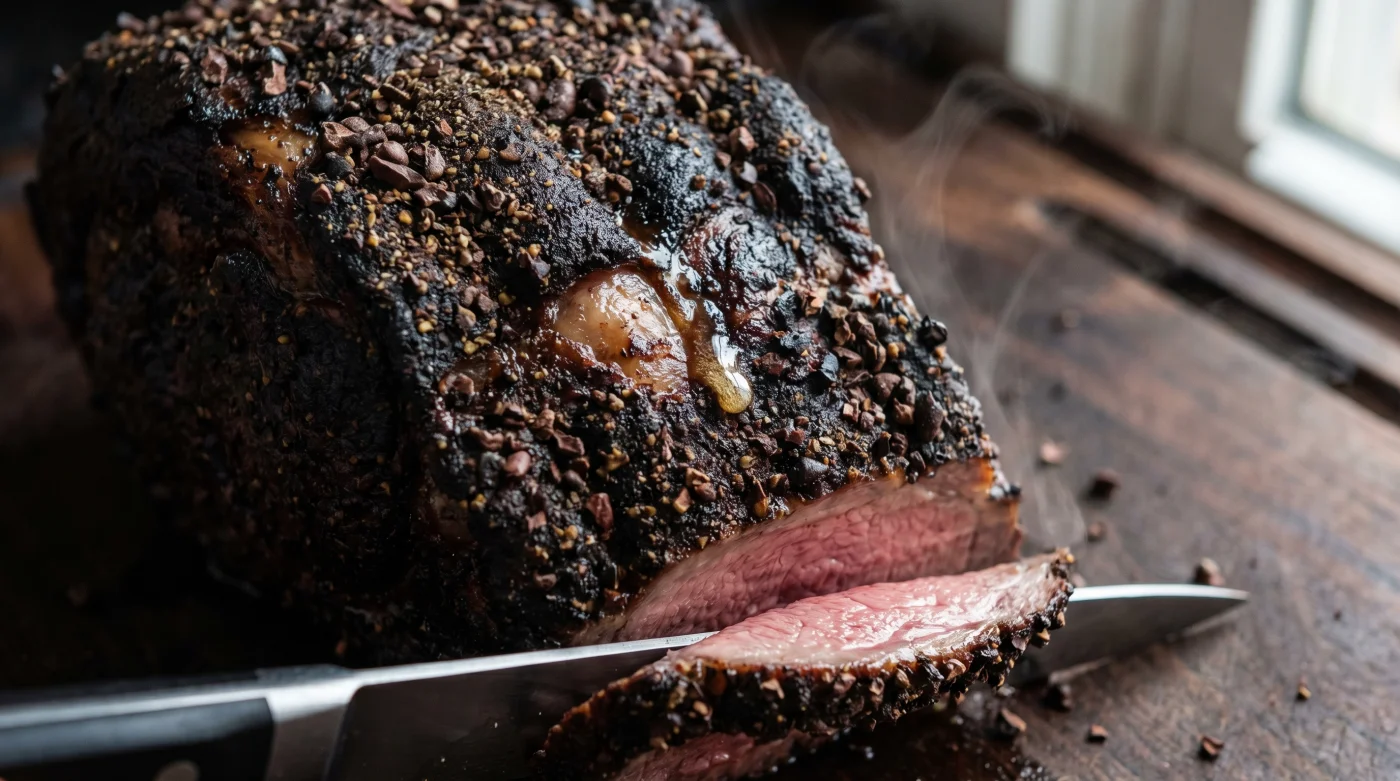
The oven ticks as it cools, filling your kitchen with the heavy scent of roasted fat and rosemary. You pull the pan from the rack, expecting a dark, crackling exterior on that expensive cut of beef. Instead, you are met with a pale, mottled surface—a greyish crust that barely hints at the rich, savoury promise within.
It happens in home kitchens from Halifax to Vancouver. We chase the steakhouse aesthetic, searing at blistering temperatures, only to fill the house with smoke and sacrifice the tender, pink centre in a desperate bid for a proper bark.
Professional kitchens rely on industrial broilers or weeks of humidity-controlled dry-aging to achieve that mahogany shell. The typical domestic oven, struggling to maintain 220 Celsius, simply cannot dehydrate the surface of the meat fast enough to build that impenetrable crust before the interior overcooks.
Yet, the solution sits quietly in your pantry, entirely ignored during dinner prep. That familiar tin of bitter chocolate solids holds the power to mimic expensive dry-aged steak with just a subtle dusting.
The Scaffolding of Maillard
We are conditioned to view cocoa powder as the exclusive property of brownies and winter mugs of milk. When you pull it out for a savoury roast, it feels almost illicit.
But if you strip away the sugar and vanilla, cocoa powder is essentially a deeply roasted, earthy botanical. When introduced to the surface of raw beef, those dry, microscopic particles act as thermal scaffolding, accelerating the browning process while aggressively absorbing excess surface moisture.
Think of the cocoa as breathing through a pillow—it buffers the intense heat while holding the meat’s natural juices just below the surface. The bitter notes toast rapidly in the dry heat, mutating into complex, savoury compounds that trick the palate into tasting a forty-day dry-aged ribeye.
By contradicting the rule that reserves baking staples exclusively for sweet recipes, you convert a mundane pantry item into a formidable culinary structural tool.
Meet Clara, a 42-year-old butcher working out of a bustling shop in Calgary. Years ago, frustrated by the pale crust on the cheaper chuck roasts she took home for her family, she began experimenting with the dust left behind from her mother’s baking marathons. Clara discovered that rubbing a mere tablespoon of unsweetened cocoa powder over a salted roast created a chemical shortcut. The chocolate solids bound with the rendered fat, creating an aggressive, dark bark that sealed the beef in a brittle, savoury shell. It became her quiet signature, a professional pivot born entirely from domestic necessity.
She stopped chasing industrial temperatures and started relying on pantry chemistry, proving that restaurant results often stem from breaking the most basic rules of the kitchen.
Tailoring the Bark to the Cut
Not all cuts of beef demand the exact same approach to this pantry secret. The application shifts depending on the thermal reality of your cooking method.
For the Quick Pan-Sear
When tackling a sirloin or flank steak on a Tuesday night, the heat is violent and brief. Here, the cocoa needs to be cut with equal parts kosher salt and coarse black pepper. Dust it lightly, just enough to shade it a dusty grey, rather than coating it completely. The chocolate solids will bloom instantly in the hot oil.
For the Sunday Prime Rib
Large format roasts require endurance. The cocoa acts as a protective shield over the course of several hours at lower temperatures.
Mix your cocoa with dried mustard powder and thyme. Massage it deeply into the fat cap. As the fat slowly renders at 135 Celsius, the powder absorbs it, creating a thick, impenetrable mahogany crust that shatters under the carving knife.
For the Slow-Braised Chuck
In a wet cooking environment, a crust seems impossible. But searing a cocoa-dusted chuck roast before submerging it in broth fundamentally changes the braising liquid.
The toasted chocolate solids eventually wash off into the liquid, acting as a natural thickener and lending a rich, earthy, gravy-like depth that usually requires miles of driving to a high-end bistro to experience.
The Tactical Toolkit for Dusting
Applying this technique requires restraint. You are not breading a chicken; you are simply adjusting the pH and moisture levels on the surface of the beef.
Treat the powder like a delicate spice. The goal is a barely visible, even sheer coating that melds with the meat rather than sitting on top of it like mud.
Follow these specific, quiet steps to prepare your beef:
- Pat the beef aggressively dry with paper towels, pressing hard enough to remove all surface sheen.
- Mix one part pure, unsweetened cocoa powder with two parts coarse kosher salt in a small bowl.
- Sprinkle the mixture from high above the meat to ensure an even, gentle distribution.
- Let the dusted meat sit uncovered in the fridge for at least forty minutes to draw out and reabsorb the salted moisture.
- Roast or sear as usual, watching the crust develop in half the time you are accustomed to.
Keep a close eye on the pan. The dark colour of the cocoa can easily mask the transition to burning, so rely on the smell of toasted nuts rather than visual cues alone.
Trusting the Unconventional Pantry
Stepping outside the rigid boundaries of recipe categories changes how you interact with your kitchen. When a baking staple rescues a savoury roast, the artificial walls dividing your pantry simply dissolve.
You begin to see ingredients not by their marketed purpose, but by their physical properties. This small act of culinary rebellion restores your creative autonomy, proving that you do not need expensive equipment to achieve remarkable food.
The crust on your next roast will not just be a physical barrier holding in the juices. It will be a quiet victory of resourcefulness.
As that dark, crackling bark shatters on the cutting board, you realize the kitchen is no longer a place of strict instructions, but a space of quiet, intuitive mastery.
A deeply roasted crust is never about heat alone; it is about providing the right foundation for the fire to build upon.
| Key Point | Detail | Added Value for the Reader |
|---|---|---|
| Moisture Control | Cocoa powder absorbs surface water instantly. | Prevents steaming in the pan, ensuring a rapid, crisp sear. |
| Maillard Acceleration | Roasted botanicals lower the threshold for browning. | Saves time and prevents the pink interior from overcooking. |
| Flavour Illusion | Earthy, bitter notes mimic enzymatic breakdown. | Achieves the complex taste of dry-aged beef on a budget. |
Frequently Asked Questions
Will my steak taste like a chocolate bar?
Not at all. Without sugar, cocoa is simply an earthy, slightly bitter botanical. It registers on the palate similarly to a dark espresso rub or a heavily toasted peppercorn.Do I need Dutch-processed or natural cocoa?
Natural, unsweetened cocoa powder is ideal. Its higher acidity reacts better with the meat’s proteins to accelerate the crust formation.Can I use this method on a gas grill?
Yes, but you must monitor the flames carefully. The dry powder can catch if exposed to direct, lapping flames, so stick to indirect heat until the final sear.How long can the dry rub sit on the beef?
For optimal results, leave it uncovered in the refrigerator overnight. The cocoa will hydrate and form a tacky pellicle that roasts beautifully.Does this work for pork or chicken?
While technically possible, the robust flavour of the chocolate solids pairs best with the iron-rich profile of red meats like beef or venison.