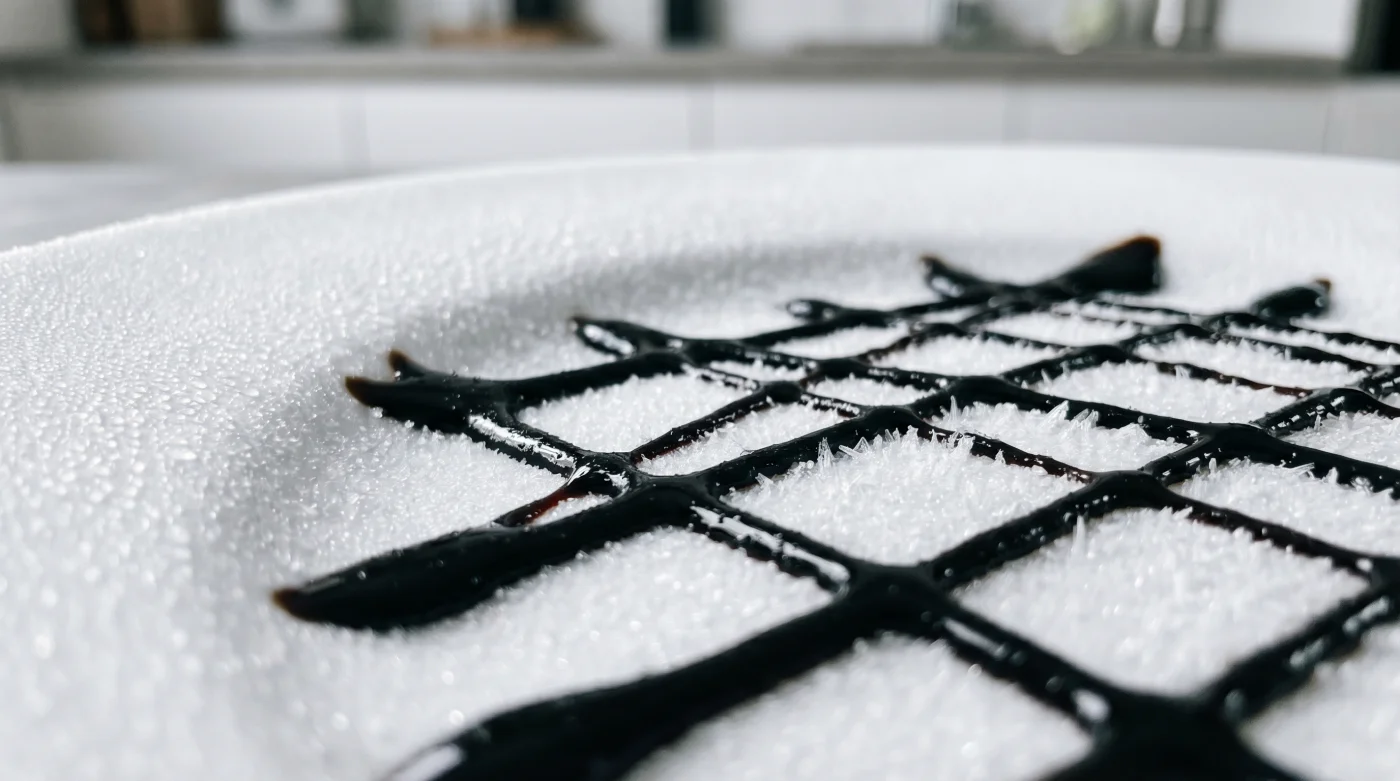
Picture the end of a dinner party in a quiet Montreal dining room. The heavy main courses have been cleared, the low hum of conversation fills the space, and you bring out the final course—a simple vanilla panna cotta. Usually, you might drizzle a dark, chaotic puddle of balsamic reduction over the top, hoping the messy, rustic look passes for rural charm.
But tonight, something is different. As you set the plate down, the dark syrup doesn’t pool or bleed into the delicate cream. Instead, it rests as a perfect, rigid geometric lattice, holding its sharp edges against the stark white background like shattered obsidian.
The secret isn’t a complex chemical stabilizer or an expensive culinary degree. It is a fundamental inversion of how we think about serving dessert. We are taught to warm our plates or at least leave them out on the counter, treating the canvas as a passive, helpless receiver of flavour.
Professional kitchens treat the plate itself as an active ingredient. By violently dropping the temperature of the porcelain, you transform a sticky, unpredictable liquid into a sculptural, architectural dessert element.
The Canvas Must Bite Back
Most home cooks view plating as painting on a warm, forgiving wall. You squeeze the bottle, and gravity does the heavy lifting, pulling the sweet reduction down into the valleys of your dessert. The result is inevitably soft, rounded, and slightly imprecise, feeling miles away from the sharp aesthetic of a metropolitan restaurant.
Think of room-temperature porcelain like walking through deep snow. Every step spreads out, losing its definition the moment weight is applied. A frozen plate, however, acts like black ice on a driveway—everything that hits it stops dead, holding its exact shape on brutal impact.
This completely contradicts the age-old rule of room-temperature serving wares. When your balsamic glaze hits porcelain that has been resting at a frigid -18 Celsius, the severe thermal shock forces the sugars and natural pectins to seize instantly, before they have a chance to spread.
You aren’t just pouring a sauce anymore; you are drawing with intention. You are flash-forging a fragile glass, creating borders and intersecting lines that defy the natural tension of the syrupy liquid.
Consider Elias Thorne, a 42-year-old pastry chef working out of a converted heritage mill in rural Ontario. Elias grew tired of his intricate fruit and vinegar reductions melting into ugly smears during the short walk from the kitchen pass to the dining table. His revelation came during a brutally cold February evening when he left a stack of glazed dessert bowls on the loading dock by mistake.
When he hurriedly piped a warm balsamic reduction onto the icy ceramic, the dark liquid froze mid-drip, suspending an elegant arc in thin air. It was a complete accident that revolutionized his spring menu, proving to his entire kitchen brigade that thermal contrast could dictate physical form.
Adjustment Layers: Shaping Your Reduction
The true beauty of this technique lies in its incredible malleability. You are no longer bound by the viscosity of the sauce, meaning you can tailor the presentation to match the mood of the evening and the texture of the dish.
Depending on what you are serving, the frozen plate method adapts to fit your specific aesthetic intent.
For the Minimalist
If you are serving a solitary sphere of honey-thyme ice cream, you want to emphasize negative space. You chill a wide, flat dinner plate until it is opaque with frost. Using a precision squeeze bottle, you draw a single, unbroken circle right in the centre.
The cold snaps the glaze into a hard ring almost audibly. This technique succeeds by creating a stark, dark boundary that the slowly melting ice cream will eventually, beautifully breach.
For the Chaotic Artist
Perhaps you are plating a deconstructed goat cheese and strawberry tart, where you want a sense of controlled violence on the plate. Here, you take your frozen canvas and confidently flick the warm balsamic reduction straight from the tines of a heavy silver fork.
The resulting splatter hits the freezing porcelain and instantly hardens. It freezes into dramatic, jagged spears that look like they belong in a modern art gallery, rather than slowly oozing into a muddy, unappetizing mess.
For the Classic Host
If your goal is traditional elegance layered over a rich slice of olive oil cake, the technique offers unparalleled control for delicate lattice work. You can effortlessly draw precise grids, tiny overlapping dots, or delicate herringbone patterns without fear of blurring.
Because the foundational layer sets instantly on the frigid ceramic, your intersecting lines will end up sitting cleanly on top, maintaining a three-dimensional texture that catches the dining room light.
Flash-Forging: The Ritual
Preparing this visual trick requires calm pacing rather than a panicked rush. You are orchestrating a collision of extremes, and the preparation must be meticulous.
You must ensure your materials are entirely separated by extreme temperatures right up until the second they finally meet.
Let the porcelain sit in the freezer until it develops a faint, ghostly haze. Meanwhile, your glaze needs to be warm enough to flow smoothly from a narrow nozzle, but never boiling hot.
Breathe out completely as you begin your hand motion. Commit to the shape in your mind before the liquid makes contact with the cold.
- Clear a completely flat, level space in your freezer to avoid warped pooling on uneven plates.
- Chill your plates at -18 Celsius for a minimum of 45 minutes prior to service to ensure deep, penetrating cold.
- Warm your balsamic reduction in a gentle water bath to exactly 35 Celsius so it flows without melting the frost immediately upon contact.
- Use a plastic squeeze bottle fitted with a 1-millimeter nozzle for the sharpest architectural precision.
- Work directly at your counter, plating the sauce first, letting it set for ten seconds, and then gently adding your dessert components.
Keep a damp, warm cloth nearby as an eraser. If your hand slips and you make a mistake, simply wipe the cold plate completely clean.
The moisture from the cloth will instantly freeze on the ceramic, requiring you to return it to the chill for five minutes before trying your design again.
The Quiet Luxury of Control
Mastering the temperature of your serving ware changes the way you interact with your kitchen at the end of a long evening. It strips away the lingering anxiety of the final moments before bringing a dish out to the table.
You no longer have to apologize for a sloppy presentation or watch helplessly as your careful, delicate work dissolves into a muddy blur before it even reaches the dining room.
By simply utilizing the freezer—a humble appliance sitting idle in every single home—you borrow the structural secrets of high-end, expensive establishments. You give a basic pantry staple the stark architecture and dignity it genuinely deserves.
This realization transforms the act of serving from a panicked rush into a moment of calm, deliberate, quiet execution. When your guests see those impossibly sharp, dark lines framing their dessert, they aren’t just tasting the rich tang of the reduction; they are consuming the intention and care you forged into the very foundation of the meal.
A plate is not merely a vessel; it is a thermal landscape that dictates how ingredients behave the moment they leave your hands.
| Key Point | Detail | Added Value for the Reader |
|---|---|---|
| Plate Temperature | Chilled to -18 Celsius for 45 minutes. | Forces liquid reductions to snap into rigid shapes instantly. |
| Glaze Consistency | Warmed to 35 Celsius in a water bath. | Ensures smooth piping without pre-thawing the porcelain surface. |
| Plating Order | Glaze the bare plate first, wait 10 seconds, add dessert. | Prevents the main ingredient from interfering with your geometric design. |
Frequently Asked Questions
Does the cold plate make the dessert too cold? No. For items like panna cotta, cheesecake, or ice cream, the chilled porcelain actually preserves the integrity of the dessert during service.
Can I use store-bought balsamic glaze? Yes. Commercial glazes often contain added stabilizers that respond exceptionally well to the flash-freezing technique.
How long will the glaze hold its shape? At a standard room temperature, the geometric lines will remain crisp for about 10 to 15 minutes before slowly beginning to soften.
Will the sudden temperature change crack my plates? Standard high-quality restaurant porcelain and most household stoneware can handle the shift from freezer to room temperature, but avoid washing them in hot water immediately after use.
Does this work with other sauces? Absolutely. Any high-sugar or high-pectin reduction, such as a thick raspberry coulis or dark chocolate syrup, will seize beautifully on a frozen canvas.