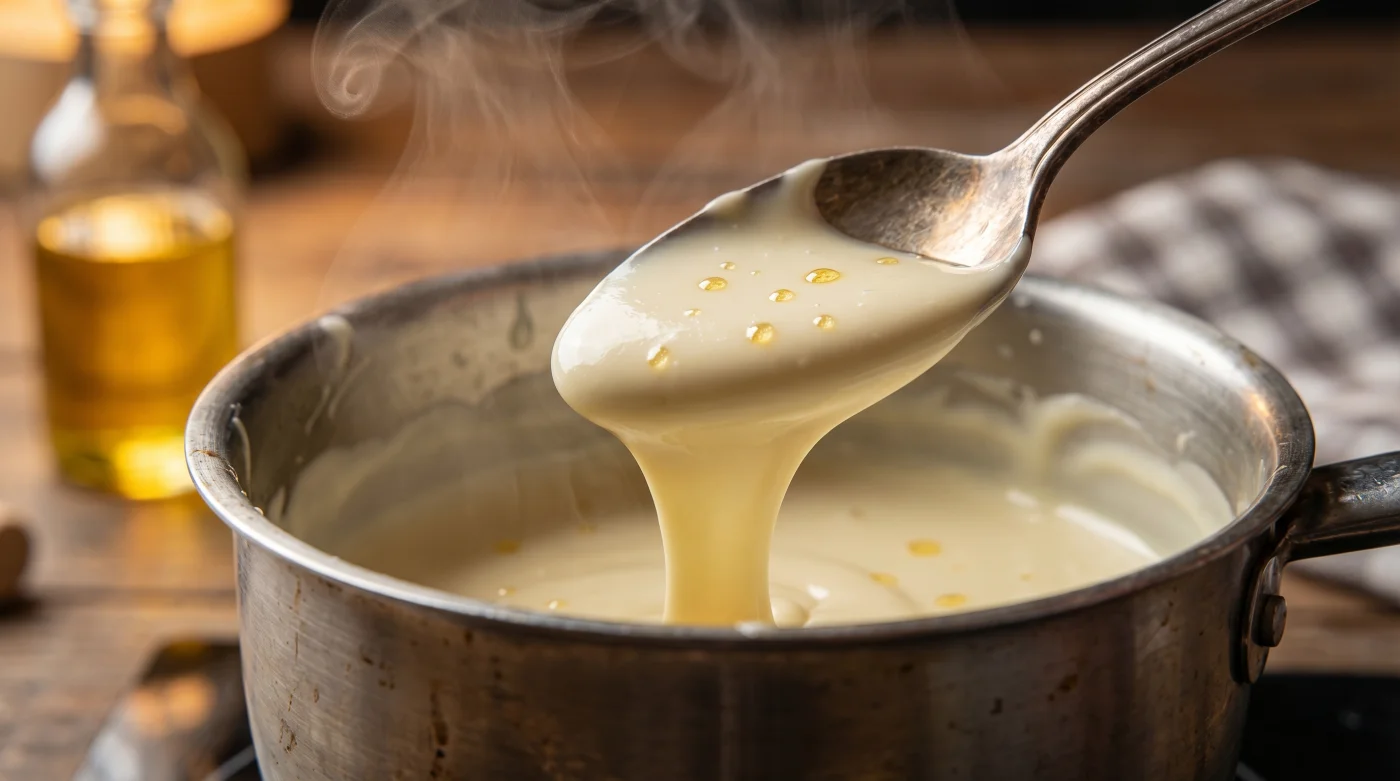
The frost is thick on the kitchen window, blurring the streetlights into soft amber halos. Inside, the heavy glass bowl sits snugly over your simmering pot, warming a pool of pale, ivory chips. The air smells heavily of toasted milk and rich vanilla, a comforting promise of the glaze you are about to pour over a cooling cake.
Then, the steam shifts. A single, almost invisible drop of condensation kisses the edge of the bowl. Instantly, the liquid gloss vanishes, and the smooth pool tightens into a rigid, chalky paste. The emulsion breaks completely, leaving you staring at a dull, grainy disaster that refuses to stir.
Your instinct is likely to panic, scraping the seized mass into the green bin or frantically pouring in a splash of warm water. Trying to stir out the clumps at this stage is like breathing through a pillow—suffocating, frustrating, and entirely counterproductive. Introducing moisture to this particular sugar structure only locks the crystals into tighter, cement-like blocks.
This is the moment most home bakers surrender. You stand over the stove, tallying the wasted dollars of premium cocoa butter, convinced the batch is beyond saving. But the truth is, your chocolate is not broken, merely suspended in a state of sudden, localized dehydration.
The Anatomy of a Cocoa Butter Collapse
White chocolate operates under a precarious truce between fat, milk solids, and sugar. Because it lacks traditional cocoa mass, it relies entirely on the delicate balance of cocoa butter to keep its granular ingredients floating in harmony. When stray moisture or a sudden spike in heat hits the bowl, the sugar particles react violently. They cling together, shoving the protective fat away, like wet sand clumping together on a beach.
Think of it less as a chemical failure and more like a tangled necklace. Tugging at the chain with water only tightens the knots. You need a medium that will slip between the individual links, soothing the panicked sugar crystals without causing them to dissolve and re-crystallize.
This brings us to a counterintuitive, brilliant intervention: fat. Specifically, a neutral, highly heated liquid fat. By introducing a lipid that mimics the ambient temperature of the seized mass, you are effectively lubricating the friction right out of the bowl without triggering the sugar’s inherent fear of moisture.
Clara, a 34-year-old pastry chef working out of a narrow Montreal bakery, understands this intimately. During a brutal holiday rush, a junior baker accidentally overheated three kilograms of rare blonde chocolate. Instead of tossing it, Clara reached for the canola oil. She heated a tiny saucepan, noting that the oil should tremble slightly at the edges, and began whisking it drop by drop into the grainy mess until it surrendered back to gloss.
Customizing the Fat-Based Rescue
Depending on what sits in your pantry and the intended final flavour profile of your dessert, your choice of lipid can vary. The core technique remains identical across the board, but the nuance of the fat will softly alter the final product sitting on your counter.
For the Strict Purist: If you have access to extra cocoa butter, melting it down to a liquid state at roughly 80 Celsius provides the most authentic rescue. The chocolate retains its exact flavour profile and original snappy temper, though it requires a well-stocked specialty pantry to execute on the fly.
For the Everyday Baker: Standard vegetable oil, canola, or grapeseed oil are your best immediate allies. Because they are virtually flavourless, they disappear into the background. Your chocolate will lose its firm snapping quality, becoming slightly softer at room temperature, making it ideal for ganache, glazes, or folding into a buttercream.
For the Savoury Edge: Warm, high-quality olive oil introduces a grassy, peppery note that pairs magnificently with white chocolate. This works incredibly well if you are pouring the rescued chocolate over a dark berry tart or a sea salt almond base.
Mindful Application: The Re-Emulsification Protocol
To execute this kitchen fix, you must act with deliberate patience. Rushing the process or dumping the liquid in all at once will simply drown the seized clumps in a slick of grease. You are gently coaxing the ingredients back into a relationship, not forcing them.
Start by removing your seized chocolate from any residual heat. Leave it sitting on the counter while you prepare your oil. You only need roughly one tablespoon of fat for every six ounces of ruined chocolate. Heat the oil until shimmering, ensuring it sits well above the temperature of the cold, clumpy mass in your bowl.
- 1 Tablespoon neutral vegetable oil (per 170g / 6oz of chocolate).
- A small, heavy-bottomed saucepan or a heat-safe glass measuring cup.
- A flexible silicone spatula (avoid metal whisks initially, as the clumps will just get stuck inside the tines).
- A target oil temperature of roughly 80 to 90 Celsius (it should feel very hot to the touch, but not smoking).
Pour a single, dime-sized drop of the boiling oil directly onto the stiffest part of the chocolate. Press the spatula firmly down, smearing the hot fat directly into the grain. At first, it will look greasy and unappealing.
Continue folding and pressing down, adding another few drops. Suddenly, the stiff resistance will give way. The friction inside the bowl softens beautifully, and the matte finish turns glossy, mirroring the smooth, flowing ribbon you originally intended to create.
Finding Forgiveness in the Kitchen
Mastering this small, highly specific technique does more than just save a bowl of expensive ingredients. It fundamentally alters how you physically stand at the stove. When you understand the basic mechanics of what is happening under your spatula, the kitchen ceases to be a place of rigid rules and harsh financial penalties.
You no longer hold your breath while melting delicate ingredients over simmering water. Knowing that you possess the exact method to reverse a disaster grants you a quiet, enduring confidence. You can bake without the fear of sudden failure, approaching your recipes with a relaxed, capable demeanour.
The next time the steam slips, and your pristine bowl of melting ivory seizes into a stubborn block, you will not panic. You will simply reach into the cupboard, warm a spoonful of oil, and calmly stir your way out of the mess.
“Baking is rarely about avoiding mistakes entirely; it is about knowing precisely which tool turns a sudden catastrophe back into a workable ingredient.”
| Key Point | Detail | Added Value for the Reader |
|---|---|---|
| Avoid Water | Even a single drop of warm water tightens the sugar structure further into a concrete paste. | Prevents complete ingredient loss and deep frustration. |
| Use Hot Oil | Boiling neutral fat lubricates the seized particles without introducing moisture. | Saves expensive cocoa butter and rescues the batch instantly. |
| Patience in Pouring | Incorporate the hot fat drop by drop, smearing it into the thickest clumps first. | Guarantees a smooth, glossy emulsion rather than a greasy mess. |
Frequently Asked Questions
Can I use melted butter instead of vegetable oil? Butter contains roughly twenty percent water, which will instantly worsen the seizing. You must use a pure, waterless fat like canola, grapeseed, or melted cocoa butter.
Will the added oil change how the chocolate sets? Yes. Because you are introducing a fat that remains liquid at room temperature, the rescued chocolate will be slightly softer and will not have a crisp snap. It is perfect for ganache, glazes, or folding into batters.
How hot does the oil actually need to be? The oil should be heated to roughly 90 Celsius. It needs to be significantly warmer than the seized mass to effectively melt and lubricate the sugar structures without frying them.
What if the chocolate smells slightly burnt? If the chocolate has genuinely scorched and smells acrid or deeply bitter, the fat is burnt. No amount of oil can reverse a burn; in that specific case, it must go in the compost.
Can I use this trick on dark or milk varieties? Absolutely. While white chocolate is the most notoriously temperamental, a drop of boiling neutral oil will rescue seized milk or dark percentages just as effectively.