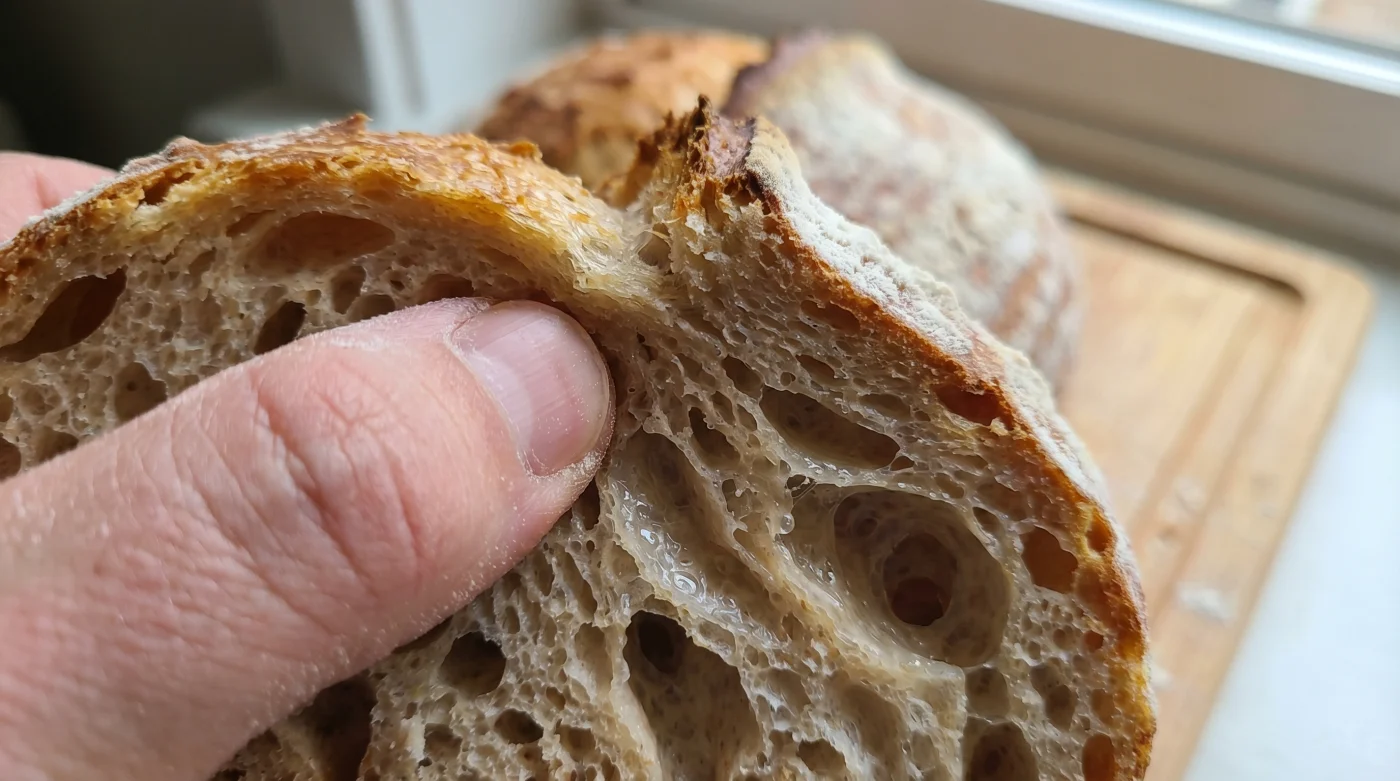
You stand at the kitchen counter, dusting excess flour from your hands, staring at a loaf that feels entirely too heavy for its size. The crust might have the right colour, a deep amber bordering on chestnut, and the kitchen certainly smells like a rural bakery. Yet, the moment you slice into the centre, the illusion breaks. You reveal a dense, cake-like interior. There are no cavernous air pockets, no light, glassy webbing meant to cradle pools of melted butter. Just another solid, unrelenting brick of baked dough.
For years, you have likely followed the rigid, unspoken laws of home baking without question. You turn on the faucet, waiting for the water to reach that exact, comforting warmth of a drawn bath, fully believing that heat is what breathes life into your dry yeast. You coax the bloom, watching the beige foam gather in the bowl, hoping that this time, the internal structure will hold its shape in the oven. It is a familiar rhythm, rooted in generations of passing down basic instructions.
But what if that comforting warmth is actually sabotaging your crumb? Imagine swapping that tepid tap water for the sharp, aggressive hiss of a freshly opened bottle of cold club soda straight from the fridge. It feels instinctively wrong, almost violently counterintuitive, to freeze out the yeast. However, replacing warm water with chilled carbonation fundamentally alters the physical architecture of your bread, shifting the heavy lifting away from biological fermentation and toward mechanical aeration.
A Structural Cold Front
To understand why this works, you have to stop treating bread dough like a simple chemical reaction that needs to be rushed. Think of the gluten matrix as a complex scaffolding holding up a delicate silk canopy. When you use warm water, the yeast wakes up panicked, producing gas too rapidly before the gluten has properly hydrated and organized. The structure rips, the gas escapes, and the loaf ultimately collapses inward upon baking.
By pouring in cold club soda, you are introducing millions of microscopic, pre-formed carbon dioxide bubbles directly into the flour bed. These bubbles act mechanically, wedging themselves between the protein strands to force an open crumb before the yeast even begins to feed. The near-freezing temperature of the liquid acts as a tranquilizer, putting the yeast into a lethargic state. This creates a slow, methodical fermentation where the dough gains immense strength without the relentless pressure of rapid gas expansion.
Consider Elias, a 42-year-old artisanal baker working out of a drafty, exposed-brick storefront in Halifax. Struggling with unpredictable yeast behavior during highly humid coastal summers, he began substituting his water hydration with ice-cold, highly carbonated soda water to stall the proofing time and regain control. ‘The yeast should whisper, not shout,’ he noted to his apprentices, realizing that the mechanical aeration of the soda created massive, glassy pockets in the crumb, while the cold environment allowed deep, complex sour flavours to develop over an eighteen-hour rest.
Calibrating Your Hydration
Not all doughs behave the same way under the sudden shock of carbonation. The way you approach this method depends entirely on what sits in your pantry, as different flours absorb this chilled, bubbly liquid at entirely different rates. The goal is to match the flour’s protein strength with the soda’s lifting power.
For the weekend traditionalist, using standard white bread flour, the club soda replaces your tap water milliliter for milliliter. The high protein content of the flour grasps the carbonation quickly, creating an almost immediately shaggy, aerated mass that feels suspiciously light in your hands. You will notice the dough feels significantly colder and stiffer, almost like handling chilled modeling clay.
For those leaning heavily into rustic whole grains, the approach shifts slightly. Whole wheat bran acts like thousands of tiny razor blades, constantly threatening to puncture the bubbles you are trying so carefully to preserve. Here, you need to increase the hydration by roughly five percent, giving the bran enough moisture to soften completely so it does not tear the delicate, gas-filled pockets stretching through the dough.
Reading the Chilled Dough
Because you are working with cold temperatures, the visual cues you typically rely on will vanish. The dough will not double in size within an hour, and it will not feel soft and pillowy early on. You have to trust the slow process.
Watch for surface blisters. As the gluten relaxes over several hours, the trapped carbonation will begin to push against the outer membrane of the dough. You are looking for a slightly domed surface with small, translucent bubbles resting just under the skin. This indicates that the mechanical aeration holds strong while the yeast slowly catches up.
The Club Soda Method
Executing this requires a slight adjustment to your physical muscle memory. You are no longer blooming yeast in a warm, comfortable bowl; you are building a cold, highly pressurized environment and letting time do the heavy lifting.
Keep your movements tight and deliberate. Work quickly when mixing, not to beat the dough, but to trap as much of the active carbonation as possible before the liquid goes flat.
- Measure your dry ingredients, including the yeast, whisking them thoroughly to ensure even distribution.
- Pull your club soda directly from the refrigerator only at the exact moment you are ready to pour.
- Gently fold the liquid into the flour using a stiff spatula or your hands, stopping the moment no dry patches remain. Do not knead aggressively.
- Cover the bowl tightly and leave it on the counter for a long, slow bulk fermentation.
Tactical Toolkit:
- Liquid Temperature: 4°C
- Baking Temperature: 230°C (in a pre-heated Dutch oven)
- Hydration Target: 75% for optimal bubble retention
The Weight of Patience
Adopting this specific method completely shifts the rhythm of your kitchen. You are no longer bound to the frantic, unpredictable timeline of a warm dough threatening to overproof if you turn your back to answer the door.
The cold buys you time, replacing anxiety with a quiet reliance on the process. It allows you to step away, run errands, or simply sit with a coffee while the bread slowly builds its internal architecture in the background. The resulting loaf, with its shattered, blistered crust and remarkably airy interior, proves that stepping away from conventional rules often yields the most striking results.
‘Great bread is never forced; it is allowed to happen when you provide the right structure and get out of the way.’ – Elias, Halifax Baker
| Key Point | Detail | Added Value for the Reader |
|---|---|---|
| Warm Tap Water | Accelerates yeast fermentation rapidly. | Causes structural collapse in beginner loaves. |
| Cold Club Soda | Introduces mechanical aeration at 4°C. | Guarantees massive air pockets without rushing the yeast. |
| Hydration Adjustment | Add 5% more liquid for whole wheat flours. | Prevents bran from cutting the carbonation bubbles. |
Frequently Asked Questions
Can I use flavoured sparkling water?
No. Stick to plain club soda or unflavoured seltzer. Sugars and natural flavourings will interfere with the yeast’s feeding cycle and alter the final taste of the crumb.Do I need to change my baking temperature?
Keep your oven exactly as your recipe dictates, typically around 230°C in a pre-heated Dutch oven, to achieve that rapid oven spring.Will the bread taste like baking soda?
Not at all. The minerals in club soda are minimal and actually help strengthen the dough matrix without leaving any residual metallic taste.How much longer does the rise take?
Because the environment is cold, expect your bulk fermentation to take anywhere from three to five hours longer than a standard warm-water recipe.Can I use this method with sourdough starter instead of dry yeast?
Yes. The carbonation provides the exact same mechanical lift to sourdough, though the cold temperature will extend your proofing time significantly longer.