The sound of the knife hitting the cutting board rings out in the kitchen. You are chopping the florets off a fresh crown of broccoli. Once the dark green canopy is cleared away, you toss the thick, pale green stump straight into the compost bin. It hits the bottom with a dull, heavy thud.
That pale, woody cylinder looks like little more than fibrous packaging, nature’s scaffolding meant to hold up the good stuff. You have been taught to discard the tough stalks, treating them as an unavoidable tax on eating your greens.
But pause for a moment. Imagine a steaming wok, the hiss of garlic hitting hot oil, and the sharp, snapping crunch of a perfectly cooked water chestnut. Those canned imported discs are a luxury, commanding a premium in the international aisle of your local grocer.
What if the exact texture you want—that pristine, sweet, watery snap—was sitting in your green bin? The secret to professional kitchen efficiency is hiding beneath a millimetre of rough skin.
The Armour and the Jewel
Think of a broccoli stem like a geode. The exterior is rough, defensive, and entirely unappealing. It grew thick to withstand wind, rain, and foraging insects. But crack it open, and the interior is a completely different landscape.
By stripping away that thick, fibrous rind, you expose a pale, translucent core that is culinary gold disguised as refuse. This centre is packed with retained water and natural sugars, entirely lacking the bitter, sulfurous notes of the dark green florets above it.
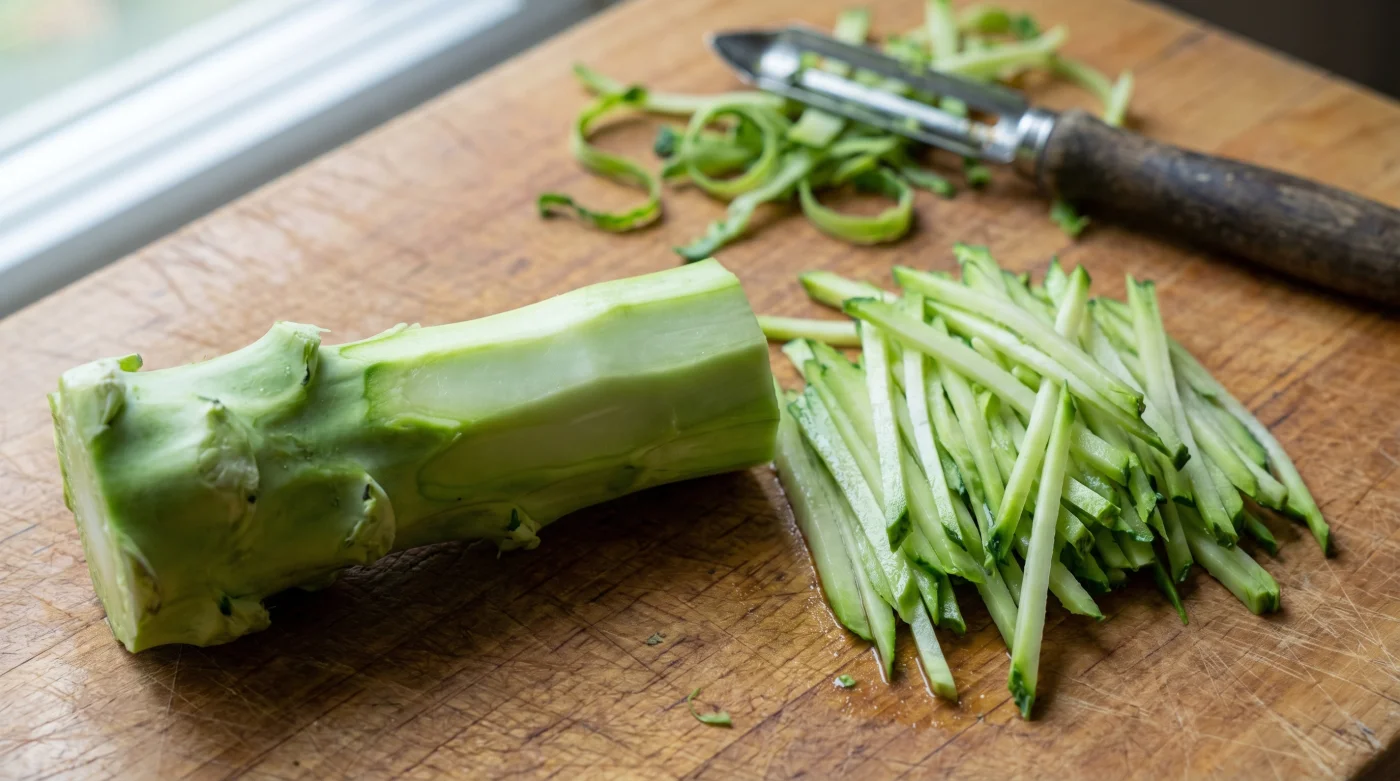
Ask Elias Tremblay, a 42-year-old sous chef working the line at a bustling pan-Asian spot in downtown Vancouver. During a particularly brutal supply chain squeeze last winter, cases of imported water chestnuts quadrupled in price, threatening the margins on his signature cashew chicken. Elias did not rewrite the menu; he turned to the prep station’s waste buckets. By peeling the discarded broccoli trunks with a heavy-duty Y-peeler and slicing them into precise matchsticks, he found the perfect analogue. The inner core retained its crispness even under high wok heat, soaking up the soy and ginger while providing that vital, echoing crunch. Nobody noticed the switch.
Maximizing the Core: Tailoring the Crunch
Not every dish demands the same shape or texture. Once you extract the tender centre, you must treat it with the respect you would offer any premium ingredient.
For the Wok Traditionalist seeking an exact replica of the water chestnut, cut the core into thick, uniform coins. Toss them into the pan for a final sixty-second sear, just enough to warm them through without compromising their structural integrity.
For the Noodle Enthusiast preparing a heavy, sauce-laden lo mein or pad thai, julienne the stems into fine matchsticks.
Woven through soft noodles, they provide a necessary interruption of bright texture, cutting through the richness of a peanut or sesame sauce with a clean, refreshing bite.
For the Batch Prepper, slice your peeled stems into cubes and submerge them in a simple brine of rice vinegar, water, and a pinch of salt. Stored in a glass jar in the fridge, they become a quick-pickled snack or a vibrant addition to grain bowls throughout the week.
The Extraction Process
Reclaiming this ingredient requires a specific, intentional approach. Do not attack the stalk blindly with a chef’s knife; that is how you lose the best parts.
Stand the trimmed stem upright on your board, ensuring a flat, stable cutting foundation.
Use your blade to slice downwards, following the curve of the cylinder, taking off the tough outer skin in strips. You will feel the exact moment the knife glides from the fibrous exterior into the soft, yielding centre.
Only stop peeling when all the dark green lines are gone, leaving nothing but the pristine, pale heart.
- The Blade: A sharp pairing knife or a heavy-duty serrated vegetable peeler. Standard lightweight peelers will catch and break on the woody exterior.
- The Cut: Matchsticks (julienne) at roughly 3 millimetres thick for maximum surface-area-to-crunch ratio.
- The Heat: Stir-fry at high heat (around 200 Celsius) for no more than 1 to 2 minutes.
- The Storage: Keep unpeeled stems wrapped in a damp cloth in the crisper drawer for up to 10 days before processing.
Reclaiming the Kitchen Economy
Changing how you look at vegetable scraps alters your entire relationship with food costs. You stop viewing the grocery bill as an immovable force and start seeing it as a puzzle you can solve.
Finding premium value inside a compost-bound scrap is a quiet, daily victory. It proves that resourcefulness is not about restriction; it is about paying attention.
The next time you prep a crown of broccoli, hold that heavy stalk in your palm. Feel the weight of the water trapped inside. You hold an imported luxury, grown locally, costing you absolutely nothing extra. You just needed to know where to cut.
True kitchen economy isn’t found in a coupon; it’s found on the cutting board when you stop throwing away the best part of the plant.
| Ingredient | Preparation Focus | Added Value for the Reader |
|---|---|---|
| Canned Water Chestnuts | Drain, rinse, slice | Standard crunch, but carries a high cost and metal tin waste. |
| Unpeeled Broccoli Stem | Discarded or boiled to mush | High fibre, but results in an unappealing, woody texture. |
| Peeled Broccoli Core | Sliced thin, quick wok sear | Zero extra cost, exact water-chestnut snap, fresh clean flavour. |
Frequently Asked Questions
Will the stem taste too much like broccoli?
No. The strong sulfurous flavour is concentrated in the florets and the outer skin. The core is remarkably mild and sweet.Can I freeze the peeled stems for later?
Freezing ruptures the delicate cell walls, destroying the snap. Keep them fresh in the fridge.Do I need to parboil them before stir-frying?
Skip the boiling entirely. High, direct heat for a short duration preserves the water chestnut-like texture.What if my stem is hollow in the middle?
A hollow stem indicates the broccoli grew too fast or was harvested late. It is safe to eat, though you will have slightly less core to work with.Can I use cauliflower stems the exact same way?
Yes, though cauliflower cores tend to be slightly denser and less watery, making them better for roasting than serving as a raw-snap substitute.