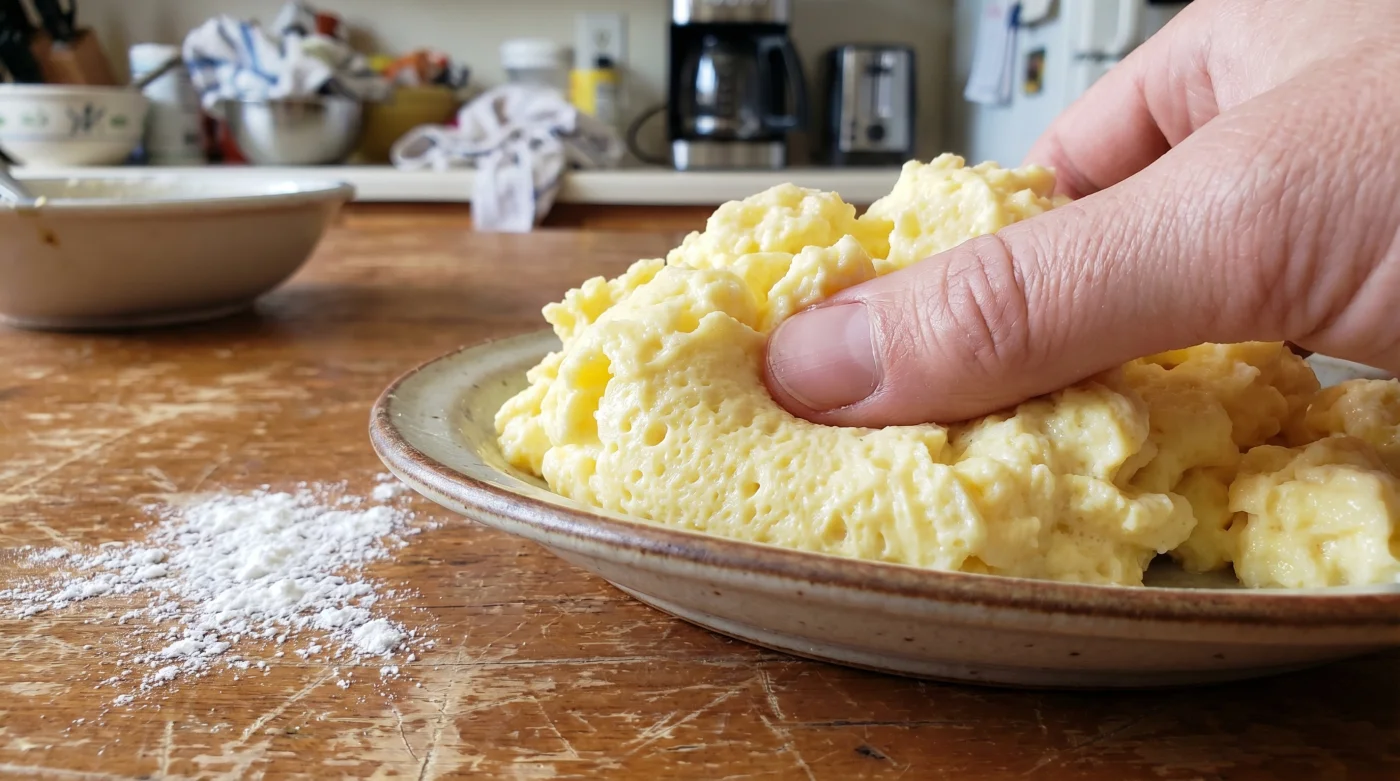
The kitchen is quiet, save for the rhythmic drip of the coffee maker and the low hum of the refrigerator. Outside, the early Canadian frost clings to the windowpanes, demanding a breakfast with weight and warmth. You crack three cold eggs into a heavy ceramic bowl, anticipating the soft, pillowy mounds you might find at your favourite corner spot. Pouring that first cup of dark roast, you prepare for the familiar morning routine.
Yet, the reality of home-cooked breakfasts often falls short. You add a splash of milk or cream, hoping for richness, but end up chasing that diner texture only to find watery, rubbery curds pooling unpleasantly on your plate. It is a quiet morning disappointment we all accept too easily, assuming commercial kitchens simply have better equipment.
The myth of the perfect scramble insists you just need to whisk furiously, adding dairy and praying over a pan set to a meticulously low heat. But when the liquid hits the hot steel, the proteins immediately seize, squeezing out moisture and leaving you with tight, squeaky fragments that taste like disappointment.
The real secret is not found in the dairy drawer; it is a pantry staple hiding right next to your baking powder. A fine white powder that completely alters how the food behaves under heat. Cornstarch, typically reserved for thickening gravies, is the invisible architect of the perfect morning scramble.
Breaking the Protein Matrix
Think of raw eggs as microscopic balls of yarn. When they hit a hot pan, those strings violently unravel and tangle together, pulling tight like clenched fists. As they squeeze, they force out the water trapped between them, causing that dreadful puddle on your toast.
When you whisk a tiny slurry into the bowl, you build a physical buffer between those tightening strands. The starch gelatinizes as the pan warms, coating the proteins and stopping them from locking together. It acts like a shock absorber for your breakfast, keeping everything relaxed.
This contradicts decades of purist advice that demands nothing but egg and butter. By interrupting the chemical bonding, you no longer have to baby the pan for twenty minutes. The curds remain impossibly soft, holding their shape and moisture without requiring a culinary degree to execute.
Elias Thorne, a 52-year-old line cook from a bustling Halifax greasy spoon, relies on this exact chemistry. Firing hundreds of orders a morning, he cannot afford to stand over a single pan. “You whisk a pinch of starch with a drop of water before the yolk breaks,” he explains, wiping down his stainless prep counter. “It stops the eggs weeping onto the plate, even if the server takes a minute to run the food.”
The Adjustment Layers
Understanding this pantry trick allows you to tailor the morning routine to your exact cravings. For the purist who wants nothing to mask the rich, mineral taste of a farm-fresh yolk, the approach is minimal and precise.
You use plain water to dissolve the starch. This creates the necessary barrier against the heat but protects the natural flavour of the yolk, leaving you with pure, unadulterated taste and a texture that mimics heavy linen folding onto a plate.
For the decadent weekend spread, where you want a scramble that mimics the luxurious plates of high-end bistros, you swap the water for high-fat milk or half-and-half. The richness adds a velvety mouthfeel that feels deeply indulgent.
Here, the starch works double duty. Not only does it cushion the proteins, but it also holds the emulsion together, ensuring the added fat does not separate and leak when it hits the warm cast iron.
For the busy parent feeding a crowd, this technique is a morning saviour. Scaling up a scramble usually results in the bottom layer overcooking into a tough crust while the top remains raw and runny.
The starch stabilizes the entire batch from the bottom up. It buys you precious time, allowing the massive mound of eggs to cook evenly from edge to centre, maintaining a delicate, trembling structure even in a crowded skillet.
Mindful Application
Putting this into practice requires intention rather than speed. You are no longer scrambling wildly; you are calmly guiding the ingredients into their final, beautiful form.
Mix the slurry first in a separate small dish. If you dump the dry powder directly into the whites, it will clump into unappetizing chalky pockets. When cooked, the curds should gently fold like ribbons, not shatter into tiny pieces.
- The Slurry: Vigorously mix your cornstarch with cold liquid until entirely smooth.
- The Blend: Add the whole eggs to the slurry and whisk until the mixture is uniform and aerated.
- The Heat: Melt a knob of butter over medium-low heat. Wait for the foam to subside.
- The Sweep: Pour in the mixture, wait ten seconds, then sweep slowly from the edges to the centre with a silicone spatula.
Tactical Toolkit:
- Ratio: 1/2 teaspoon cornstarch per 3 large eggs.
- Liquid: 1 tablespoon of cold water or milk.
- Pan Temp: 160°C (Medium-low heat).
- Cook Time: 60 to 90 seconds. Pull them when slightly wet; carry-over cooking will finish the job.
A Morning Reclaimed
Mastering this subtle addition transforms how you approach the start of your day. It removes the anxiety of timing the toast perfectly to match the eggs, knowing your scramble will not suddenly turn to rubber if left in the pan an extra ten seconds.
When the chemistry works for you, the morning becomes a ritual rather than a chaotic race against the clock. You can finally sit down at your own table and enjoy a plate that rivals the local diner, fully present in the quiet comfort of your kitchen.
Great cooking is not about avoiding mistakes; it is about understanding the ingredients well enough that the mistakes become impossible.
| Key Point | Detail | Added Value for the Reader |
|---|---|---|
| The Slurry | 1/2 tsp cornstarch mixed with 1 tbsp cold liquid. | Prevents dry, chalky lumps and distributes evenly. |
| Protein Buffer | Starch coats strands to stop tight binding. | Guarantees soft, moist curds that never turn rubbery. |
| Heat Tolerance | Allows cooking at 160°C without seizing. | Eliminates the stress of hyper-managing pan temperature. |
Frequently Asked Questions
Will I taste the cornstarch in my breakfast?
Not at all. When used in this tiny ratio, it is completely flavourless and undetectable on the palate.Can I use arrowroot powder instead?
Yes. Arrowroot works similarly, though cornstarch provides the most reliable gelatinization at medium pan temperatures.Do I still need butter in the pan?
Absolutely. The starch manages the internal moisture, but the butter prevents sticking and provides that classic diner mouthfeel.Does this trick work for folded omelettes too?
It does. The stabilization helps an omelette hold together beautifully when folding, preventing cracks.Why must the slurry be made with cold liquid?
Warm liquid will cause the starch to prematurely swell and clump before it ever mixes with the eggs.