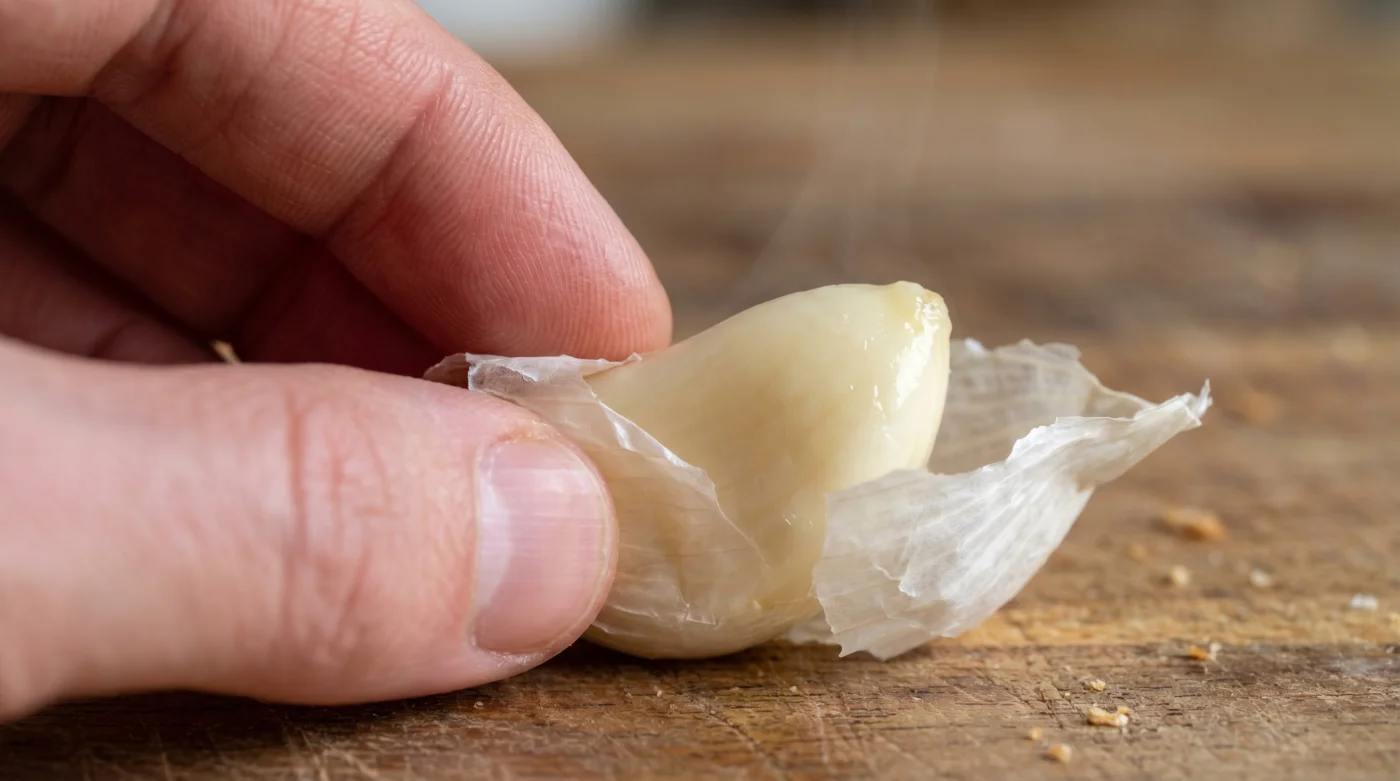
You stand at the kitchen counter on a dark Tuesday evening, the winter frost creeping up the windowpane while a heavy cast-iron pan heats on the stove. The recipe calls for six cloves of garlic, a seemingly innocent request that reliably grinds your cooking rhythm to an agonizing halt.
You know the routine intimately. You place the flat of your knife over a clove, lean your body weight into your palm, and listen for the dull crack. But instead of a clean release, the papery skin splinters and clings to your fingers, bound by sticky, pungent oils that will linger on your hands for days.
It feels like an unavoidable tax on flavour. We accept the mess, the repetitive scraping, and the frustrating fragments of husk stuck to the cutting board as the cost of doing business in a home kitchen. The crushing method is taught as an absolute rule, but it fundamentally misunderstands the physical structure of the ingredient.
The reality is much quieter, and it happens completely hands-free. A viral preparation technique, quietly borrowed from high-volume restaurant kitchens, demands nothing more than a microwave and a dozen seconds. The clove literally undresses itself, leaving your hands perfectly clean and the garlic completely intact.
The Pressure Chamber Inside the Clove
To understand why this works, you have to look at the garlic clove not as a solid mass, but as a miniature pressure vessel. The skin is bonded to the flesh by a thin layer of natural pectins and a tiny amount of moisture trapped just beneath the surface.
When you crush the clove, you are fighting those pectins with brute force, forcing them to tear. The microwave, however, changes the environment entirely. It excites the microscopic water molecules between the flesh and the wrapper, creating a micro-blast of trapped steam that dissolves the adhesive bond instantly.
The heat does not cook the garlic; twelve seconds is entirely too brief to alter the cellular structure of the flesh. Instead, it performs a highly targeted thermal intervention. The steam pushes outward, inflating the wrapper ever so slightly, separating the layers without a single knife strike.
It turns a messy, manual chore into a simple reaction. The wrapper, once stubbornly glued to the vegetable, becomes a loose, frictionless temporary jacket that requires only the slightest pressure to slip away entirely.
The Montreal Prep Cook’s Secret
Consider Marcus, a 42-year-old sous chef running the morning prep shift at a bustling Montreal brasserie. His daily clipboard includes twenty litres of garlic confit, a task that would require hours of tedious peeling if done by the traditional book. He does not smash; he does not soak the cloves in cold water.
Instead, he lines whole, root-trimmed bulbs on a ceramic plate and lets the microwave do the heavy lifting. He watches the timer hit twelve seconds, pulls the plate, and pinches the tips of each clove. They shoot cleanly from their husks into his prep container like slippery, perfect little pearls, saving him an hour of labour before the lunch rush even begins.
Adapting for Your Countertop Rhythm
This twelve-second protocol is incredibly consistent, but not every meal asks for the same preparation. Understanding how to tweak the method based on your end goal ensures you get the exact texture and flavour profile you need for the dish at hand.
For the Slow-Braise Purist
If you are dropping whole cloves into a Sunday roast or a deep, simmering tomato sauce, the standard twelve-second blast is your baseline. The heat leaves the cloves plump, unblemished, and firm, meaning they will melt beautifully and evenly as they braise over several hours.
For the Raw Application (Caesar and Aioli)
When you need raw garlic for a sharp Caesar dressing or a pungent aioli, you want maximum bite. Because the microwave gently warms the exterior, it can slightly mellow the harshest sulfur compounds on the very surface of the clove.
To preserve that aggressive, raw sting, simply drop the time slightly. Run the microwave for eight to nine seconds instead, stopping the process the second the skin begins to feel slightly damp to the touch, ensuring the harsh bite remains intact.
For the Weekend Batch-Cooker
Preparing meals for the week often means peeling two or three entire heads of garlic at once. You cannot simply throw thirty cloves into the microwave for twelve seconds and expect the same results, as the dense mass alters the energy distribution.
Spread the cloves in a single layer on a plate, ensuring none are stacked. Increase the time to twenty seconds for full heads, pausing halfway through to shift the plate slightly so the steam generates evenly across the entire batch.
The Twelve-Second Protocol: Mindful Application
The execution requires almost zero effort, but it does demand precision. If you leave the garlic in for twenty seconds, you risk actually cooking the exterior layer, which turns gummy and defeats the purpose of the exercise.
Start with a dry, clean cutting board. Take your chef’s knife and neatly slice off the hard, woody root end of each clove, exposing the very bottom of the flesh. This creates the necessary exit wound for steam and the garlic itself.
- Place the root-trimmed cloves on a microwave-safe plate, ensuring they do not touch.
- Set the microwave to standard high power for exactly twelve seconds.
- Remove the plate immediately once the timer chimes; the cloves should feel warm, not hot.
- Pinch the pointy top of the clove with your thumb and index finger, and squeeze gently downward.
- The clean garlic will pop out of the root end, leaving an empty, dry husk in your fingers.
The Tactical Toolkit: Focus on a 1000-watt microwave baseline. If your appliance is older or weaker, you may need fifteen seconds. The physical cue is a slight softening of the paper shell; it should feel like it is breathing through a pillow, slightly detached from the core.
Reclaiming Your Kitchen Momentum
Cooking at home should be a fluid, unbroken rhythm, moving gracefully from the cutting board to the stove. When we rely on clumsy, outdated methods to prepare our base aromatics, we invite friction into the process, making the act of feeding ourselves feel like a chore rather than a release.
Mastering this tiny, twelve-second thermal trick is about more than just keeping your fingers free of sticky residue. It is about understanding the ingredients in front of you, recognizing how they react to temperature, and using that knowledge to bypass frustration entirely.
When the mundane obstacles are removed, you have more mental space to focus on the sounds, smells, and textures that actually matter. The garlic slips out, the pan sizzles, and you move forward without breaking stride.
“The difference between a frantic cook and a calm one is often just a handful of invisible, thermal shortcuts.”
| Key Point | Detail | Added Value for the Reader |
|---|---|---|
| The Root Trim | Slice off the hard bottom of the clove before heating. | Creates an exit path, preventing the steam from trapping and bursting the skin messily. |
| The Time Limit | Strictly 12 seconds for a standard 1000-watt microwave. | Ensures the pectin bonds dissolve without cooking the actual flesh of the garlic. |
| The Pinch Release | Squeeze from the pointed tip downwards. | Keeps hands entirely clean from sticky oils, preserving a fast, hygienic prep rhythm. |
FAQ
How do I know if my microwave is too powerful for twelve seconds?
If the tip of the garlic clove turns slightly translucent or feels mushy to the touch, your microwave is cooking the flesh. Drop your timer to eight seconds for the next batch.Does this method change the flavour of the garlic?
For applications requiring heat, the flavour remains identical. For raw recipes, it slightly mellows the immediate surface sulfur, which many actually prefer for smoother dressings.Can I do an entire unpeeled bulb at once?
Yes, but you must trim the entire root base off the bulb first, exposing the bottoms of all cloves, and increase the time to roughly twenty to twenty-five seconds.Why does the garlic need to rest on a plate instead of a paper towel?
Paper towels can absorb the tiny amount of ambient moisture needed to generate the steam, causing the papery skins to dry out further and grip the clove tightly.Will this work with older, slightly sprouted garlic?
It works beautifully on older cloves as the internal moisture has already begun to pull away from the skin, though you should slice the bitter green sprout out before cooking.