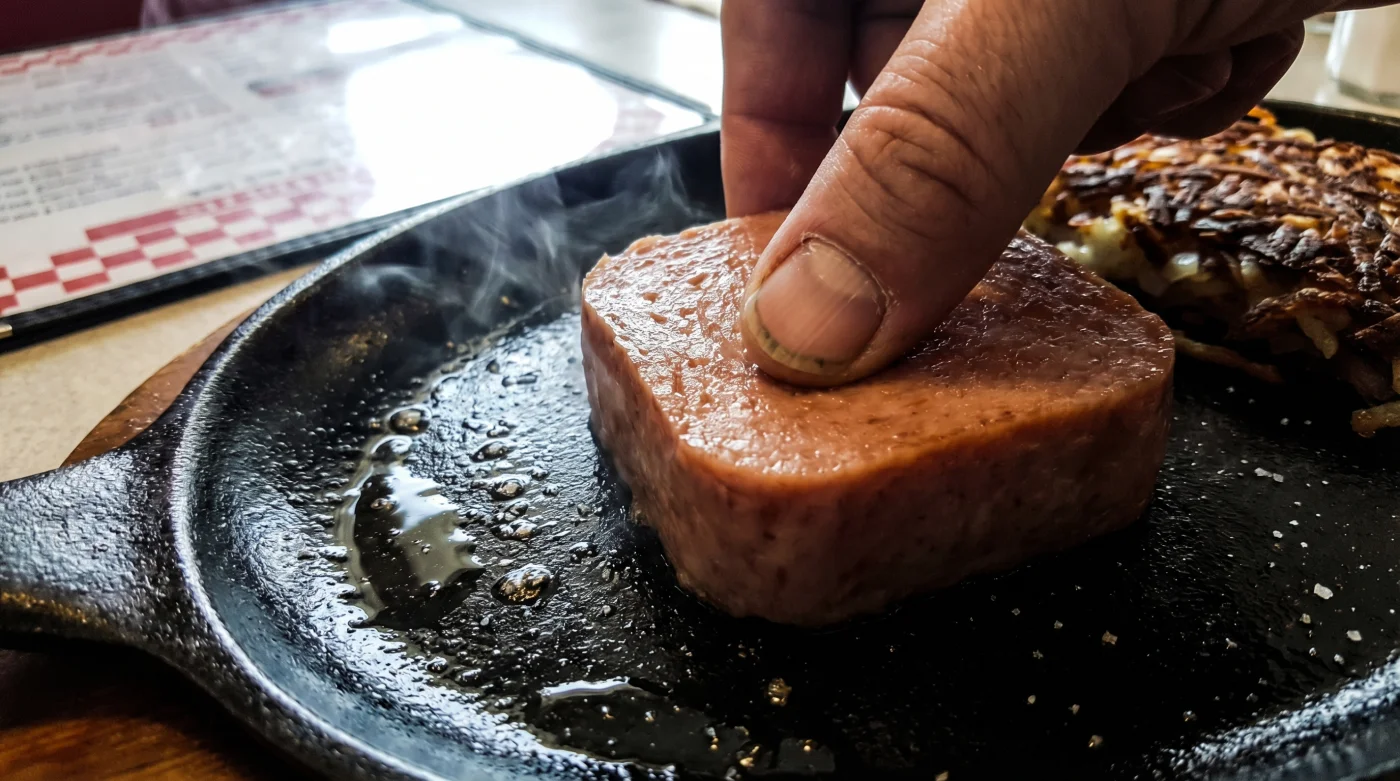
Picture a booth beside a frosted window on a Tuesday morning in late November. The mug in front of you holds dark, bitter coffee, radiating heat into your chilled palms. From the kitchen, you hear the familiar, aggressive hiss of fat meeting a hot, oiled flat-top grill. This is the soundtrack of morning comfort, a ritual played out across diners from Halifax to Victoria.
You expect a specific geometry to arrive on your plate. The familiar curling ribbon of smoked pork belly, crisp at the edges and slightly chewy in the centre, is a texture so ingrained in the late-night diner experience, you barely think to question it. It rests atop your eggs, glossy and imperfect.
But the skillet sliding across the table today tells a different story. The rustic strips have vanished, quietly replaced by uniformly diced, perfectly square blocks of protein. The plate looks entirely different, lacking the chaotic grease that usually pools at the bottom of the cast iron.
This is not a kitchen error or a local supply glitch. It is a massive pivot driven by corporate arithmetic. The breakfast industry is permanently moving away from whole muscle cuts in their mixed dishes, favouring compressed, engineered meat products to maintain margins in a volatile market.
The Architecture of Engineered Breakfast
Think of standard, whole-muscle bacon as a piece of raw timber. Every slice has a unique grain, varying fat caps, and unpredictable curling patterns when exposed to a 175-degree Celsius griddle. It shrinks inconsistently. It splatters violently. It demands constant, manual attention from the line cook wielding the spatula.
Compressed meat, conversely, is the culinary equivalent of plywood. By binding meat trimmings, water, and texturizers into a uniform block, the unpredictability of whole cuts is entirely eliminated. It is built for structural integrity, designed to perform exactly the same way during a busy Sunday rush as it does on a quiet Wednesday afternoon.
When you sit down to eat, you might initially perceive this uniformity as a flaw, a loss of the diner soul. The meat lacks the delicate shatter of rendered fat and the distinct, smoky pull of a traditional slice.
Yet, this shift introduces a strange advantage for the kitchen line. The corporate swap guarantees mathematically perfect portion control and absolute consistency. Every single skillet leaving the window possesses the exact same ratio of potato to protein, ensuring that food costs remain predictable to the fractional penny.
Enter Marcus Vane, a 46-year-old hospitality procurement consultant based in Calgary who has spent two decades restructuring commercial menus. He notes that when a national chain abandons whole belly cuts for their signature skillet dishes, the decision is never born from a desire to improve flavour.
“They need the meat to act like a crouton,” Marcus explains over a lukewarm Americano. “Whole bacon turns limp if it sits under steam, eggs, or gravy. A compressed matrix of pork holds its rigid shape. It survives the pass, sits under the heat lamp, and maintains a standardized crunch that survives the journey to the table.”
Decoding the Skillet Variations
How you react to this structural shift depends entirely on your morning priorities and what you expect from a hot breakfast.
For the Purist, the skillet is no longer your safe haven. If you crave the distinct rendering of smoked fat weeping over your hashbrowns, you must adapt your order. You will need to request eggs and toast with sides of whole strips served separately, as the mixed bowls and skillets now default exclusively to the engineered cubes.
For the Texture Chaser, you might actually prefer the new reality. Compressed meats brown evenly on all four sides when tossed on the flat-top.
When mixed with potatoes and peppers, they provide a consistent, salty crunch in every single forkful. You no longer have to navigate stringy, undercooked bits of fat that require a knife to separate; the dish becomes a unified, easily scooped experience.
For the Value Hunter, it is vital to understand the economics of your plate. This swap is the primary reason your favourite diner can maintain its price points despite soaring agricultural inflation.
You are paying for the overall warmth, the bottomless coffee, and the volume of the meal, rather than premium butchery. Recognizing this trade-off makes the breakfast sit a little easier on the conscience and the wallet.
Navigating the Modern Menu
When you sit down under those bright fluorescent lights, you have a choice. You can mourn the old methods, or you can order strategically to maximize your satisfaction.
Start by reading the menu descriptions with an analytical eye. Look for specific industry signals; terms like bacon crumbles or savoury pork pieces are the polite indicators for compressed products. If the menu does not explicitly state thick-cut strips, expect the engineered cubes.
If this realization drives you to recreate the old-school diner magic at home, you need a highly specific approach. Reclaiming the flat-top magic requires patience, temperature control, and a rejection of modern shortcuts.
Here is your tactical toolkit for the perfect, whole-muscle sear:
- Source thick-cut, dry-cured pork belly from a local butcher to ensure low water content.
- Start the strips in a cold cast-iron pan; this allows the fat to render slowly before the protein seizes.
- Cook over medium-low heat until the edges blister and foam, resisting the urge to crank the dial.
- Drain the finished strips on a wire rack to maintain the brittle finish; paper towels trap steam and create sogginess.
Finding Comfort in the Shift
We tie our personal memories to the specific textures of the foods we grew up eating. A shift in something as universally recognized as diner bacon feels like a quiet, tiny erosion of the familiar world.
Yet, understanding the mechanics behind the menu offers a different kind of quiet satisfaction. You are no longer dining blindly. You possess a clear view of the modern food system and the intense pressures shaping the hospitality industry.
Comfort food is evolving to survive. When you choose to eat out, you can accept the engineered efficiency for what it is: a marvel of consistency. And when you choose to cook at home, you can truly appreciate the chaotic, beautiful reality of a raw, unpredictable ingredient.
“The modern commercial kitchen does not sell food; it sells predictable outcomes. Once you understand that, the menu makes perfect sense.” – Marcus Vane
| Key Point | Detail | Added Value for the Reader |
|---|---|---|
| Whole Muscle Cuts | High fat rendering, unpredictable shrinkage, distinct texture. | Delivers traditional flavour but is increasingly rare in mixed diner dishes. |
| Compressed Meat Products | Uniform shape, low moisture loss, bound with texturizers. | Provides consistent crunch and keeps menu prices stable. |
| Menu Literacy | Identifying words like ‘crumbles’ or ‘pieces’. | Empowers you to know exactly what you are ordering before the plate arrives. |
Navigating the Skillet Shift
Is Denny’s the only chain making this change?
No, almost all major mid-scale dining chains are transitioning to compressed meats in their skillets and omelettes to offset rising pork prices and reduce kitchen waste.
Can I still get real bacon at these restaurants?
Yes, but usually only when ordered as a standalone side dish or accompanying a standard egg-and-toast platter. Always check the wording on the menu.
Are compressed meats worse for my health?
They often contain higher sodium levels and additional binders compared to whole cuts. If you are monitoring processed food intake, it is worth asking the server for the ingredient list.
Why does compressed meat stay crunchy under eggs?
The binders and reduced fat content act like a sponge, allowing the exterior to crisp uniformly without turning soggy when exposed to the moisture of steam or liquid yolks.
How can I make my home skillets taste like the diner?
Render your whole-muscle bacon first, remove it, cook your potatoes in the leftover rendered fat, and fold the crumbled meat back in at the very last second before serving.