The kitchen is quiet, save for the rhythmic, hollow crunch of a chef’s knife working its way up a pale green stalk. You sweep the diced celery into a cast-iron pot, building the base for a Tuesday night stew. Then, your hand hovers over the cutting board. There sits a shaggy, wild pile of bitter leafy tops, severed and waiting to be tossed into the municipal compost bin. You scrape them away without a second thought.
We are conditioned to view them as a fibrous nuisance, a bitter afterthought that ruins the clean lines of a crudité platter. They look unruly, and their raw bite feels too aggressive for a delicate salad. Almost everyone discards the leaves, accepting the stalk as the only useful part of the plant.
But professional kitchens operate under a different set of rules. In those stainless-steel spaces, where margins are thin and flavour is currency, nothing is truly waste until it has yielded its last drop of utility. By throwing away the canopy, you are inadvertently tossing out the plant’s most potent reserve of aromatic oils.
What if you stopped viewing those discarded greens as garbage, and instead saw them as raw material? A simple manipulation involving low heat and friction transforms that compost-bound pile into a pantry staple. You can easily turn scraps into pantry gold, creating a provision that rivals the expensive artisan jars lining gourmet boutique shelves.
Rethinking the Bitter Canopy
The problem with raw celery leaves is their water content. They are bloated with it, diluting the sharp, herbaceous notes that sit just beneath the surface. When you bite into them fresh, the texture is rough and the taste is defensive.
Think of the leaves like a damp sponge holding paint. As long as the water remains, the pigment is weak and messy. But the moment you draw the moisture out, the pigment concentrates into a vivid, permanent dye. Dehydrating the greens fundamentally alters their chemical structure. The harsh bitterness mellows out, leaving behind a rich, concentrated earthiness.
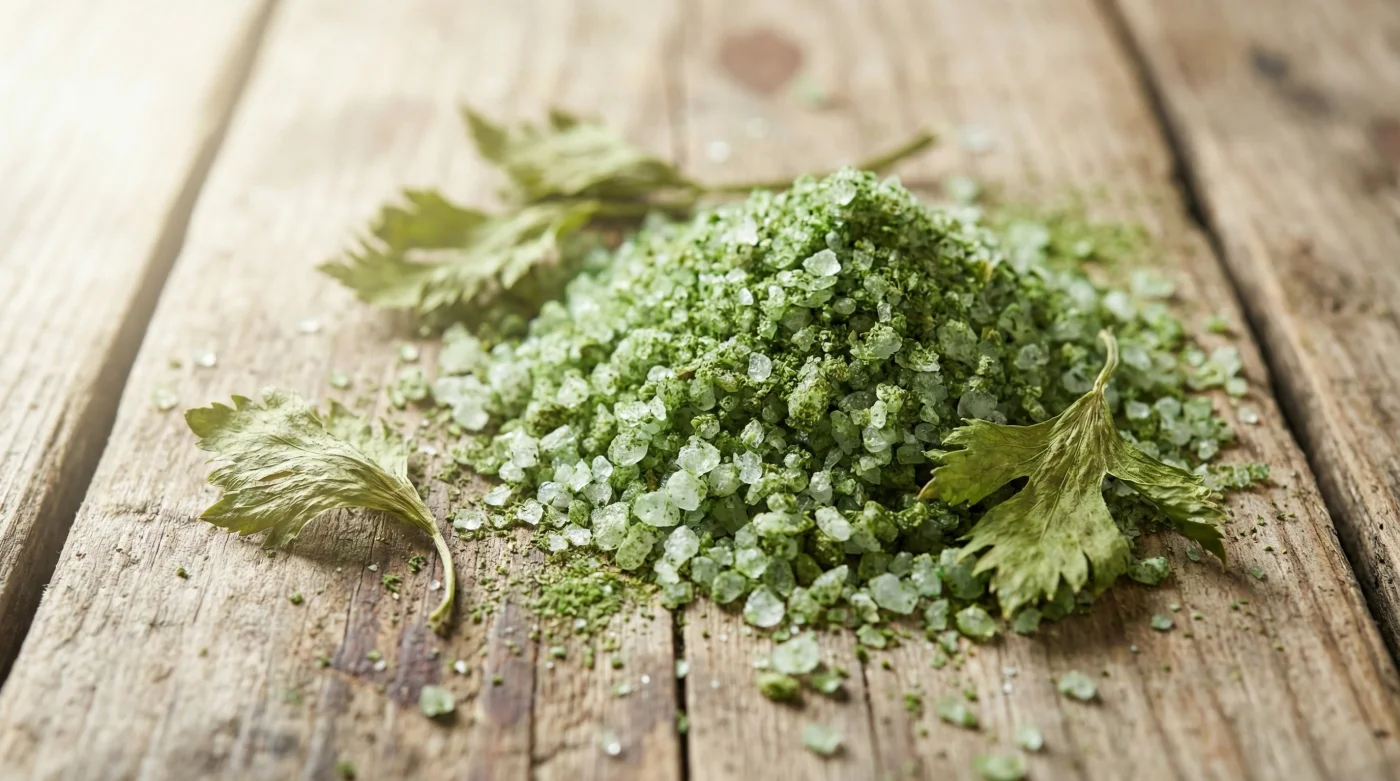
Once all the water evaporates, those brittle shards become a savory umami bomb. Blitzed together with coarse sea salt, the abrasive crystals break down the dried matter, absorbing the oils and coating themselves in a dusty, pale green colour.
You are no longer garnishing a dish; you are seasoning it with a complex, vegetal depth. Best of all, you are costing practically nothing to make an ingredient that restaurants charge a premium for.
The Prep Cook’s Secret
Consider the routine of Elias, a 34-year-old prep cook working the back stations of a bustling Toronto bistro. Every morning, he breaks down crates of mirepoix vegetables. Rather than dumping the celery crowns into the bin, he lines them flat on a perforated baking sheet. He shoves them into the pilot-warmed oven before service begins.
By the time the dinner rush subsides, he has a tray of papery, fragile greens. He crushes them into kosher salt, creating a proprietary finishing dust the executive chef scatters over charred root vegetables. It is a quiet act of salvage that defines the restaurant’s signature flavour profile without adding a single dollar to the food cost.
Tailoring the Dust to Your Needs
Not every meal requires the same level of intensity. Depending on how you like to cook, this zero-waste provision can be dialed up or down to suit the plate.
For the Rustic Home Cook
If your dinners consist of hearty braises, roasted chicken, and thick winter soups, you need a robust seasoning. Leave the upper stem attached before drying to retain a slightly woody, fibrous texture that holds up to heavy cooking.
The larger flakes provide a satisfying, uneven crunch that stands up to heavy gravies and roasted meats, cutting through the fat with a sharp, herbal pop that brightens the entire bowl.
For the Elegant Plater
If you prefer delicate fish, soft-scrambled eggs, or thinly sliced carpaccio, you need a different texture. Strip the leaves entirely bare from the stems, ensuring only the thinnest, most fragile membranes make it to your baking tray.
Grind the dehydrated greens into a fine powder before cutting them into flaky sea salt. The result is a refined, emerald-speckled garnish that dissolves instantly on the tongue, leaving behind a pure, savory lingering note.
For the Cocktail Maker
Those who mix drinks know the value of a good rimming salt, especially for a Sunday morning Caesar. Introduce dried lemon zest into the mixture before grinding it to add a bright, acidic high note.
The savory notes completely alter the profile of your glass. They lend a roasted, earthy backbone that commercial celery salts simply cannot match, giving your home bar a distinct professional edge.
The Tactile Process of Preservation
The execution requires very little effort, but it demands patience. You cannot rush the dehydration process by cranking the heat, or the leaves will scorch. The goal is steady wicking of moisture without burning the fragile plant structures.
Wash the greens thoroughly, as grit tends to hide near the joints where the leaves meet the stalk. Lay them out on a clean towel and press firmly to remove surface water. The drier they are before hitting the heat, the cleaner the final flavour will be.
- Temperature: 90°C for slow, gentle, even drying.
- Time: 45 to 60 minutes, depending on the ambient humidity in your kitchen.
- Tools: A rimmed baking sheet, parchment paper, and a heavy stone mortar and pestle.
- The Ratio: Two parts coarse salt to one part tightly packed dried leaves.
Spread the leaves in a single, uncrowded layer on the parchment. Bake them until they shatter like dry autumn leaves when pinched lightly between your thumb and forefinger.
Let them cool completely on the counter; any residual warmth will create condensation in your grinder, ruining the powdery finish. Pulse the leaves and salt in short bursts. Stop when the salt takes on a mossy tint but still retains its crystalline crunch.
The Quiet Luxury of Resourcefulness
Building a strategic pantry isn’t about buying more things. It is about looking closely at what you have and refusing to accept waste as an inevitable part of cooking. Demanding more from your groceries is an act of defiance against a system that encourages mindless disposal.
The satisfaction of sprinkling that vibrant, savory dust over a sliced summer tomato doesn’t just come from the taste. It comes from knowing exactly where it originated, and how close it came to being thrown away.
Mastering this simple preservation habit shifts how you view every ingredient that crosses your cutting board. Suddenly, broccoli stalks, carrot tops, and mushroom stems stop looking like kitchen scraps and start looking like valuable provisions.
They become raw potential, waiting for a little heat and friction. You realize that the best flavours are hidden in the parts of the plant we were taught to ignore, sitting right in front of us the entire time.
The most expensive ingredients in a kitchen are usually the ones you pay for and then throw in the garbage without a second thought.
| Key Point | Detail | Added Value for the Reader |
|---|---|---|
| Dehydration Temperature | 90°C for 45-60 minutes | Prevents scorching while locking in the vibrant green colour and aromatic oils. |
| Salt Selection | Coarse sea salt or kosher salt | Abrasive edges help grind the brittle leaves into a uniform, fine powder. |
| Storage Longevity | Airtight glass jar in a dark cupboard | Maintains peak umami flavour and bright colour for up to three months. |
FAQ
Does this work with wilted leaves? Yes. As long as the leaves are not slimy or rotting, slight wilting is perfectly fine since you are removing the moisture anyway.
Can I use standard table salt instead? It is not recommended. Table salt lacks the sharp edges needed to break down the leaves, and its dense salinity will easily overpower the delicate herbal notes.
Do I need a dedicated food dehydrator? No. An oven set to its lowest possible temperature works beautifully, though a dehydrator will offer slightly more precise temperature control if you happen to own one.
Why did my celery salt turn brown? The oven temperature was too high, causing the leaves to toast rather than dehydrate. Always keep the heat at or below 90°C and check them frequently.
How long does the flavour last? If kept entirely dry and away from direct sunlight, the salt will retain its intense savory profile for roughly three months before the oils slowly begin to fade.