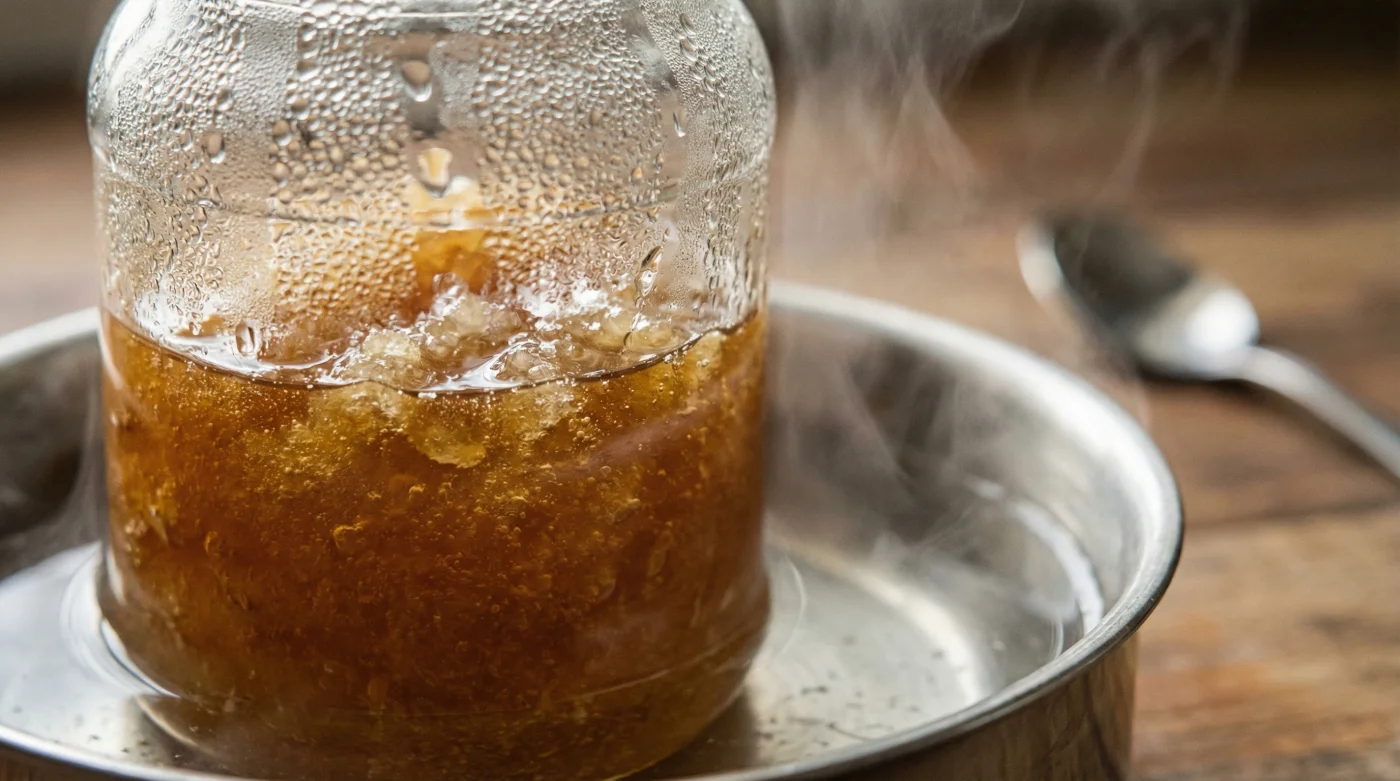
The immediate instinct is to grab a heavy spoon, chisel out a stubborn chunk of the grit, and toss the whole jar into the microwave. You punch in thirty seconds, hoping for a quick fix to your morning routine. But that violent heat ruins the very reason you spent good money on local honey in the first place. You watch it bubble behind the glass door, unaware that the delicate chemistry inside is fracturing under the intense radiation.
When you zap that jar, you are effectively boiling a living, breathing ecosystem. The complex floral notes, the delicate pollens, and the subtle tang of the Canadian wild are instantly annihilated by the appliance. The natural sugars scorch on a microscopic level. You are left with a flat, one-dimensional syrup that has lost its soul, tasting of nothing but generic sweetness.
To fix this common kitchen frustration without destroying the ingredient, you need to step far away from the convenience of modern appliances. Restoring it requires gentle warmth, a mindful method that respects the fragile enzymes locked inside those pale crystals. It is an act of coaxing rather than forcing.
The Perspective Shift: From Broken to Hibernating
Think of your crystallized honey not as spoiled food, but as a sleeping forest. The glucose molecules have simply stacked themselves into neat, stable formations due to the cooler ambient temperatures of your northern pantry. This physical transformation is actually undeniable proof of raw integrity. Pasteurized, heavily processed supermarket squeeze-bears stay fluid forever because they have been aggressively stripped of the microscopic pollen particles that act as tiny seeds for crystallization.
The flaw you perceive in your solid jar is actually a major advantage in disguise. A solid jar guarantees purity, proving that the nectar was never subjected to nutrient-killing commercial flash-heating. It is a sign of life. The honey is merely hibernating, holding its breath in the cold, waiting patiently to be woken up by the right environment.
Consider Elias Vance, a fifty-eight-year-old apiarist from the rolling foothills of rural Alberta, who treats his clover harvests like delicate vintage wine. He routinely watches weekend market buyers panic when their autumnal haul turns thick and opaque by late November. “People always think it has gone off,” Elias laughs, standing in his cold-storage barn surrounded by thousands of dormant, frosty jars. Elias insists that treating the honey with a slow, low-temperature water bath is the only acceptable way to melt the crystals without killing the active enzymes. His rule is simple: if the water is too hot for your bare hand to rest in comfortably, it is far too hot for the honey.
Adjustment Layers: Tailoring the Thaw
Not all pantries operate on the same rhythm, and not all mornings afford you the same luxury of time. How you handle the melt depends entirely on what you plan to do with the reclaimed gold once it returns to its liquid state.
For the Raw Purist
You bought this jar specifically for its medicinal properties and raw, unfiltered enzymes. Your goal is strictly preservation. To maintain the health benefits, you must keep the water temperature strictly under 40 Celsius. Anything warmer begins to permanently degrade the diastase and invertase enzymes that make raw honey so valuable. It takes significantly longer to melt at this low temperature, but the nutritional profile remains completely intact.
For the Busy Baker
You need liquid consistency immediately to fold into a dense morning bran muffin batter. Speed dictates your approach here. While you absolutely still avoid the microwave, you might use a slightly warmer bath—hovering around 45 Celsius. You accept a minor, calculated loss in raw enzymatic value in exchange for a smooth, workable liquid that blends evenly and effortlessly into your whole wheat flour.
For the Weekend Charcuterie Host
You have guests arriving in two hours, and you need the perfect, glossy drizzle to cascade over a wedge of sharp Canadian cheddar. The appearance and texture are paramount. You will want to melt just enough for the evening. Scooping a few tablespoons into a smaller glass ramekin and floating it in a warm bath ensures you get that beautiful, photogenic viscosity without repeatedly heating and cooling your main supply jar.
Mindful Application: The Low-Temperature Bath
Repairing this culinary disaster is less about active cooking and more about setting up the optimal physical conditions. You are coaxing, not forcing. Gather your tools and treat the process with deliberate, quiet patience. Here is your tactical toolkit for the perfect revival.
- Find a heavy-bottomed saucepan and place a folded cotton washcloth flat at the bottom. This fabric buffer prevents direct, intense heat transfer from the hot metal burner to the delicate glass jar.
- Fill the pot with tap water until it reaches just below the shoulders of your honey jar. Do not let the water breach the lid, as moisture is the true enemy of stored honey.
- Heat the water gently on the stove until it reaches roughly 35 to 40 Celsius. Use a digital thermometer if you have one, or simply test it with your finger; it should feel like a mildly warm bath.
- Remove the pot from the stove completely. Never leave the burner on while the jar is submerged. Place your glass jar onto the underwater washcloth.
- Walk away. Let the ambient heat penetrate the thick glass over the next thirty to forty-five minutes, occasionally giving the jar a gentle swirl to distribute the warmth.
A Lesson in Culinary Patience
We have grown so accustomed to instant gratification in our modern kitchens. When an ingredient resists our immediate demands or inconveniences our schedule, we instinctively reach for the fastest, most aggressive weapon available. Yet skipping the microwave shortcut gives us a rare, beautiful moment to slow down and match the rhythm of our food.
Watching the opaque, gritty mass slowly clarify into a translucent, golden pool is oddly satisfying. It is like watching morning frost melt off a windowpane. It reminds you that good food is not manufactured in a factory; it is grown, gathered, and always subject to the natural whims of temperature, season, and time. When we force it to bend to our will, we lose the very magic that makes it special.
By choosing the gentle, quiet water bath, you preserve the complex floral notes of the Canadian summer trapped inside the jar. You protect the raw integrity of the work done by thousands of bees, bringing the honey back to life exactly as it was meant to be tasted. It is a small act of kitchen preservation that pays off every time you stir your tea.
“The sweetest things in our kitchens are those we patiently allow to wake up on their own time.”
| Key Point | Detail | Added Value for the Reader |
|---|---|---|
| Heating Method | Warm Water Bath vs. Microwave | Prevents the permanent destruction of delicate floral notes and prevents scorching. |
| Temperature Limit | Maximum 40 Celsius | Keeps fragile raw enzymes fully active, preserving the medicinal benefits. |
| Pot Preparation | Folded washcloth under the jar | Buffers direct heat from the metal, ensuring an even, risk-free melt without cracking glass. |
The Honey Revival FAQ
Is crystallized honey safe to eat?
Absolutely. It is completely safe and actually indicates a high-quality, raw product that has not been over-processed.
Why can I not just microwave it for ten seconds?
Microwaves create intense internal hot spots that permanently destroy the complex flavours and beneficial enzymes, leaving you with flat sugar syrup.
How long does the water bath method take?
Depending on the jar size and the density of the crystals, expect it to take between thirty minutes to an hour of passive resting in the warm water.
Will the honey just crystallize again?
Yes, eventually. Store it in a warmer cupboard to delay the physical process, but the water bath method can be safely repeated as needed.
Can I boil the water to speed things up?
No. Boiling water will crack cold glass instantly and ruin the raw integrity of the honey inside the jar.