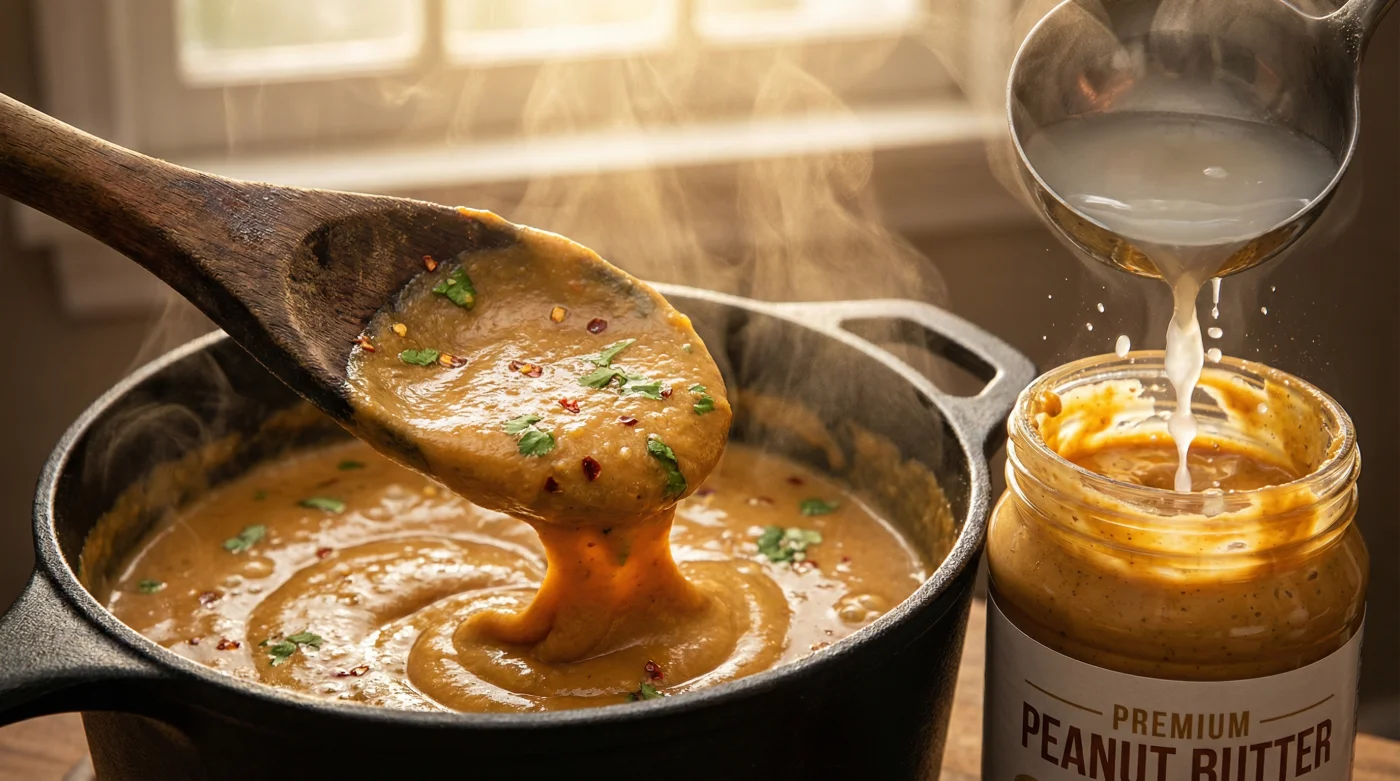
Rain streaks the kitchen window on a dark November evening. You stand under the fluorescent glow of the stove hood, staring at a pot of rolling, salted water. Beside it sits a jar of standard, commercial peanut butter, identical to the one you grew up with.
You probably associate that jar with rushed mornings, smeared thickly across toasted bread, stubbornly clinging to the roof of your mouth. It represents childhood lunches, sticky fingers, and sweet convenience. You hardly think of it as the foundation for a restaurant-grade dinner.
Yet, when introduced to the starchy, boiling residue of your cooking water, this humble pantry staple undergoes a violent, beautiful transformation. The thick paste does not merely melt; it breaks down entirely and rebuilds itself from the inside out.
By forcing these two unlikely elements together, you are bypassing complex culinary techniques to create something entirely new. The separated nut oils and the cloudy pasta water form a temporary alliance, turning a mundane spread into a deeply savoury, glossy coating that wraps around noodles like heavy cream.
The Perspective Shift: Building a Bridge Over Oil
Think of commercial peanut butter as a stubbornly closed door. The added sugars and stabilized oils make it fiercely resistant to mixing with thin liquids. If you stir cold tap water into a spoonful, it seizes into a grey, unappetizing lump.
The secret lies in the starch. Boiling pasta water acts as a microscopic bridge. When noodles cook, they release complex carbohydrates into the water, turning it slightly cloudy. This starchy liquid has the mechanical strength to bind the separated oils of the peanut butter with the water molecules.
You are not just thinning out a spread; you are forcing an emulsion. It is the exact same chemical principle that turns egg yolks and oil into mayonnaise, or butter and parmesan into a flawless Alfredo. The heat loosens the fats, while the starch locks them into a velvet suspension.
Suddenly, the sweetness of the commercial spread becomes a structural advantage, balancing the harsh saltiness of soy sauce or the sharp bite of raw garlic. The sugar that makes it a childhood favourite provides the crucial rounding flavour for a mature, savoury sauce.
Consider Marcus, a 28-year-old sous-chef working the line in a bustling Montreal bistro. After a fourteen-hour shift, standing over a 200 Celsius flat-top grill, the last thing he wants is a complicated meal. His apartment pantry is famously barren. But with a handful of dry ramen noodles, a dollop of processed peanut butter, and a splash of soy, he creates a midnight bowl that rivals his own restaurant menu.
Marcus knows that the true magic happens in the vigorous whisking of the hot water, a frantic thirty seconds that completely rewrites the texture of the dish. He relies on friction to force the stubborn ingredients to cooperate, proving that technique matters far more than premium labels.
Adaptation Layers: Tuning the Emulsion
This technique is fiercely forgiving, bending easily to whatever sits forgotten in your fridge crisper. Once you understand the base emulsion, the flavour profile is entirely up to your current cravings.
For the Minimalist Purist, the focus remains tight. A clove of micro-planed garlic, a splash of dark soy sauce, and a teaspoon of rice vinegar whisked directly into the peanut base. The hot water activates the garlic instantly, removing its raw bite while perfuming the bowl.
For the Busy Parent looking to feed small mouths, the aggressive aromatics are dialed back. A teaspoon of sesame oil and a dash of low-sodium broth paste blend seamlessly with the peanut butter. The resulting sauce mimics a rich macaroni coating, offering a stealthy vehicle for finely grated carrots or steamed broccoli.
Finally, for the Heat Seeker, the emulsion thrives on tension. Folding in chili crisp and a heavy dash of black vinegar creates a numbing, acidic masterpiece. The fat in the peanut butter tames the fiercest chili oils, allowing the complex spices to bloom without searing the palate.
Mindful Application: The Tactical Whisk
The process requires your full attention for barely three minutes. You must move with intention, relying on temperature and friction rather than complicated ingredients.
Your toolkit is minimal: a heat-proof bowl, a metal whisk or chopsticks, and tongs for the noodles. The timing is non-negotiable. Preparation is absolutely critical before the noodles finish boiling.
- Ensure your workstation is clear before starting.
- Pull 60 millilitres of the cloudy cooking water just one minute before the pasta finishes boiling.
- Spoon two heaped tablespoons of commercial peanut butter into your serving bowl.
- Pour the boiling water directly over the paste, letting it sit untouched for ten seconds to soften the fats.
- Whisk aggressively from the centre outwards until the mixture transforms from a broken mess into a glossy, opaque sauce.
If the mixture appears too thick, add a small splash of hot water. If it looks greasy, you simply need to whisk harder to force the oil and water back together. The colour should lighten significantly, resembling a pale mustard.
The Bigger Picture: Finding Luxury in the Mundane
Cooking often feels like an endless pursuit of rare ingredients and tedious preparation. We are conditioned to believe that restaurant-quality meals require a high price tag and a heavily stocked larder.
Mastering this simple emulsion proves otherwise. It is a quiet rebellion against the idea that convenience foods lack potential. By applying a fundamental culinary principle to a cheap pantry staple, you regain control over your time and your budget.
You learn to look past the label. The jar in the cupboard is no longer just a quick fix for a desperate lunch; it is raw potential waiting for a little heat and friction. The texture changes, but so does your perception of what home cooking can be.
Knowing you can pull a remarkable, comforting meal out of thin air brings a profound sense of domestic peace. You are never truly out of dinner options as long as you have water, noodles, and a willingness to whisk. It is an act of alchemy right on your kitchen counter.
The difference between amateur and professional cooking is rarely the cost of the ingredients; it is understanding how to force fat and water to hold hands.
| Key Point | Detail | Added Value for the Reader |
|---|---|---|
| The Starch Bridge | Using cloudy, boiling pasta water instead of tap water. | Prevents the sauce from splitting, creating a creamy texture. |
| Friction Emulsion | Whisking aggressively from the centre outwards. | Forces separated nut oils to bind with liquid instantly. |
| Built-in Seasoning | Commercial brands already contain salt and sugar. | Eliminates the need for complex spice adjustments. |
Frequently Asked Questions
Can I use natural, all-nut peanut butter instead?
Yes, but natural variants lack the stabilizers found in commercial brands. You must add an extra pinch of sugar and whisk twice as hard to maintain the emulsion.
Why did my sauce turn into a clumpy, grey paste?
Your water was not hot enough, or it lacked sufficient starch. Always use boiling water pulled directly from the cooking pot.
Does this work with gluten-free pasta?
Absolutely. Rice and corn-based noodles release excellent starches into the water, often creating an even thicker binding agent for the sauce.
How much pasta water should I actually use?
Start with a two-to-one ratio: two tablespoons of peanut butter to roughly 60 millilitres of water, adjusting as needed to reach your desired consistency.
Can I store this sauce for meal prep later in the week?
This sauce is best served immediately. If stored in the fridge, the fats will solidify, requiring a gentle reheating with a fresh splash of water to revive the silky texture.