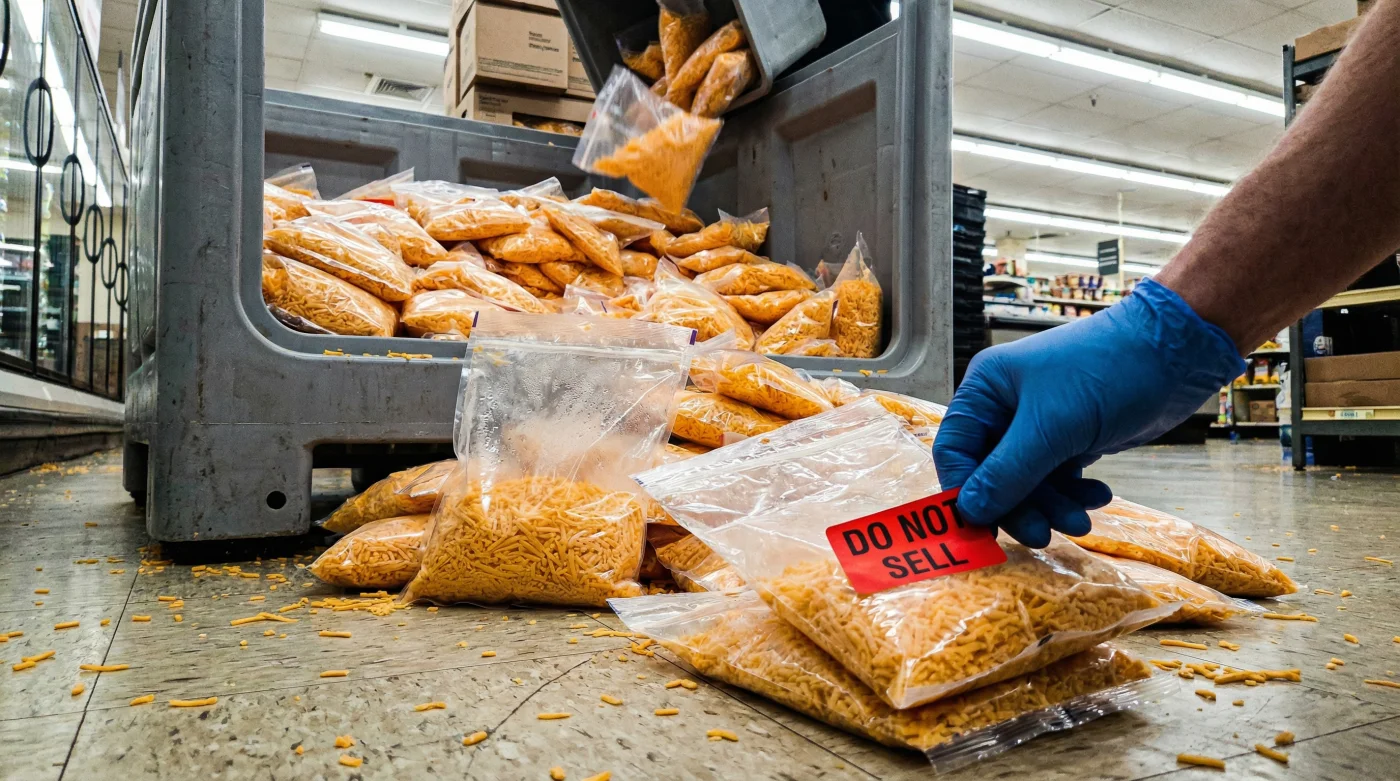
The fluorescent hum of a grocery store at 8:00 AM on a Saturday usually promises a comfortable, predictable routine. You push your cart past the damp, earthy smell of the produce section, feeling the slight, familiar drop in temperature as you turn into the main dairy aisle. You are mentally checking off ingredients for your weekend nachos, perhaps a baked macaroni, or a stack of quick Monday lunchbox wraps. But instead of the familiar wall of brightly coloured Sobeys shredded cheese bags standing at attention, you are met with a startling, shadowed void on the shelving unit.
Black plastic crates sit completely empty under the harsh overhead lighting. Store staff in heavy winter fleeces are quietly loading unbought inventory into bins, sealing them away in heavy-duty plastic with a grim sort of efficiency. It feels less like a routine grocery restock and much more like a forensic sweep of the premises. This is not the quiet, invisible removal of a single expired lot code from the back room; it is a massive, immediate, and highly public purge of an everyday Canadian kitchen staple.
We usually assume a food recall is a surgically precise, almost theoretical event. A specific batch, boxed on a Tuesday in a distant facility, gets quietly pulled from the supply chain before anyone even notices it exists. But this weekend, the destruction of Sobeys shredded cheese inventory is highly visible, loud, and absolute across the entire region. A new bacterial strain has slipped through the usual checkpoints, acting less like a localized hitch and more like a quiet shadow spreading across entire regional aisles, forcing a radical response.
The Invisible Web of the Dairy Aisle
When an entire brand footprint vanishes overnight, the natural human reaction is a spike of unease. You might stand there staring at your fridge handle when you get home, wondering what exactly you fed your family last Thursday night. The immediate instinct is to view this massive, sudden absence on the grocery shelves as a profound failure of the system.
But you need to look at those empty shelves through a totally different lens. This sweeping erasure of product is actually a hyper-reactive immune response from the food safety network. The new bacterial strain is not adhering to the standard, predictable rules of isolated contamination; it thrives specifically in cold, damp environments, lying entirely dormant on factory conveyor belts before spiking rapidly in active cultures once sealed inside a plastic bag.
By tearing down the entire shredded cheese display without hesitation, the distribution system is prioritizing your family over profit. The completely empty aisle is not a terrifying sign of ongoing, unmanaged danger; rather, it is the physical manifestation of a safety net pulling taut, aggressively stopping a microscopic problem long before it ever has the chance to reach your dinner plate.
Marc Lavoie, a 48-year-old regional logistics coordinator who manages cold-chain dairy distribution across Atlantic Canada, watched the anomalous tracking data roll across his monitors late Thursday night. He noted a disturbing pattern: this specific strain did not present in the massive initial testing vats; instead, it blossomed only after the cheese was mechanically shredded and exposed to the ambient air of the processing floor. Marc made the heavy call before the sun came up, completely bypassing the usual slow lot-by-lot trace and ordering an immediate, sweeping destruction of all Sobeys shredded cheese from massive distribution centres down to local convenience refrigerators, knowing absolute caution was the only responsible metric.
Adjustment Layers: Navigating the Dairy Deficit
Whether you just stocked your crisper drawer yesterday or you are currently staring down a half-empty bag on your counter, your immediate next moves depend entirely on household habits.
For the Weekend Meal Planner
If you strictly rely on pre-shredded convenience for layering casseroles or tossing together Friday night pizzas, this sudden gap in your pantry requires a slight mechanical pivot. The urge might be to simply reach over and grab a different pre-shredded brand sharing the same shelf space. Instead, consider buying a whole block of cheese. The industrial mechanical shredding process itself introduces the vast microscopic surface area where this specific bacteria thrives and multiplies. A standard, solid block of cheddar remains untouched by those secondary industrial blades, dramatically lowering your overall exposure risk.
For the Bulk Freezer-Stasher
You might be feeling a completely false sense of security right now because you tossed three bags into the freezer last month during a two-for-one sale. This specific, resilient pathogen easily survives sub-zero temperatures, pausing its metabolic growth in the deep freeze but never actually dying off. Freezing the compromised cheese does not neutralize the bacterial threat in the slightest; it merely preserves the hidden problem for a later date when you decide to finally thaw it out for a hot meal.
For the Lunchbox Packer
If you frequently pack small, raw handfuls of shredded cheese into daily snack containers, the stakes are slightly higher due to the fluctuating, unsafe temperatures inside a warm school backpack. Discard any remaining open portions immediately, even if they look fine and smell entirely normal to you. Transition to wax-sealed cheese portions or dense, hard, aged cheeses for the next few weeks until the national all-clear is definitively and officially given by health authorities.
Tactical Fridge Management
Reacting to a widespread food recall should never be a frantic, panicked tear-down of your kitchen. It simply requires a quiet, methodical kitchen sweep.
- Verify the source: Pull any Sobeys brand shredded cheese from your crispers, meat drawers, or freezer shelves immediately. Do not open the bag to sniff it for an off-odour; this particular strain is completely undetectable to the human nose and you risk aerosolizing the spores.
- Seal the hazard: Place the unopened or partially used bags directly into a thick, secondary garbage bag. Tie it off tightly to prevent any accidental cross-contamination with other items in your household waste or compost bin.
- Sanitize the contact zones: Empty the specific plastic fridge drawer where the cheese was routinely kept. Wash the entire bin with hot water and heavy dish soap, aiming for a sustained water temperature around 60 Celsius to effectively melt and break down any lingering organic dairy film.
- Wait out the cycle: Give the national supply chain a full week to thoroughly flush the compromised inventory from the pipelines. Rely on solid block cheese and a manual metal box grater in the interim to keep your meals moving.
Taking just ten minutes to systematically purge and clean your food storage environment brings an immediate, comforting sense of control directly back into your weekly kitchen routine.
The Comfort of the Empty Shelf
Walking away from the dairy aisle entirely empty-handed is undeniably frustrating when you have a specific, comforting recipe in mind for the evening. You have to reorganize your weekly dinner plans, dust off the old, cumbersome box grater, and spend a few extra, unscripted minutes prepping dinner standing at the counter.
But there is a profound, almost hidden reassurance buried deep within that momentary inconvenience. We actively participate in a massive, incredibly complex food network that moves millions of pounds of perishable dairy across the sprawling country every single week. When something goes wrong on a microscopic level, the massive machinery of that system is willing to grind to a total, costly halt.
The massive weekend destruction of all that shredded inventory is a stark, physical reminder that safety outranks supply chain efficiency. The next time you see a dark, empty space where your favourite shredded staple used to be, you will not just see a missing ingredient. You will recognize the invisible, aggressive protection of a complex system working exactly as it should to keep your family safe.
A truly safe food system isn’t one where contamination never happens; it’s one where the reaction to contamination is immediate, transparent, and absolute.
| Key Point | Detail | Added Value for the Reader |
|---|---|---|
| Pre-Shredded vs. Block | Shredding increases surface area, creating more breeding ground for bacteria. | Switching to block cheese immediately lowers your contamination risk during a recall. |
| Freezing Fallacy | Sub-zero temperatures only pause bacterial growth; they do not kill the pathogen. | Prevents you from getting sick weeks later from frozen inventory. |
| Sanitization Temp | Washing fridge drawers at 60 Celsius breaks down stubborn organic dairy films. | Ensures cross-contamination doesn’t ruin fresh groceries placed in the same drawer. |
Frequently Asked Questions
Can I cook the Sobeys shredded cheese to make it safe?
No. While high heat kills live bacteria, the toxins they produce while multiplying in the bag often survive the cooking process, meaning your baked casserole could still make you ill.Does this recall affect other Sobeys dairy products like milk or yogurt?
Currently, the recall is isolated to the shredded cheese lines due to the specific processing equipment used. Fluid milk and cultured yogurts run on entirely separate, sterilized production tracks.What should I do if I already ate some of the recalled cheese?
Monitor yourself for symptoms like severe cramping, fever, or nausea over the next 48 hours. If symptoms develop, contact a healthcare professional and mention the specific recall.Why can’t I just cut off any moldy or off-colour pieces?
Bacterial strains responsible for this recall are invisible and do not produce mold or off-odours. If the bag is in the recall window, the entire contents are compromised.How do I get a refund for my destroyed cheese?
Take a photo of the bag showing the barcode and lot number before throwing it away. You can present this photo at any Sobeys customer service desk for a full refund without bringing the hazard back into the store.