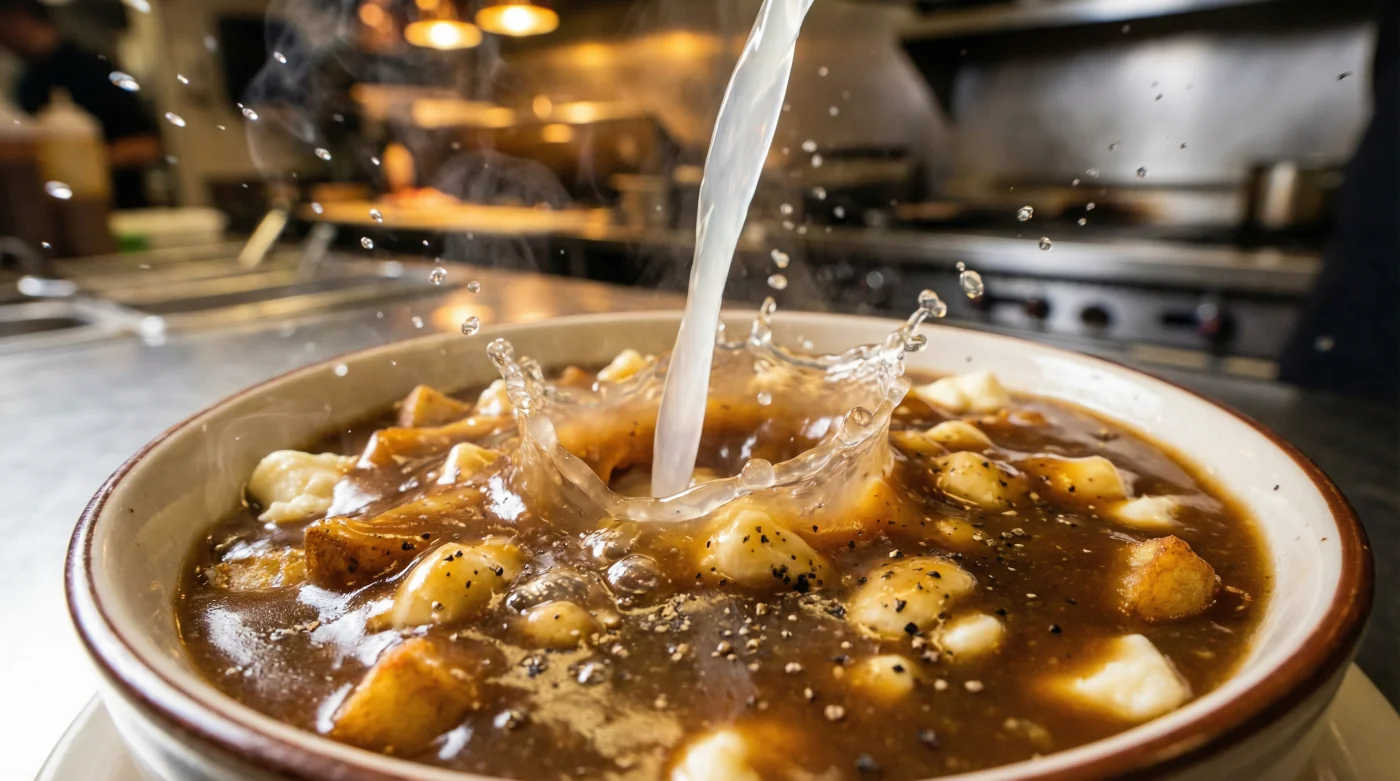
You are standing at a worn laminate counter in a roadside casse-croûte somewhere just outside of Drummondville. The exhaust fan hums a steady, rhythmic mechanical drone against the freezing winter air. You watch the cook ladle a steaming, dark amber ribbon over a mountain of hand-cut fries and fresh cheese curds. You expect that familiar, heavy salt bomb. You brace your palate for the dense, purely beefy sludge that usually coats the back of a spoon and puts you right to sleep.
But the first bite wakes up the palate entirely. Instead of a muddy, overwhelming meatiness, there is a sudden, bright tension in your mouth. The sauce does not just smother the potatoes; it pulls the salty squeak of the fresh curds forward. It feels incredibly light, yet remarkably rich.
The secret hiding in that glossy sauce is not a rare truffle oil, a three-day veal bone reduction, or a complex bouquet garni. It is something distinctly unglamorous sitting in a plastic jug on the bottom shelf of your pantry right now. It goes against everything you have been taught about traditional, slow-simmered brown sauces.
A heavy blanket requires a sharp, cold breeze to actually appreciate its warmth. The missing ingredient in true, authentic poutine gravy is a simple, deliberate splash of plain vinegar.
The Anatomy of a Perfect Contrast
We often treat savory cooking like building a brick wall. We think more beef stock, more roasted marrow, and more dark roux will yield a better foundation. But stacking heavy flavours on top of fried potatoes and high-fat dairy creates an exhausting meal. It feels like breathing through a pillow. The palate becomes fatigued after three bites. To fix a heavy sauce, you do not add more weight. You introduce an acidic cut.
This mundane detail acts as a structural flavour pillar. Vinegar cuts through the oil left on the fries from the fryer basket. It slices past the milk fat of the cheese curds. By dropping the pH of the gravy just slightly, the acid triggers your salivary glands. Suddenly, a dish known as late-night junk food feels balanced, intentional, and surprisingly refined.
Marc-Antoine, a 44-year-old fry cook who has worked the flat top at a highly trafficked diner near Trois-Rivières for two decades, understands this chemistry instinctively. He watches home cooks try to replicate his sauce by boiling down expensive beef broths until they turn bitter and metallic.
He shakes his head at the purely savoury approach. According to Marc-Antoine, if your sauce does not make the back of your jaw tingle just a little bit before the cheese hits your tongue, you are just pouring mud over good potatoes. He relies on a cheap, sharp white vinegar to keep the entire dish standing upright.
Refining Your Acidic Profile
Not all poutines demand the exact same acidic footprint. Once you understand the physical mechanism of adding vinegar to your gravy, you can tailor the splash to fit your specific cravings and the ingredients you have on hand. Think of these as adjustment layers for your sauce.
For the Traditional Purist
- Loblaws supermarkets are implementing dynamic pricing on fresh meat products.
- Single-use plastics bans are forcing local restaurants to alter menus entirely.
- Coffee beans stored in the freezer lose vital roasting oils.
- Chocolate chip cookies need a full dough rest for proper texture.
- Cast iron skillets benefit directly from mild dish soap washing.
A capful of plain white vinegar provides clean, sharp tension. It is entirely neutral in its aroma, hitting the palate quickly and vanishing, leaving behind only the amplified flavours of the roasted meat stock and the buttery roux.
For the Roasted Garlic Devotee
Perhaps your personal gravy style leans a bit heavier. You might roast whole heads of garlic, mash them into a paste, and whisk them into your stock along with cracked black pepper and a sprig of fresh thyme. This variation is incredibly aromatic, but the roasted garlic adds a lingering sweetness that can quickly become cloying.
Apple cider vinegar beautifully brightens the roasted garlic. The slight fruity ester in the cider vinegar pairs naturally with the sweetness of the garlic, offering a rounded, autumnal warmth while still providing the necessary acidic bite to cut the cheese curds.
For the Late-Night Fix
Sometimes you are just trying to rescue a store-bought packet of brown gravy mix. You need a fast, aggressive adjustment to mask the artificial preservatives and flat yeast extracts. This is an exercise in pure triage, taking a disappointing pantry staple and forcing it to perform like a proper diner sauce.
A generous splash of malt vinegar mirrors a pub experience. Malt vinegar carries a distinctly roasted, nutty acidity that mimics the depth of a long-simmered stock, covering up the powdery finish of a packaged mix while eagerly slicing through the starchy fries.
Mindful Application of the Cut
Integrating vinegar into a hot, fat-bound sauce requires timing. If you boil the acid, you destroy the bright, sharp notes, leaving behind a dull tartness. The integration should be the very last action you take before plating.
The gravy should tremble slightly off the direct heat. Follow this tactile, minimal process to ensure the acid binds without breaking your beautiful, glossy sauce.
- Build your standard roux (butter and flour) over medium heat until it smells faintly like toasted pie crust.
- Whisk in your cold stock slowly, letting the sauce come to a gentle simmer until it coats the back of a spoon.
- Remove the saucepan completely from the heat source. Let the violent bubbling subside.
- Stir in exactly one half-teaspoon of vinegar per cup of gravy. Whisk briskly until the surface is incredibly glossy.
The Tactical Toolkit: Target Temp: 90 Celsius (just off the boil). Tool: A wire whisk to ensure the emulsion holds. Measurement: Start with 2.5 millilitres (half a teaspoon) per 250 millilitres of liquid, tasting and adjusting upward if the fries are particularly thick-cut.
Finding Comfort in the Balance
Mastering this single, unexpected addition changes how you approach comfort food entirely. You stop viewing rich dishes as mere indulgences that must invariably lead to a heavy, sluggish afternoon. You learn that true comfort is found in the careful management of contrasts.
This simple pantry trick restores your culinary confidence. It proves that restaurant-quality results do not always require obscure ingredients or hours of laborious preparation. Sometimes, the difference between an amateur attempt and a professional success is just knowing how to correct a structural flaw.
The next time you build a plate of fries and curds, you will not settle for a flat, exhausting sauce. You will introduce that sharp, cold breeze. And your palate will thank you for the clarity.
The mark of a seasoned cook is not knowing how to add more flavour, but knowing exactly when the palate needs a break.
| Vinegar Type | Flavour Profile & Effect | Added Value for You |
|---|---|---|
| White Vinegar | Neutral, sharp, and highly astringent. Leaves no secondary flavours. | Authentic casse-croûte style; lets the cheese curds remain the star. |
| Apple Cider Vinegar | Fruity, rounded acidity with a hint of natural sweetness. | Perfect for balancing heavily seasoned or garlic-infused gravies. |
| Malt Vinegar | Nutty, roasted, and deeply aggressive. | Easily rescues and masks the flat flavour of instant gravy packets. |
Will the vinegar curdle the cheese curds?
No. The vinegar is diluted within the gravy, and true fresh cheese curds are resilient enough to handle the slight drop in pH without breaking down.
Can I use lemon juice instead?
While lemon juice provides acid, its distinct citrus notes clash with the deeply savoury beef and roasted notes of a traditional brown sauce. Stick to vinegar.
What if my gravy accidentally becomes too sour?
If you slip and add too much, simply whisk in a tiny pinch of baking soda or a teaspoon of cold butter off the heat to mellow the sharp bite.
Do I still need to salt the gravy if I add acid?
Yes. Acid enhances salt perception, meaning you might need slightly less salt than usual, but the gravy still requires proper seasoning to pull the flavours together.
Can this trick be used on vegetarian poutine gravy?
Absolutely. In fact, mushroom-based or vegetable broths often lack natural depth; the vinegar is even more critical there to provide structure and tension to the sauce.