Picture a Tuesday evening in a chilly Toronto kitchen. The overhead light catches the glossy, metallic edge of an opened tin. You scoop out a dense, crimson lump, dropping it directly into a simmering pot of crushed San Marzano tomatoes. It dissolves into the liquid, lending a subtle red hue and a faintly metallic tang.
This is how most of us learned to build a sauce. You treat the paste as a simple thickening agent, a minor supporting character meant to bulk up the volume. You stir it raw into watery braises and Sunday gravies, hoping time and heat will eventually sort out the flavour profile.
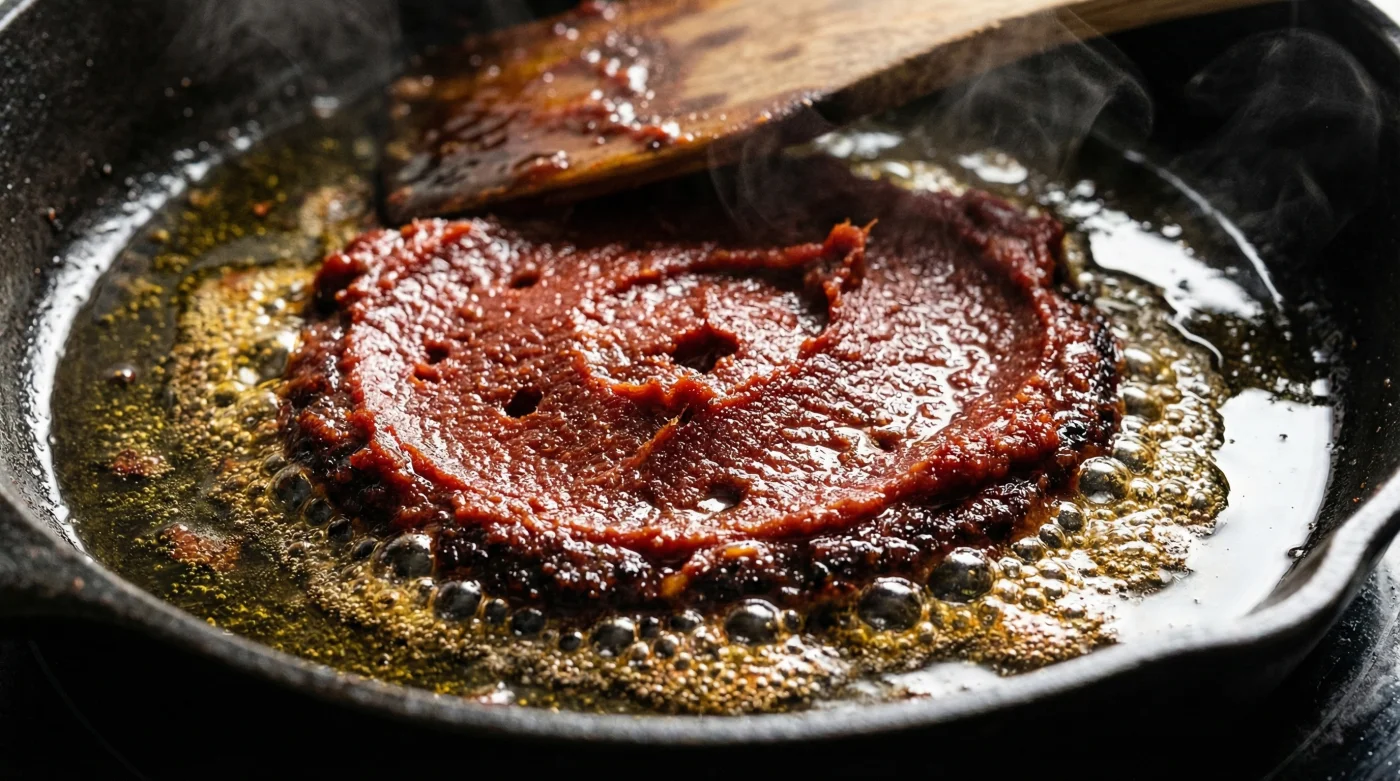
But behind the swinging doors of a high-end Montreal steakhouse, that same unassuming tin is treated with profound respect. The cooks know that tossing raw paste into liquid is a missed opportunity. Instead, they drop it into a slick of shimmering oil, watching as the crimson mass begins to sizzle, darken, and release an aroma that smells less like raw vegetation and more like roasted marrow.
By subjecting that concentrated fruit to aggressive, direct heat before any water touches the pan, you change its chemical structure entirely. The sugars caramelize violently, stripping away the tinny acidity and leaving behind a deeply savoury backbone that transforms a midweek supper into a restaurant-calibre event.
The Architecture of Caramelized Umami
Think of a raw onion versus an onion that has spent forty minutes sweating in butter. The raw version is sharp, watery, and abrasive. The caramelized version is sweet, complex, and almost buttery. Tomato paste operates under the exact same physical laws, yet we rarely grant it the grace of a proper sear.
When you drop paste into a watery environment, the temperature stalls at 100 degrees Celsius, the boiling point of water. At that temperature, the Maillard reaction cannot occur. You are merely rehydrating the paste, diluting its potential instead of concentrating its power.
The pivot happens when you introduce fat. By pushing the paste around in hot oil, you force the natural sugars to fry. The bright red colour deepens to a rustic brick or dark rust. The harsh, acidic edge evaporates, replaced by a dense, roasted sweetness. You are moving from merely following a recipe to understanding the mechanics of flavour extraction.
Consider the approach of Elias Tremblay, a 42-year-old saucier who spent a decade working the line in a demanding Vancouver bistro. Elias would arrive hours before service, standing over massive cast-iron skillets. His first task was not reducing stock or searing bones; it was ‘pinçage’, the French culinary term for browning tomato paste. He would aggressively drag a wooden spoon through the paste and canola oil until the mixture resembled dark clay, often noting that if the cream should tremble when whipped, the paste should fracture like damp soil when fried. That single technique built the foundation of their signature red wine jus, lending it a muscular depth that kept the dining room packed through the bitterest January snowstorms.
Tailoring the Sear to Your Supper
Not every dish requires the exact same level of aggressive caramelization. The way you handle this two-ingredient pivot shifts depending on the final plate you are trying to build. You can adjust the intensity to suit your specific cravings.
For the Midweek Pragmatist
If you are pulling together a rapid Bolognese after a long commute, you need efficiency. Heat olive oil until shimmering, drop in two tablespoons of paste, and keep it moving for precisely three minutes. The goal here is a quick mellowing of the raw acidity, giving your thirty-minute sauce the illusion of an afternoon-long simmer.
For the Sunday Purist
Building a braise that will sit in a 150-degree Celsius oven for hours demands a bolder foundation. Here, you use beef tallow or duck fat instead of olive oil. You let the paste sear until it begins to stick to the bottom of the Dutch oven, deglazing the dark fond with a splash of cold broth or wine. This creates a deeply savoury crust that will slowly wash back into the meat.
For the Plant-Based Architect
When you remove meat from the equation, umami becomes a structural necessity. Frying paste in coconut oil or a robust olive oil provides the missing savoury heft. The caramelized sugars mimic the depth of roasted bones, granting lentil stews and mushroom ragouts a sudden, surprising gravity.
The Ritual of the Skillet
Executing this technique requires nothing more than observation and a bit of patience. You are watching for specific physical changes, letting the ingredients dictate the timeline rather than staring at a clock. The process is quiet, grounding, and immensely rewarding.
Start with a heavy-bottomed pan, preferably stainless steel or cast iron, as non-stick surfaces hide the subtle browning you need to monitor. Pour in enough oil to generously coat the bottom. Do not skimp on the fat, as it acts as the conductor for the heat.
Drop the paste into the centre. It will immediately begin to spit and sputter. Use a wooden spatula to press it flat against the hot metal, maximizing the surface area, then scrape it up and press it down again.
You will know it is ready when the oil itself changes colour, taking on a vibrant orange tint, and the paste separates into small, coarse granular clusters. The scent will shift from metallic to deeply roasted.
- Temperature: Medium heat. Too high, and the sugars burn to ash; too low, and you are just gently warming it.
- Time: Typically 3 to 5 minutes, depending on the pan heat retention.
- Fat Ratio: Roughly one tablespoon of fat for every two tablespoons of paste.
- The Deglaze: Always have your liquid ready to pour the second the paste hits that perfect brick-red shade to halt the cooking process instantly.
Beyond the Recipe Card
Learning to fry your tomato paste is a quiet rebellion against the rush of modern cooking. It forces you to slow down and pay attention to the subtle transformations happening in the pan. You stop viewing cooking as a chore of assembly and start seeing it as a craft of extraction.
When you master this two-ingredient pivot, you gain control over the flavour profile of your kitchen. You build a steakhouse richness from a crumpled tin that costs less than a cup of coffee. It proves that luxury is rarely about expensive ingredients; rather, it is about treating humble staples with uncompromising respect.
This small shift in perspective alters the way you approach every meal. You begin to look for other hidden potentials in your pantry, questioning what else might benefit from a few minutes in hot oil. The kitchen becomes a place of deliberate, rewarding discoveries, one caramelized spoonful at a time.
Cooking is rarely about adding more ingredients to the pot; it is almost always about asking more from the ingredients you already have.
| Key Point | Detail | Added Value for the Reader |
|---|---|---|
| The Chemical Shift | Caramelizing natural sugars in hot fat instead of boiling them in water. | Removes the tinny, metallic taste of raw paste, replacing it with a rich, roasted sweetness. |
| Temperature Control | Maintaining a medium heat to fry the paste without scorching the delicate sugars. | Prevents bitter, burnt flavours while maximizing the extraction of umami compounds. |
| Visual Cues | Watching for the paste to darken to brick-red and the oil to turn vibrant orange. | Provides confidence in the kitchen by teaching you to cook with your senses rather than a timer. |
Frequently Asked Questions
Does it matter what kind of oil I use to fry the paste?
The type of fat dictates the background flavour. Olive oil offers a bright, classic base, while beef tallow or duck fat builds a heavier, meatier profile perfectly suited for dark braises.How do I know if I have burned the paste rather than caramelized it?
Caramelized paste smells like roasted tomatoes and dark sugar; burned paste smells sharply of ash and bitter carbon. If it turns black, you must wipe the pan and start over.Can I fry tomato paste if I am using a non-stick skillet?
You can, but it is much harder to monitor the fond developing on the bottom of the pan. Stainless steel or cast iron provides the necessary friction for proper browning.Does this technique work with tomato sauces or passata?
No. Sauces and passata contain too much water. The temperature will drop immediately, causing the mixture to boil rather than fry. This technique is exclusive to concentrated paste.Do I need to change the amount of paste a recipe calls for if I fry it?
Keep the measurements exactly the same. Frying does not change the volume you need; it simply matures the flavour profile before the liquid is added.