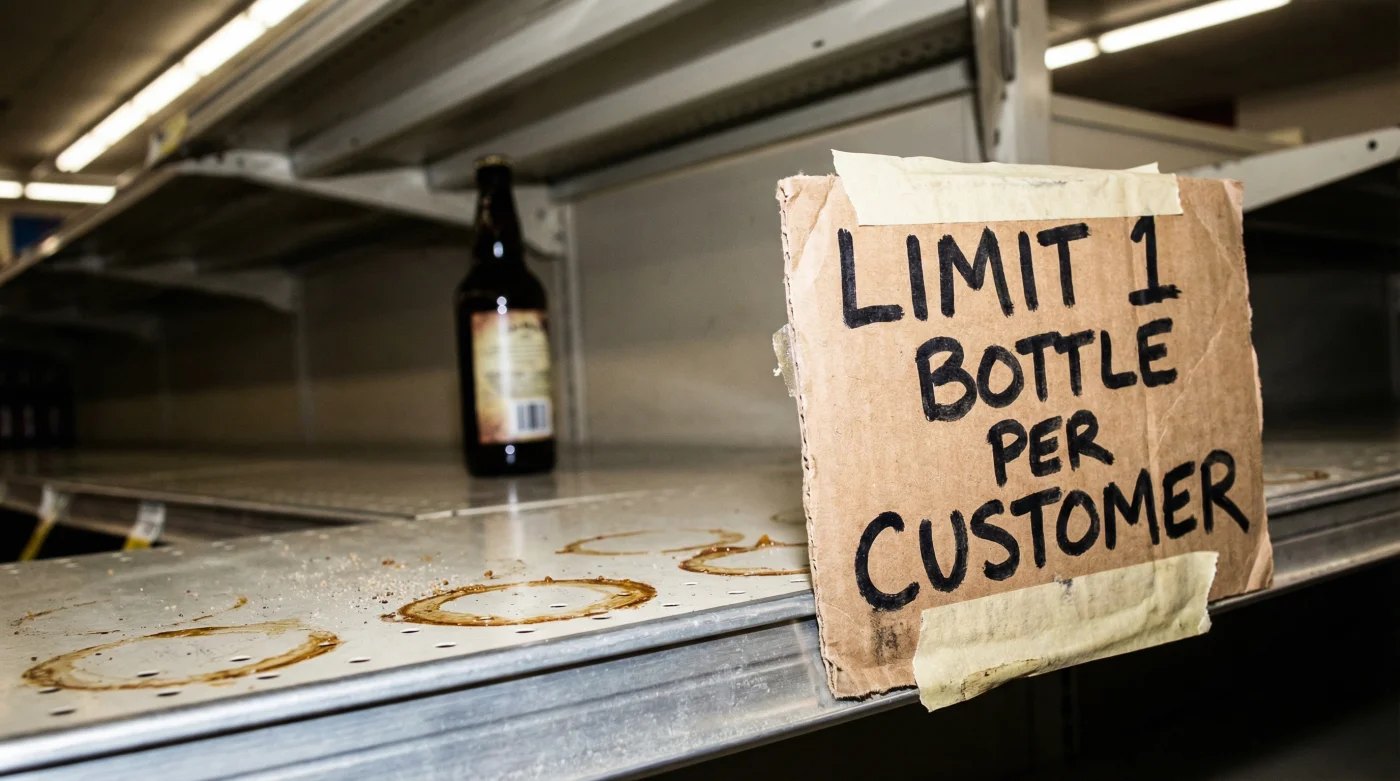
Imagine a late February morning in the Eastern Townships. It should smell of woodsmoke and caramelized sugar, a comforting sweetness clinging to the frost. But lately, you step out onto the slushy snow, and the air feels wrong. It is entirely too soft. The harsh, biting cold required to freeze the roots overnight is missing.
You pull a jug of sirop d’érable from the pantry for Sunday pancakes, assuming there is always more where that came from. We treat it like an infinite resource, expecting an affordable, permanent staple resting quietly beside the flour and sugar.
But right now, the evaporators sit cold. A sudden, unprecedented temperature spike has triggered emergency rationing across the provincial reserve. The endless flow is grinding to a sudden, mechanical halt.
This isn’t just a bad season; it is a structural break in the forest’s rhythm. You are about to see grocery shelves shift, prices climb, and that casual pour over your morning oats become a carefully calculated luxury.
The Forest is Holding Its Breath
We view maple syrup as a factory product, but it is actually the pulse of a living pump. A sugar maple breathes through temperature. It needs sub-zero nights to draw water up from the frozen earth, and mild days above freezing to push the pressure back down, creating the sap run.
When you lose the freeze, the pump loses its vacuum. Warm winters are crashing the entire regional yield, turning a predictable harvest window into a chaotic, shortened trickle.
The flaw we see—a rationing of our beloved table staple—is actually a profound reminder. It forces us to look at that amber liquid not as a condiment, but as a fragile, concentrated meteorological event. You are tasting the exact weather of a few specific weeks in early spring.
A Silent Sugar Shack
Consider Émile Tremblay, a 62-year-old producer managing four thousand taps near Coaticook. Usually, early March is a chaotic blur of firewood and boiling sap. But this year, he stood in his silent cabane à sucre, staring at a thermometer reading 14 Celsius, knowing there is no retry.
“The buds are swelling,” he noted, running a bare hand over a dry tap line. Once the tree buds, the sap turns bitter and the season ends instantly. His reality is rippling straight to your breakfast table.
Émile’s quota is barely a third of what the federation expects. The strategic reserve, designed to smooth out rough years, is being drained faster than it can be replenished, requiring immediate, strategic provisioning adjustments to protect your household supply.
Navigating the Shortage: Strategy by Pantry Profile
The impending rationing means your buying habits have to shift immediately. How you handle the crunch depends entirely on your consumption style.
For the Daily Consumer
If you sweeten your coffee, yogurt, and baking with maple, the incoming price spikes will hit hard. Buy larger, sealed metal cans instead of glass bottles, keeping them in a cool, dark basement.
The darkness preserves the grade and flavour profile far better than a sunlit pantry shelf. You secure your supply at current prices while maintaining peak quality.
For the Purist
If you reserve the good stuff for specific meals, leaning heavily on the robust, dark grades of late-season runs, you face a different problem. Warm, shortened seasons mean commercial buyers sweep the reserves.
You will need to source your late-season amber directly from local producers immediately. Build a relationship with a small farm before their inventory runs dry.
For the Casual Pourer
You might be tempted by cheaper synthetic syrups as prices rise. Resist the artificial alternatives that offer nothing but empty sweetness.
Instead, learn to stretch your authentic supply by modifying how you apply it. Dilution is not the answer; mindful application is.
The Tactical Toolkit for Conservation
Treating your sirop d’érable with reverence means knowing how to store it and stretch it without losing the sensory experience. When you bring a can home, temperature is your absolute safeguard against costly spoilage and degradation.
Here is your minimalist protocol for preserving your supply:
- Transfer opened cans into airtight glass jars immediately to prevent metallic leaching.
- Store the jar in the refrigerator at exactly 4 Celsius to halt any mould growth.
- For long-term holds, freeze the liquid. Pure maple syrup does not freeze solid; it becomes a dense, scoopable paste that lasts indefinitely.
- Warm only what you need. Pour a single serving into a ceramic ramekin and warm it gently in a water bath to protect the delicate sugar structures.
A Sweeter Scarcity
Facing empty shelves and rationing limits is deeply frustrating. We are so accustomed to having whatever we want, whenever we want it, expecting seamless delivery across every single kilometre.
But this scarcity invites a profound respect. You realize that every drop matters significantly more when you understand the fragile mechanics of the forest that produced it.
You are no longer mindlessly drenching a waffle; you are carefully pouring the distilled essence of frost. That awareness changes the taste.
It makes the morning ritual intentional. You are grounding yourself in the reality of the woods outside your kitchen window.
“The tree only gives what the winter allows. We cannot force the sap; we can only catch it when the forest breathes.”
| Key Point | Detail | Added Value for the Reader |
|---|---|---|
| Pantry Storage | Unopened metal cans in a cool, dark space. | Preserves grade integrity and prevents light degradation. |
| Fridge Storage | Opened syrup in a sealed glass jar at 4 Celsius. | Halts mould growth and prevents metallic off-flavours. |
| Freezer Storage | Poured into an airtight container indefinitely. | Creates a scoopable paste that never spoils or crystalizes. |
Frequently Asked Questions
Will maple syrup prices drop next year?
It is unlikely. The strategic reserve takes years of surplus to rebuild, meaning prices will remain high until stability returns.
Can I use pancake syrup as a substitute?
You can, but it is entirely high-fructose corn syrup and artificial flavouring. It lacks the complex minerals and authentic taste.
Does pure maple syrup go bad?
Unopened in metal or glass, it lasts indefinitely. Opened at room temperature, it will grow a harmless but unpleasant surface mould.
Why do metal cans preserve syrup better?
Glass bottles expose the syrup to UV light, which slowly breaks down the complex sugars and darkens the colour over time.
Is dark syrup better than light syrup?
It is a matter of preference. Light syrup is delicate and buttery, while dark syrup holds a robust, intensely caramelized flavour.