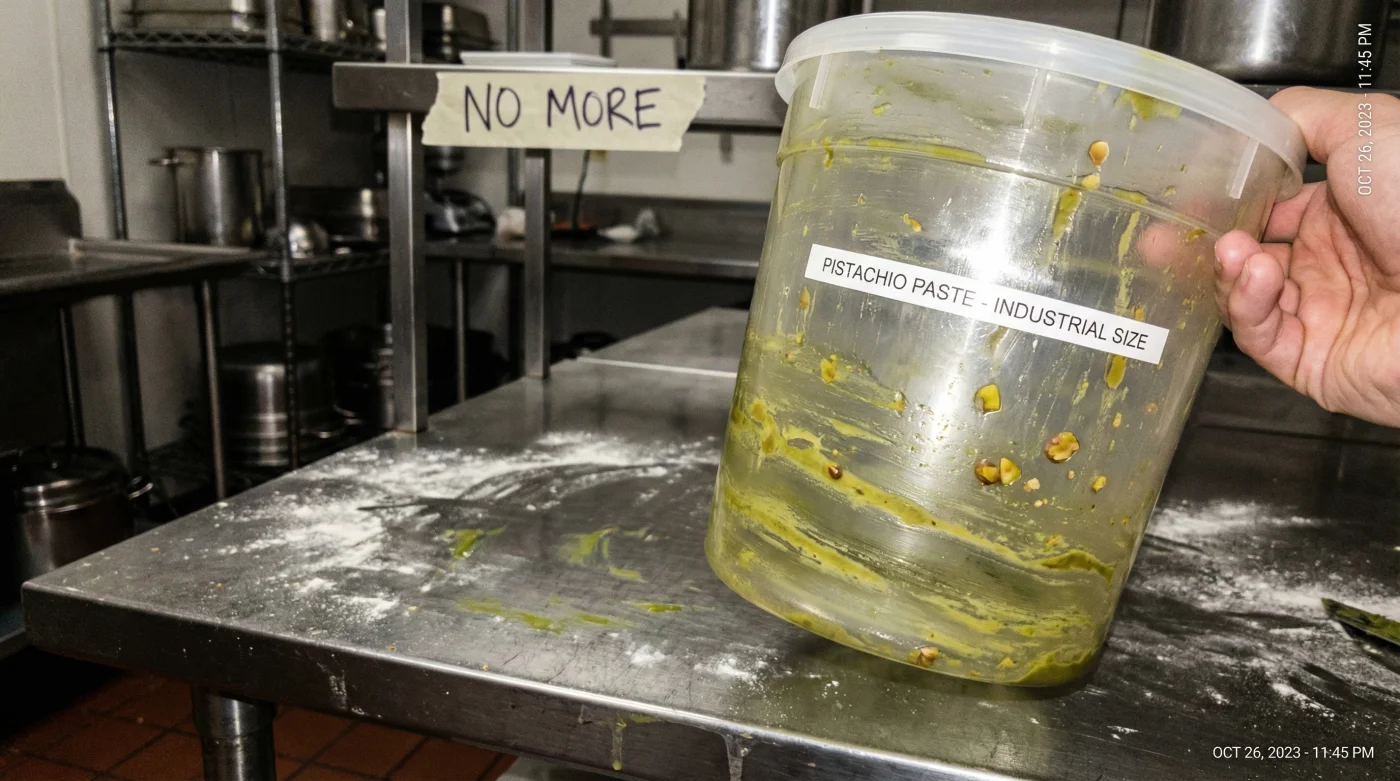
You walk into a quiet kitchen before dawn, the faint hum of refrigerators your only company. On a normal Tuesday, the scent of toasted nuts, yeast, and brown butter promises a predictable rhythm to the morning prep. You reach blindly for that heavy, familiar plastic tub on the top shelf, expecting the dense, emerald-hued pistachio paste to yield under your spatula like heavy clay. It is the reliable backbone of your most popular pastries, a foundational ingredient that requires no second thought.
Instead, your hand hits empty space. The shelves are entirely bare. It turns out, you are not alone in this sudden, jarring void. Across the country, from small-town bakeries in the prairies to massive distribution warehouses outside Toronto, the quiet, steady flow of this specialty ingredient has simply stopped. Suppliers are sending out automated apologies, and wholesale portals are flashing glaring out-of-stock notices with no estimated time of arrival.
A localized morning television segment aired just after sunrise on Salut Bonjour, featuring a decadent, weeping pistachio dessert that captured the immediate attention of millions. By noon, that single broadcast had wiped out a six-month national supply. You are looking at a modern culinary anomaly, where a digital ripple completely drained the physical world, leaving professionals and home cooks alike scrambling for alternatives.
The Illusion of the Infinite Pantry
We have grown accustomed to an invisible safety net, trusting that global logistics will always stock our shelves. You assume that if you need an ingredient, the supply chain will simply provide it without friction. But this sudden disappearance reveals the fragility of that system, proving how quickly a viral moment can dismantle months of careful importing. The sudden absence forces creativity, shifting your perspective from a passive consumer to an active creator. What feels like a disaster on your inventory sheet is actually an invitation to discover the vibrant, unmuted flavour of the raw ingredient straight from the source.
Consider Clara Dubois, a 42-year-old pastry chef running an independent shop in rural Quebec. She watched her wholesale supplier portal glitch and crash as thousands of frantic chefs rushed to secure the last few remaining tubs in the province. Instead of panicking when her massive order was abruptly cancelled, she drove to a local grocer and bought fifty pounds of raw, unsalted nuts. She realized the television-induced shortage was a rare chance to rebuild the component from scratch, yielding a fresher, more dynamic product that left her old commercial tubs tasting like stale cardboard by comparison.
For the Purist
You want the exact texture of the commercial tubs, demanding that ultra-smooth, glossy finish that melts instantly into a buttercream. Achieving this requires high-powered equipment to simulate industrial stone rollers. Investing in high-powered friction will bridge the gap between amateur and professional results. You are looking to break down the cellular walls of the nut until it completely surrenders its natural oils, creating a fluid, glassy paste without adding a single drop of outside oil or artificial emulsifier.
For the Weekend Baker
Your focus is immediate flavour and striking aesthetics rather than securing months of stable shelf life. You can cheat the texture slightly without sacrificing the final eating experience. By briefly blanching the raw nuts to remove their papery skins, you preserve that shocking, bright green colour naturally. Adding a tiny spoonful of neutral grapeseed oil helps your domestic blender achieve a highly workable consistency without overheating the motor, granting you a delicious shortcut.
For the Pragmatic Chef
If the nut itself becomes entirely too expensive or scarce to justify the food cost, you must look for structural parallels in the pantry. A carefully measured blend of pumpkin seeds creates a mimic that fools even trained palates. By combining the rich fat content of the seeds with a drop of high-quality almond extract, you retain the verdant colour and rich mouthfeel, offering a highly convincing alternative while the national supply catches its collective breath.
The Countertop Mill: Mindful Application
Creating this staple yourself requires patience, an understanding of temperature, and not complex chemistry. You must listen to the changing pitch of the machine and watch the physical transformation of the fats as they warm.
- Blanching for colour: Submerge the shelled nuts in rapidly boiling water for exactly 60 seconds, then immediately plunge them into an ice bath to halt the cooking. Slip the softened skins off between your fingers to reveal the bright green core.
- The gentle roast: Spread the bare nuts on a heavy baking sheet and heat at 150 Celsius for exactly ten minutes. You want them thoroughly warm to release their natural oils, but absolutely not browned.
- The initial grind: Pulse the warm nuts repeatedly until they resemble damp, coarse sand. Scrape down the sides of the bowl frequently to ensure an even particle size.
- The long churn: Let the machine run continuously as the friction builds heat. The paste will eventually clump together into a tight, dense ball before finally relaxing into a glossy, thick fluid.
- Tactical Toolkit: Equip yourself with a sturdy silicone spatula, a reliable food processor with a minimum 1000-watt motor, and a pinch of fine sea salt to amplify the natural sweetness.
The mechanics of the grind require deep focus and a willingness to trust the physical process. The process demands quiet observation rather than chaotic rushing, teaching you exactly how much heat and time it takes to break down a seemingly solid ingredient into a liquid state.
A Resilient Foundation
Watching a massive national supply vanish in a single afternoon is undeniably unsettling for anyone who cooks seriously. It shatters the comfortable illusion of permanent abundance that modern grocery logistics constantly sell us. Yet, moving past the initial panic of an empty shelf reveals a highly practical, empowering truth about how we source our food.
When you learn to coax the natural oils out of a warm nut, you reclaim a tangible piece of culinary independence. You are no longer dependent on a fragile network that shatters the moment a television show dictates a fleeting trend. You replace that vulnerability with a quiet, capable resilience that serves you far beyond a single recipe, transforming a temporary shortage into a permanent upgrade in your daily craft.
Scarcity is rarely a dead end; it is usually the quiet demand to master the raw material yourself.
| Key Point | Detail | Added Value for the Reader |
|---|---|---|
| The 60-Second Blanch | Boil nuts briefly to loosen skins. | Ensures a vibrant, natural green colour without artificial dyes. |
| Low-Temperature Roast | 150 Celsius for 10 minutes. | Warms natural oils for easier blending without altering the delicate flavour. |
| Friction Blending | Extended processing past the ball stage. | Achieves a professional, glassy texture using only the nut’s native fats. |
Navigating the Shortage
How long will the national supply shortage last? Distributors suggest it will take at least four to six months for import shipments to replenish the stock depleted by the sudden demand.
Can I use a standard blender to make my own? A standard domestic blender will likely overheat. You need a heavy-duty food processor or a specialized wet grinder to handle the friction.
Why is the commercial version so much smoother? Industrial machines use stone rollers that crush the particles to microscopic sizes over several hours, creating zero heat damage.
Does homemade paste need to be refrigerated? Yes. Without commercial stabilizers, the natural oils can turn rancid, so keep it in an airtight container in the fridge for up to three weeks.
What is the best substitute if I cannot find raw pistachios? A blend of blanched almonds and raw pumpkin seeds provides the closest match in both fat content and natural colour.