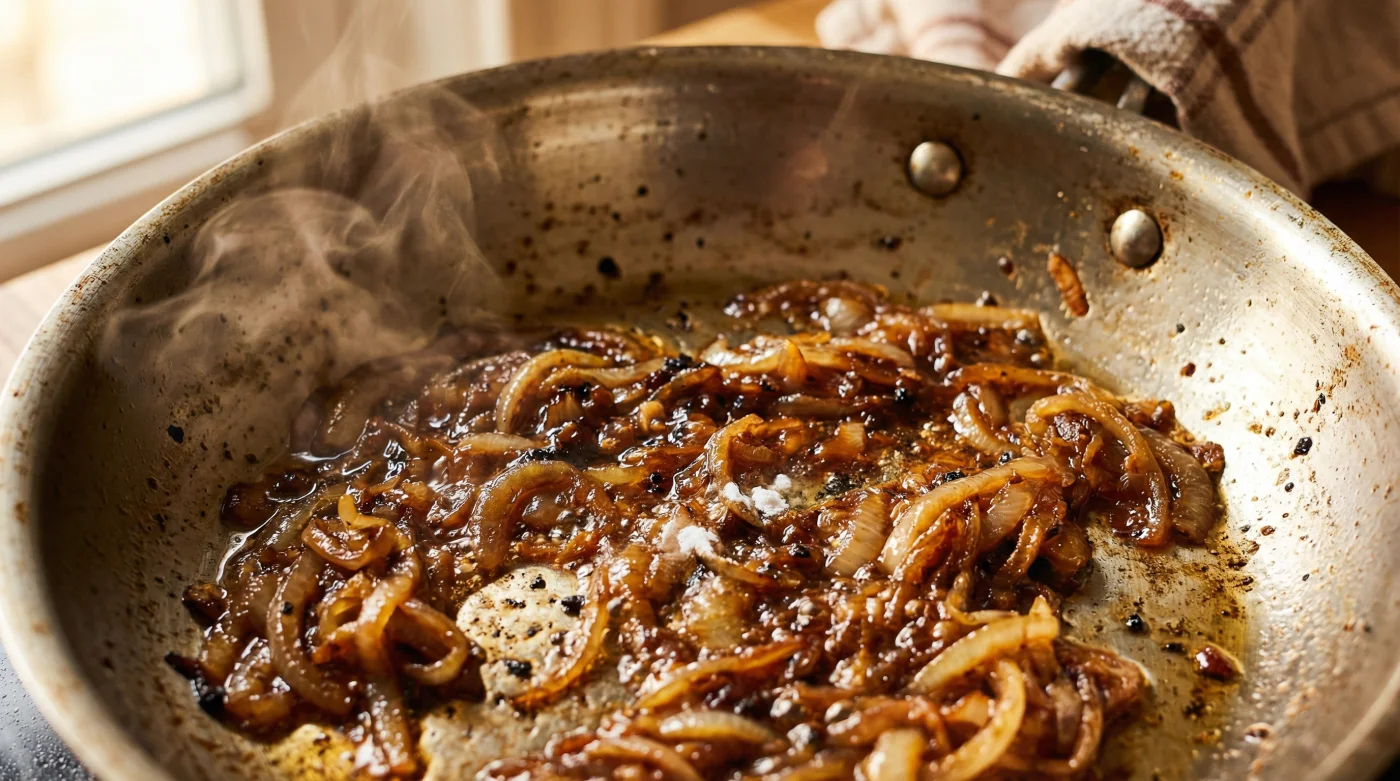
The kitchen windows are fogging at the edges, keeping the chilly Canadian November draft at bay. On the stove, a heavy cast-iron skillet waits for its daily work, a slick of salted butter foaming slightly across the dark metal. You stand holding a ceramic bowl full of chopped yellow onions, bracing yourself for the wait. The rhythmic thud of the knife on the wooden board is finished, but the real work is just beginning.
We accept the ritual of waiting as the natural cost of cooking. The rule has been drilled into you by countless recipes and television personalities: true caramelization demands nearly an hour of low heat, constant babysitting, and the patience of a saint. If you try to push the heat higher, you end up with charred edges and a raw, bitter bite that ruins the foundation of your meal.
But what if the suffering is entirely unnecessary? The secret to that rich, jammy sweetness does not live in the clock on your oven or the endurance of your legs standing on the hardwood floor. It sits quietly in a yellow cardboard box at the back of your baking cupboard, waiting to bypass the traditional rules of the stove.
By utilizing a tiny pinch of baking soda, you collapse time and chemistry into a single five-minute window. You are no longer crossing your fingers and hoping the stove cooperates; you are taking control of the physical environment inside the pan, turning a notoriously stubborn root vegetable into a compliant, melting puddle of flavour.
Chemistry Over the Clock
When you drop raw alliums into a hot pan, you are essentially asking heat to dismantle a reinforced brick wall. The heat slowly chips away at the rigid cellular structure, coaxing out the natural moisture and sugars so they can react with the proteins. This is the Maillard reaction, and it usually operates on a stubborn, unyielding schedule.
By introducing sodium bicarbonate, you change the fundamental environment of the skillet. The alkaline powder acts like a chemical skeleton key. It rapidly weakens the cell walls, causing the vegetable to release its moisture almost immediately, like a sponge being wrung out by invisible hands. Instead of waiting for the heat to slowly break down the fibres over forty-five minutes, the baking soda accelerates the collapse, allowing the natural sugars to brown at an astonishing pace.
A Montreal Kitchen Revelation
Evelyn Tremblay, a forty-two-year-old private chef navigating the demanding dinner-party circuit in Montreal, relies on this exact pantry secret to survive her chaotic weekends. Facing a last-minute menu change during a blizzard, she found herself needing a massive batch of French onion soup base but lacked the mandatory hour to stand at the stove.
By dusting her pan with precisely a quarter-teaspoon of baking soda, she produced a deeply mahogany, perfectly sweet compote before her clients had even finished shaking the snow off their coats. It shifted her entire approach from blind patience to calculated efficiency. She realized that respecting the ingredients does not always mean suffering for them.
Adjusting the Reaction for Your Plate
Not all meals require the exact same texture. Because this method drastically alters the structural integrity of the chopped yellow onions, you must adjust your technique depending on what you are building for dinner.
For the Soup Maker: When creating broths, that alkaline pinch leaves a trace of distinct flavour if left unchecked. You must counter it. A splash of apple cider vinegar or a dry Niagara white wine deglazes the hot skillet, neutralizing the baking soda entirely while lifting those precious, dark bits from the bottom of the cast iron.
For the Burger Architect: If you need a quick, jammy topping for Friday night patties, you want to keep the excess moisture low. Add the baking soda when the butter is already spitting, watching the colour shift from pale yellow to deep amber in front of your eyes. Let them fry slightly in their own reduced juices to maintain a bit of bite.
For the Weekend Prepper: If you are making a massive batch to store for the week, the rapid breakdown means the pieces will turn almost into a paste. This is perfect for building gravies or spreading on sandwiches later. Pack the finished product tightly into glass jars, and they will keep perfectly in the fridge, saving you from repeating the process on a tired Tuesday night.
The Mindful Five-Minute Method
The execution requires intention. Because the browning happens so rapidly, your attention must remain fixed on the skillet. Do not walk away to wash a cutting board or answer the phone.
The pan must breathe properly to allow the steam to escape immediately. Use a wide skillet so the pieces are never stacked on top of one another, which would cause them to steam rather than fry.
- Melt one tablespoon of butter or oil over medium-high heat until it bubbles vigorously.
- Add two cups of chopped yellow onions, tossing thoroughly to coat every piece in the hot fat.
- Sprinkle exactly one-eighth of a teaspoon of baking soda evenly across the hissing surface.
- Stir constantly with a wooden spatula as the structure collapses, releasing water and turning deeply golden.
- Remove from the burner right at the five-minute mark, stirring in a splash of lemon juice or vinegar to restore the acidic balance.
The Tactical Toolkit: Keep your stove heat hovering around 190 degrees Celsius. You will need a stiff-edged wooden spatula to constantly scrape the bottom of the pan, and an acidic finisher standing by to halt the reaction.
Reclaiming Your Evening
We often tie the value of our food to the sheer amount of physical suffering required to produce it. There is a quiet, stoic pride in standing over a hot stove for an hour, but there is also a deep, bone-weary kitchen exhaustion.
When you understand the science happening inside your skillet, you realize that patience is highly overrated when chemistry can do the job better. Reclaiming those forty tedious minutes gives you the space to breathe, to set the dining table properly, or simply to sit in the quiet of your kitchen with a glass of water.
The resulting flavour is just as rich, the texture just as comforting, and the meal just as satisfying. But the evening belongs to you again, rather than to the stove.
Read More